Taurus TX9 Review: Results From My Months-Long Test of All 3 Sizes
Full Taurus TX9 review: duty-grade 9mm pistol with modular chassis, optics-ready platform, and genuine build quality for under $500. See specs & testing.

Written By
Michael Crites
Licensed Concealed Carry Holder
Reviewed by
Editorial Team
Learn About The Editorial Team
Share:
Products are selected by our editors. We may earn a commission on purchases from a link. How we select gear.
Updated
Sep 2026
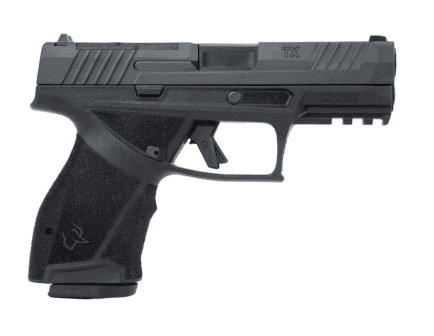
Taurus is no stranger to handguns, as they’ve been in the business for decades. While many of their handguns have likely been used by law enforcement and militaries, today we are looking at a ground-up-designed duty-grade pistol from Taurus. The Taurus TX9 is a 9mm pistol positioned to compete with the likes of Glock service pistols like the Glock 17 and 19, and the family of P320s from Sig Sauer.
While we are looking specifically at the full-size TX9, we will also go over the differences between the various compact and subcompact TX9 models.
Duty pistols often share a great many features and durable designs. What sets the TX9 apart in that crowded market is its modular chassis system — a serialized stainless-steel fire control pack that moves between grip modules in seconds, giving you three size options from a single core engine.
We’ll walk through how the TX9 stacks up against well-known competitors and whether that modularity translates to real-world advantage.
In This Article
The Taurus TX9



Pros
- Excellent grip angle and natural point of aim
- Modular chassis system — move the trigger pack between frames in seconds
- Ambidextrous controls (slide release and reversible magazine release)
- Four interchangeable backstraps for hand size customization
- Good trigger break for a duty pistol
Considerations
- Optics mounting plates sold separately (additional cost)
- Trigger reset is subtle (not pronounced or audible)
- Sear pack pins can fall out when removed from grip frames
- Not compatible with standard Glock holsters (slightly wider frame)
- Parts availability limited vs. Glock/S&W ecosystems
- Unserviceable internals (per warranty)
There are three distinct buyers for the TX9, and each one gets genuine value for a different reason.
For the law enforcement agency or duty-minded shooter who wants a service pistol with real modularity—full-size for the range, compact for plainclothes, subcompact for deep carry—the TX9 is the answer. One serialized trigger pack, three grip frames, three complete pistols for the price of two Glocks. For the concealed carry shooter who’s tired of buying multiple guns, the TX9 offers the same modularity argument at a consumer price point. And for the shooter who just wants a reliable, accurate pistol that doesn’t carry the Glock or S&W tax, the TX9 delivers—no compromise on build quality, no apology for the price tag.
The TX9 is not the most established pistol on the market. It is the most practical. The serialized fire control pack that swaps between grip frames solved the only real problem that plagues duty pistol shooters: the cost of covering multiple roles. What remains is a stainless-steel backbone, genuine ergonomics, and a platform that’s already proven reliable in the hands of shooters willing to test it hard.
The TX9 doesn’t have a decade of service record yet. But if you’re looking for genuine engineering at a price that doesn’t require a second mortgage, it earns its place. Just register that warranty.
Specs
| Specification | Value |
|---|---|
Caliber | 9mm Luger |
Action | Single-action striker fired |
Capacity (Full Size) | 17+1 rounds |
Barrel Length | 4.5 inches |
Overall Length | 7.75 inches |
Height | 5.2 inches |
Width | 1.28 inches |
Weight (empty) | 25 ounces |
Barrel Twist | 1:16.5 |
Safety | Firing pin block + bladed trigger safety |
Frame Material | Stainless steel (serialized) + polymer grip modules |
MSRP | $507.99 |
Street Price | $399–$500 |
Building a Duty Pistol: What Taurus Does Right
Taurus USA has been refining the duty pistol formula for decades, but the TX9 feels like a genuine reset — not an iteration. Before we get into the specifics of this striker-fired defensive pistol, it’s worth understanding what makes a “duty” designation meaningful.
But what is a duty pistol? Is it just a pistol that’s been designated for service? I’ve often wondered what makes the difference. And for those that are curious, I will share:
Duty pistols are designed to stand up to rigorous standards above the manufacturers’ own testing protocols. For example, duty weapons are subjected to endurance testing to ensure a certain number of rounds can be fired before stoppages. As well as ensuring the parts within the weapon are robust enough to make it last a certain lifespan.
Adverse conditions are also tested with the duty weapon, testing at lowered and elevated temperatures to ensure it can work in adverse conditions. Add in things like dirt, water, and even mud to the testing to ensure that the weapon will function in most any situation. They even test the guns with bore obstructions and water drainage under fire to see if the weapons will suffer catastrophic failures in these extreme conditions.
In addition to the duty-grade testing, there are also features popular for duty and service-grade weapons — optics-ready mounts, ambidextrous controls, and more. The TX9 goes a step further by incorporating that modular frame system with a removable trigger pack.
This allows you to swap the trigger pack from one polymer frame to another, effectively giving you various pistol options from one core engine. All this was built and guaranteed for life in Taurus’s facility in Bainbridge, Georgia.
That seems like a lot to pack into a service pistol with an MSRP of only $499.
Inside the TX9's Modular Fire Control Pack
Inside the TX9’s polymer grip frame, you will find its removable trigger and sear pack — the heart of the entire pistol.
Made from stainless steel and formed together to hold all the internal mechanical workings, and incorporating the slide frame rails that carry the slide itself, this serialized part is the component you’ll move between grip modules if you decide to mix sizes.
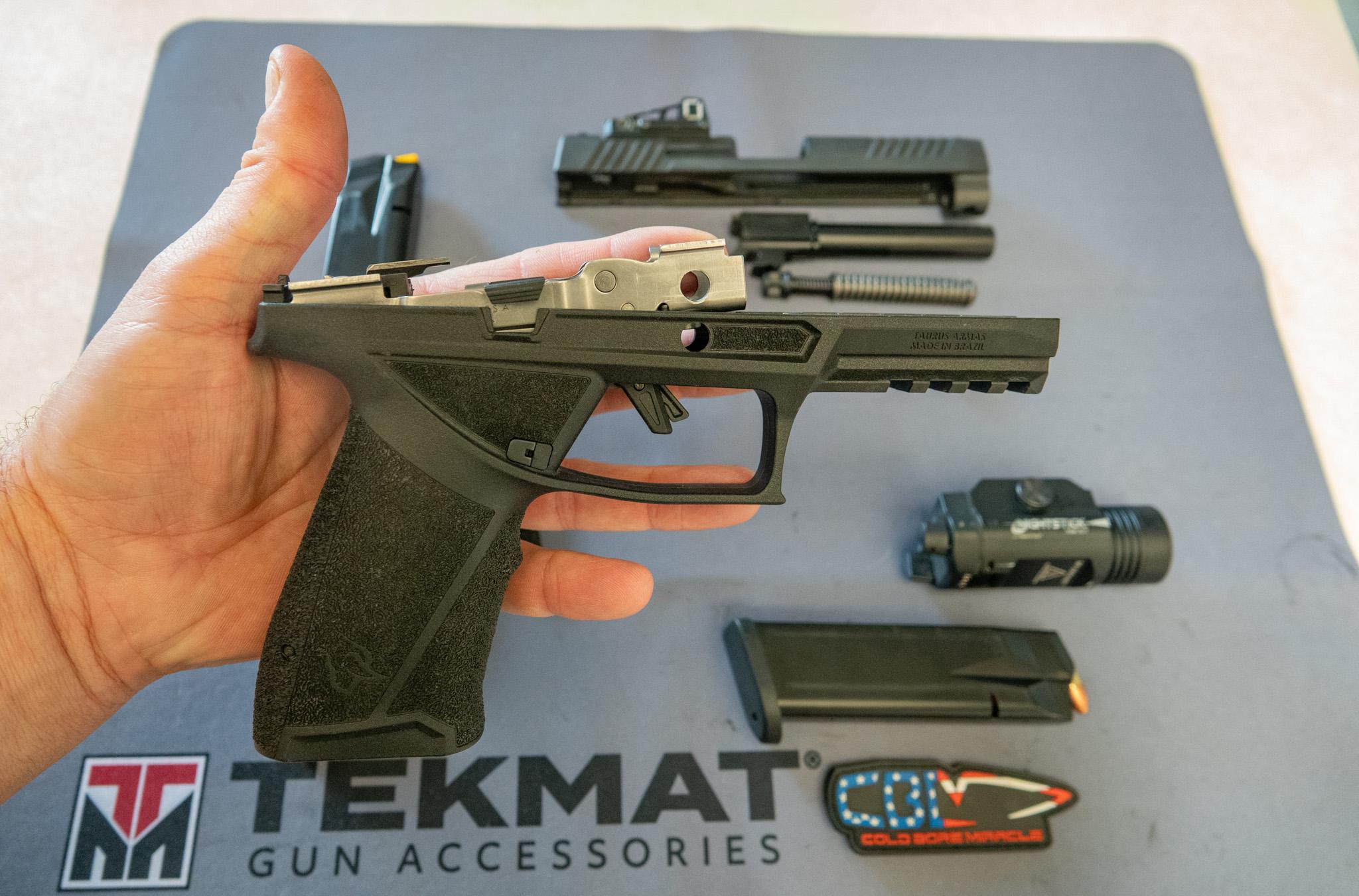
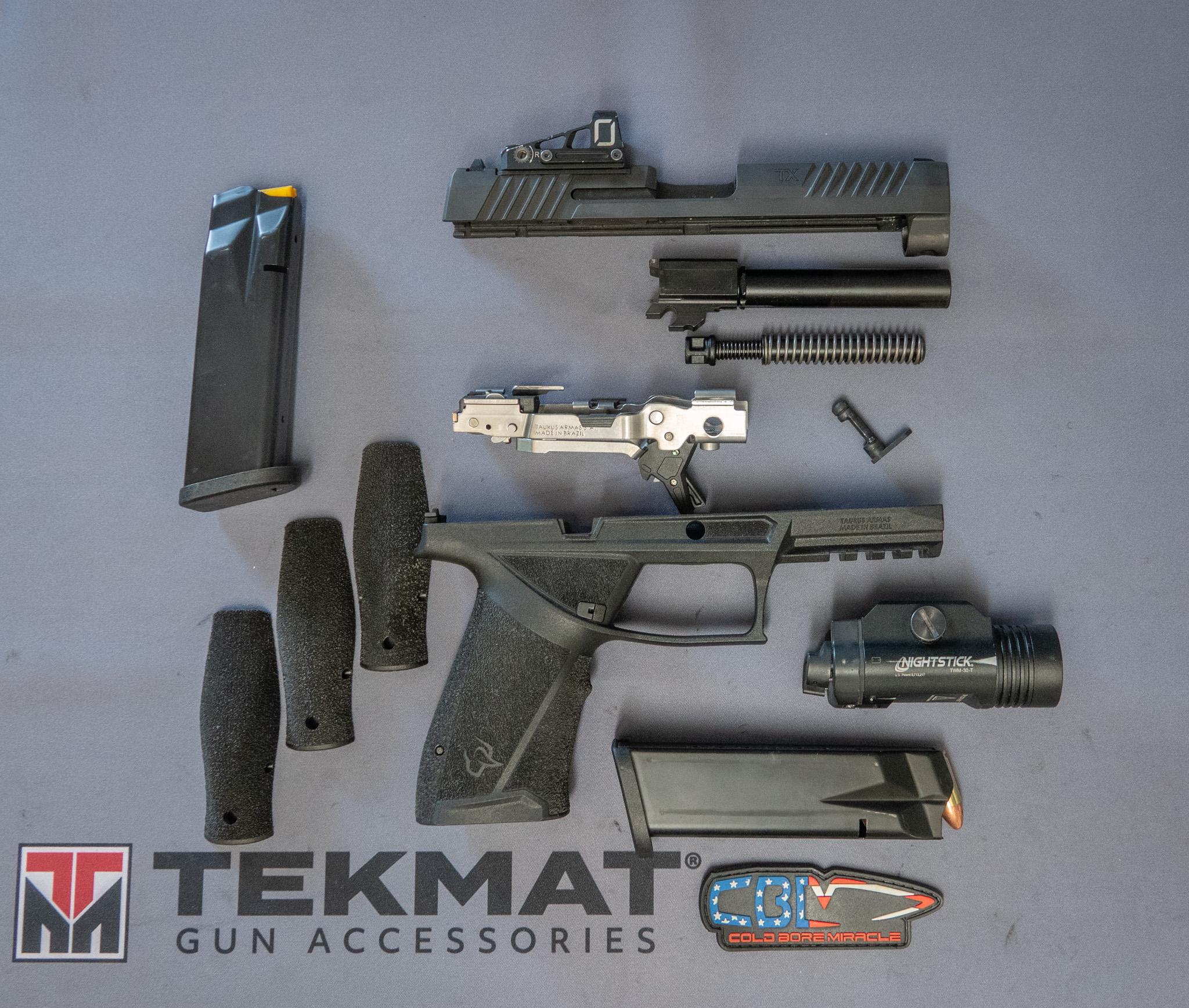
The fire control assembly is installed rear-end first, and then cammed slightly down into the front of the grip frame. It is secured rather simply by inserting the takedown lever pin through the fire control assembly, then rotating it into its locked position. It can be transferred across the various polymer grip frames in the same way.
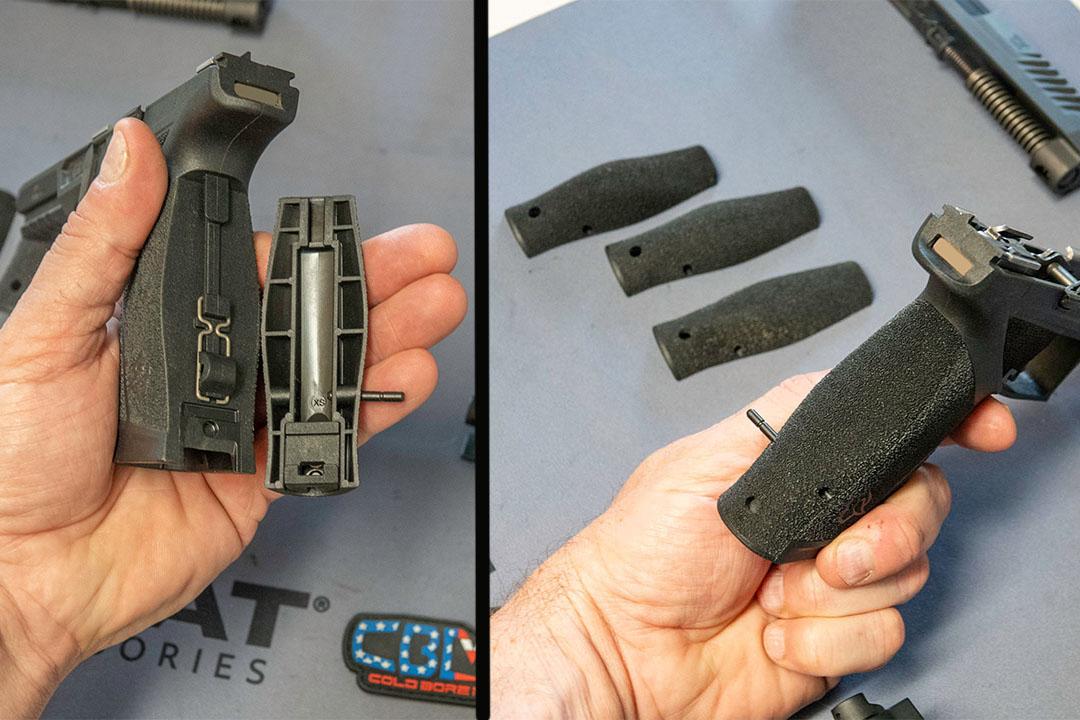
The polymer grip frame has only the magazine catch within; all other controls stay with the fire control assembly. Up front on the grip frame, you will find the Picatinny accessory rail for mounting lights. And in the back of it, you will find the interchangeable backstrap to customize the grip. In fact, the TX9 offers four backstrap options, allowing different hand sizes to dial in the fit.
The slide itself features aggressive forward cocking serrations on both the front and rear, giving you positive purchase for press checks and manipulations — something that matters more than most people admit until they’re shooting one-handed or in a stress scenario.
The frame has the same textured treatment and sits low in the hand, which aids in getting a natural point of aim without conscious thought. If you’re familiar with how the Glock 17 or Glock 19 handle, the TX9’s ergonomics will feel immediately at home, though with a few refinements.
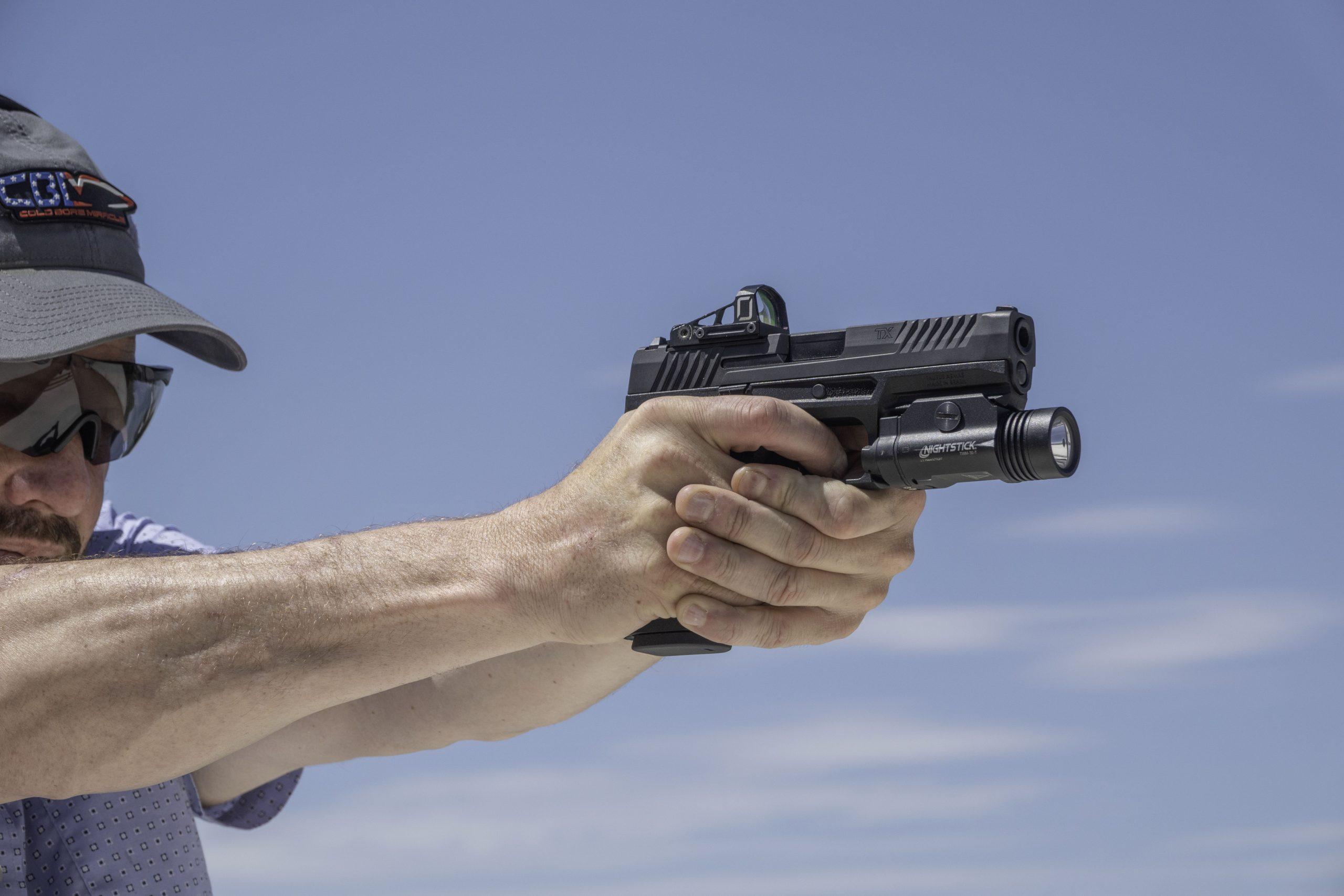
Taurus’ T.O.R.O. optics mounting system uses a series of adapter plates that fit different red dot footprints. They are attached using two screws that go through the red dot base and the plate itself, threading into the slide. This universal approach gives you flexibility once you’ve sorted which optic you prefer.
Models and Sizes
| Spec | Full Size | Compact | Subcompact |
|---|---|---|---|
Barrel | 4.5 in | 4.0 in | 3.4 in |
Capacity | 17+1 | 15+1 | 13+1 |
Best For | Duty/home defense | Crossover/IWB | Concealed carry |
The TX9 line offers the flexibility to switch between duty and everyday carry without buying an entirely new platform.
Taurus TX9 Full Size
The full-size TX9 we are testing today uses a 4.5-inch barrel and 17-round magazines. Very comparable to most service pistols in use today. The large frame and its texture give great purchase to control the pistol while firing.
Like other full-size service pistols, the TX9 is unapologetic for its size. It’s the kind of gun you carry because you want its features, not to hide it from others. The kind of pistol law enforcement would use. Therefore, there is no effort or reason to make it smaller or easier to conceal. This allows the TX9 to fully embrace every aspect of a duty pistol.
I have been shooting the pistol for a few months now, and have really quite enjoyed the way it points and shoots. It feels the way a duty pistol should.
TX9 Compact
The compact version of the TX9 gives a slightly shorter sight radius and a reduction of 2 rounds in the magazine. The remainder of the features remain basically the same other than a reduction in size.
Much like when comparing the Glock 19 to the Glock 17, the TX9 Compact gives some advantages for concealment. The shorter slide and barrel, as well as the shorter grip are less likely to print under clothing while carrying the gun. Unlike the full-size TX9, this one is a much better fit to tuck into an IWB holster.
All this while not giving up a huge portion of its ammunition capacity. 15 rounds is above average for concealed carry, and gives the user a fighting chance should they need it.
TX9 Sub Compact
Rounding out the TX9 family, the Subcompact version of the pistol gives maximum concealability. With its very short slide and barrel combination and reduced grip length, the subcompact model presents the smallest TX9. It is optimised for carry, fitting into smaller holsters to avoid printing in public.
As always, there are tradeoffs though. The smaller pistols in general tend to be a little more snappy when recoiling, as they don’t have as much weight. Holsters for subcompacts might also be a little harder to find, like the UM Tactical Boltaron IWB. One thing to keep in mind is that with a shorter accessory rail, there may be a need to change to a different weapon light option to fit properly.
The Grip That Does Half the Work
One of my favorite features of the TX family is the grip. The angle is comfortable and aligns nicely with my natural point of aim. The texture sticks to your palm very nicely, giving great control — it’s actually designed to prevent slipping during use, and it does that job well.
The interchangeable backstrap panel of the grip makes a good grip even better, allowing you to customize it to your hand size. All three TX9 grip frames have the option as well, with four distinct backstrap profiles available.
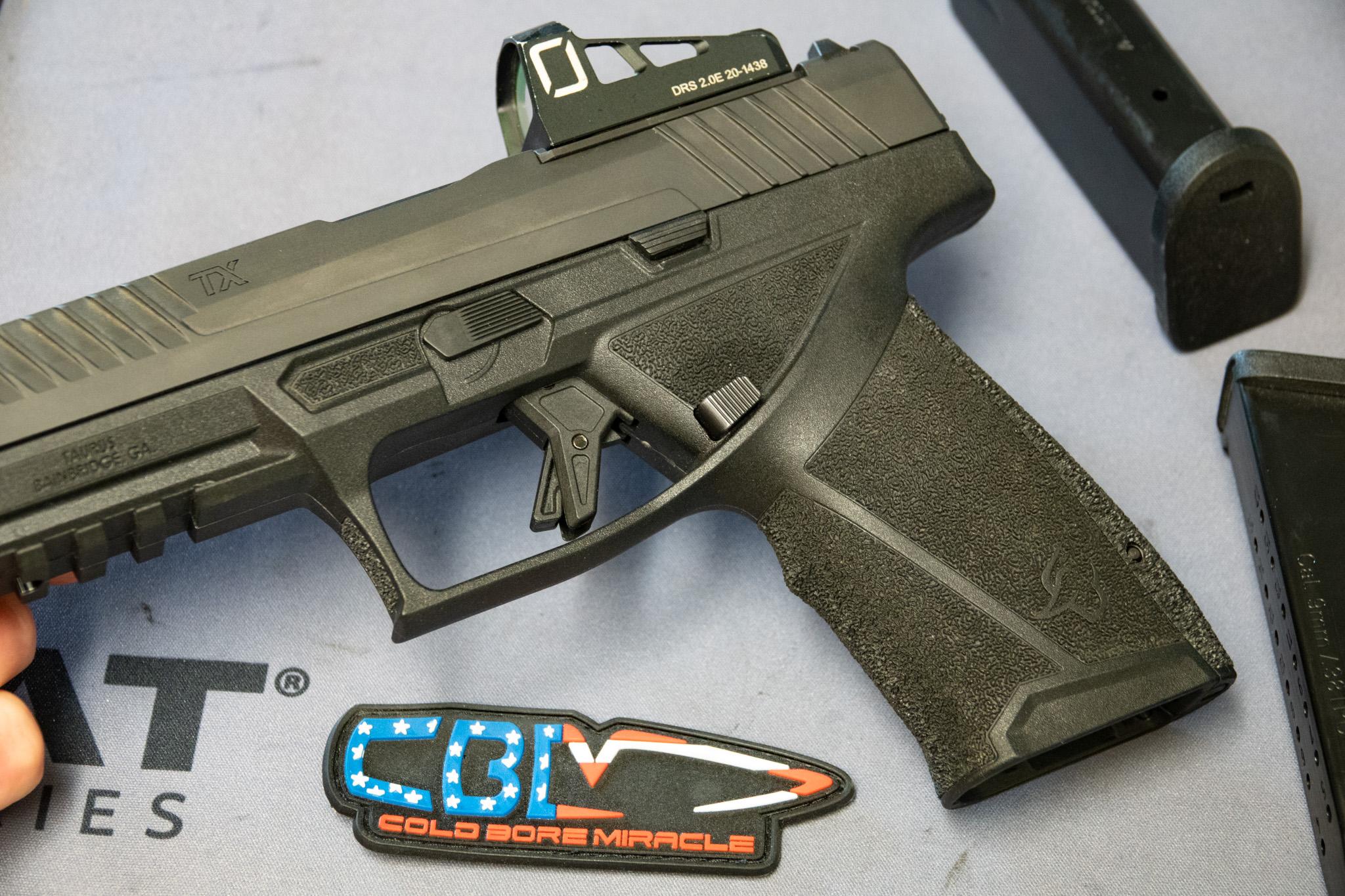
Like the TX22 before it, the TX9 frames will be available in black, OD Green, and FDE polymer as well. Adding another layer of customization for you. The square trigger guard allows room for gloved fingers inside, without stealing room from the accessory Picatinny rail.
There are also textured thumb shelves on either side of the frame. They are a perfect fit for your thumb and help control the recoil impulse.
A Trigger That Just Works
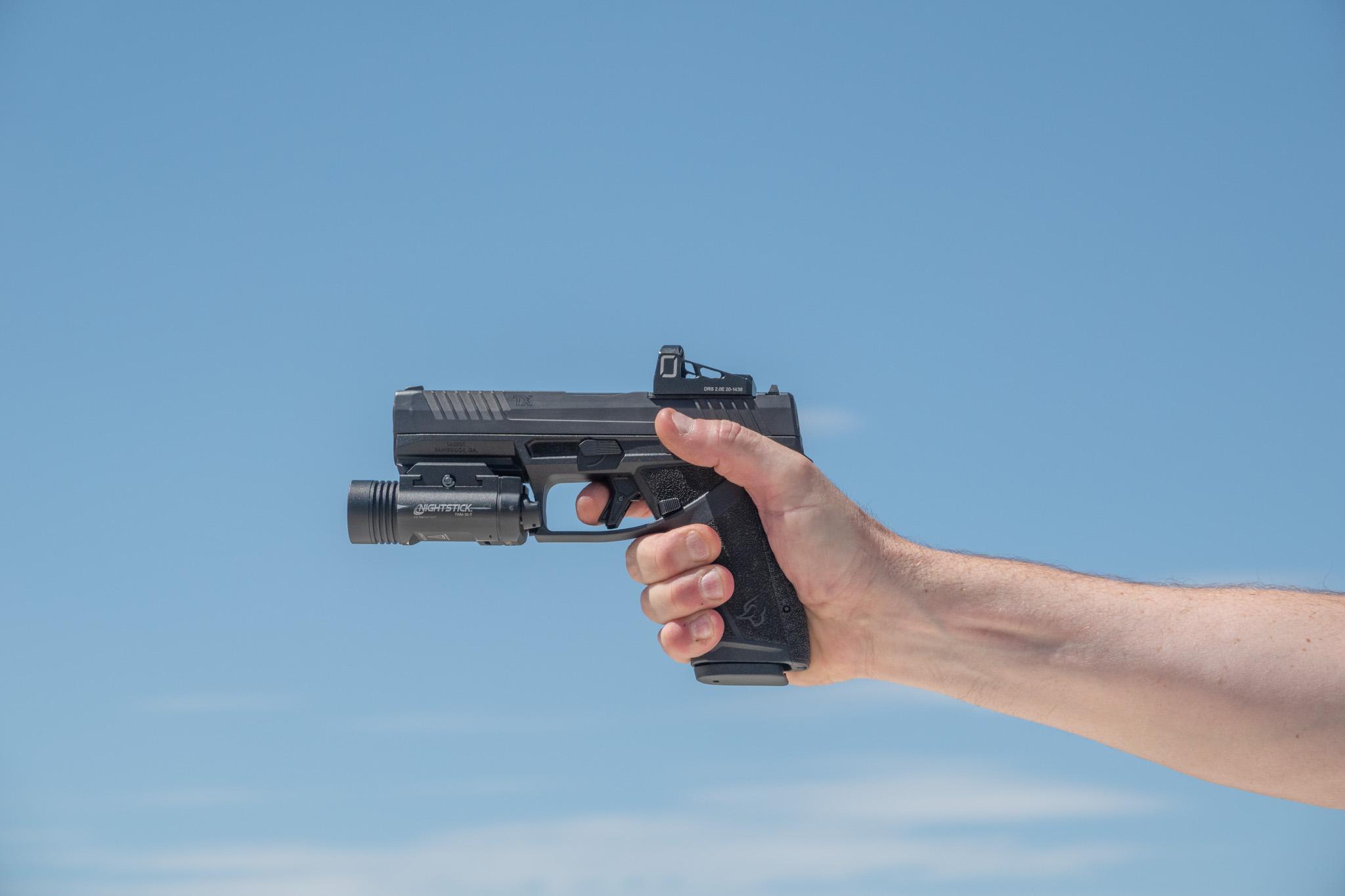
The trigger of the TX9 feels adequate for a duty pistol. It uses a common bladed safety to prevent unwanted trigger movement, but other than that, there is no safety. Perhaps a model including a manual safety is on the way.
One thing I noticed while shooting the TX9 is that the reset for the trigger is not very pronounced. It lacks the audible clicking sensation that we have become accustomed to feeling with other trigger resets. While at first it did seem concerning, after shooting the TX9 I found it to be a negligible issue — not a problem in practice.
It never came up during our shooting, and the trigger pull itself (averaging 5.5 pounds for a single-action striker-fired trigger) remained consistent across several thousand rounds we’ve cycled through test guns. It’s the kind of thing that reads as a spec sheet complaint but doesn’t matter in the real world.
The TX9's Control Layout Just Makes Sense
The controls on the TX9 are simple and intuitive; they will match what you are used to. There are ambidextrous slide release buttons for both left- and right-handed shooters. The magazine release can be reversed from right to left as well to accommodate you lefties.
I found the controls to be fantastic, making my reloads fast and smooth. There is talk online of inadvertent magazine releases from bumping the button with an aggressive support hand. I found no such problems; the TX9 felt fantastic in my hands, and the controls were right where they needed to be.
Field stripping the TX9 is fast and simple, very similar to a Glock pistol. You remove the magazine and clear the action of any cartridges, then with the slide forward you can pull the trigger to release the striker.
Turning the takedown lever releases the slide assembly, which can then be removed via the front of the frame. The guide rod and spring can then be removed, and the barrel pulled from the slide. With the takedown lever pointing down, you can pull it out of the left side of the frame.
Lift at the front of the fire control sub-assembly to lift it out of the polymer grip frame — this is when you’d perform those press checks if you prefer the indexed control method. If you’re already familiar with Glock or S&W striker-fired platforms, maintenance and fieldstripping feel like coming home.
Optics and Red Dot Compatibility
The T.O.R.O. optics mounting system is a universal plate system that fits various Taurus pistols, including the TX9. The plates have machined footprints to match most popular red dot bases. The system uses screws that go through both the red dot base and the optics plate itself, threading into the slide.
These plates are sold separately, which is a little bit of a letdown. I was hoping that Taurus would have done something similar to the Ruger RXM, making a configurable footprint to accept most any red dot.
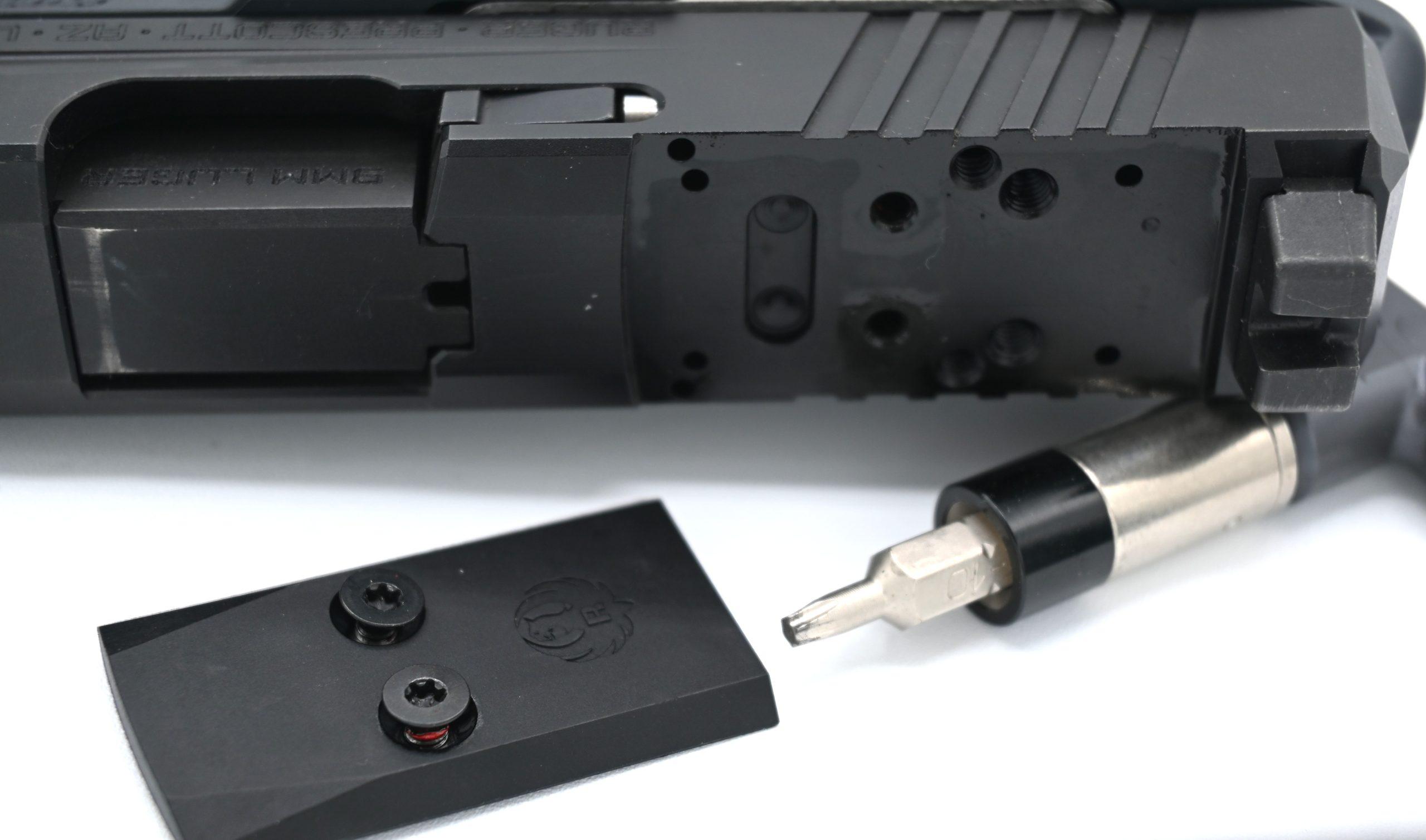
In the end, I purchased two of the plates to accept RMR and the Docter/Viper footprint. This made it easy to mount several different red dot options. I ended up using one of Gideon Optics’ Omega red dots, as well as one from US Optics. I may also try one of my Holosun red dots.
If you’re looking to pick the right optic for your TX9, our red dot buying guide can help narrow down the options.
Glock Sights But No Glock Holsters
The TX9 uses Glock footprint sights, which gives you the option to use a huge variety of aftermarket-made sight options. This can be good for those who are big on customizing their sights. Upgrading to something like XS Minimalist sights is a priority for some shooters, and the Glock compatibility means you’ll find options at nearly any price point.
My Taurus TX22 fits in most of my Glock holsters, but that is not the case with the TX9. It has a slightly wider construction that means it’s not compatible with Glock-pattern holsters — something to factor in if you’re counting on the massive aftermarket of accessories built around the Glock footprint.
While that’s disappointing at first blush, I did find that one of my Safariland P320 holsters accepted it just fine. The retention even worked, perhaps not as well as it was designed to, but good enough for me.
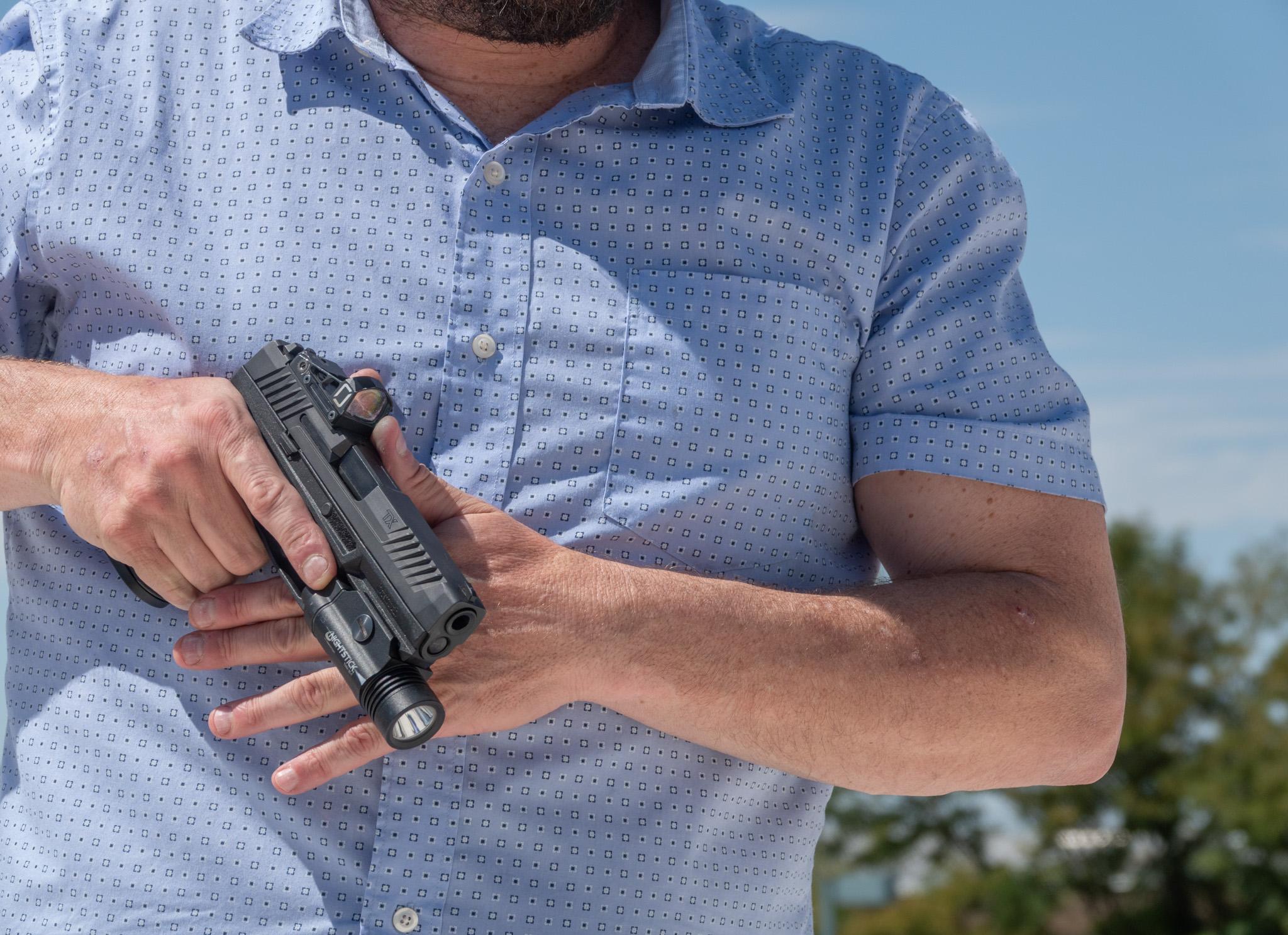
There may be some Kydex clamshell holsters that might adjust enough to fit the TX9 properly, but that, of course, is up to the individual to see how it fits. If you’re looking for holster options beyond the P320-pattern ecosystem, our concealed carry guide covers TX9 and similar-sized pistol carriers in detail.
I Ran It Hard With Zero Malfunctions
Duty pistols undergo a 1,000-cycle dry-fire test as part of their endurance testing, as well as testing with a variety of magazines totaling six or more. My testing of the TX9 wouldn’t quite reach that ceiling (at least not yet), but I did give it a good wringing out. We had zero malfunctions I could attribute to magazines during testing.
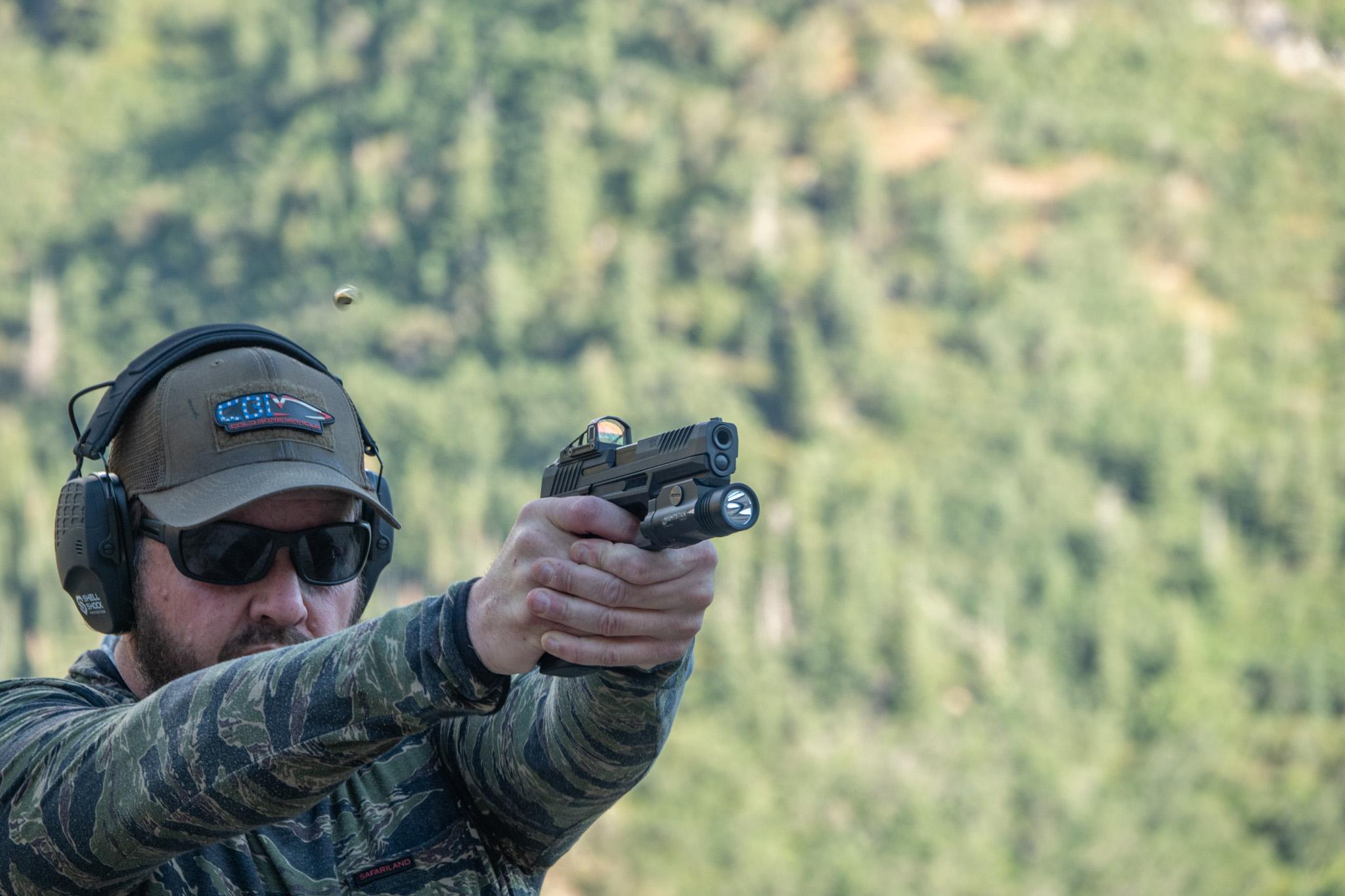
We put considerable ammunition through the TX9 — enough to get a clear sense of reliability and handling. What impressed me was the consistency: no failures to feed, no failures to eject, no stoppages attributable to the gun itself. We rotated through the two included Mec-Gar magazines and tested with several others, doing drills like magazine dumps followed by reload-and-dump cycles. These are the kinds of drills that expose issues with both magazines and controls.
Others have done more extreme torture testing. In this video, the TX9 fires 1,018 rounds over about 10 minutes. Most of us will never do such a thing, short of a test like this. What it does show is that the TX9 appears to be built well and can endure a hellacious amount of shooting.
The caveat worth noting: the TX9 is a newer design, so long-term durability track records are still a work in progress. That’s not a mark against it per se; it’s just a reality of a fresh platform. Time and the broader shooting community will validate or challenge the early reliability claims.
Recoil, Control, and Practical Accuracy
While shooting the TX9, I found it to point very well; by that I mean it naturally points where I want it. I can point the pistol at something, and when I turn my head to look at the sights, they are already lined up.
This tendency to stay where I aim made it surprisingly easy to hit targets. On one of my first trips out with the TX9, I dumped several magazines on an IPSC target from approximately 20 yards. Even without really focusing on the sights, I could keep every round on the target. Timed reloads of the shoot-reload-shoot type also proved to be on target every time.
Shooting paper targets at the typical 7–10 yards would give five-shot groups around 1 to 2 inches in diameter. I really enjoy shooting the TX9 because it feels like I can hit things very well and with frequency. The recoil impulse is mild for a full-size 9mm, and the ergonomics mean you’re not fighting the gun — you’re working with it.
That’s a rarity at this price point. For detailed testing data and load recommendations, our 9mm ammunition guide covers the loads that shot best in our test guns.
While the iron sights are perfectly useful, I am more of a red dot fan. Even so, I found I could shoot the TX9 well using just the provided sights. So I installed a few different red dots: the Gideon Omega and one from US Optics. I’m not sure if I could shoot more accurately with the red dots, but it felt like I could, and that’s what matters.
Accessories and Weapon Lights
The TX9 is at home in a duty carry, home defense, or training role. For personal defense, I’d want additional real-world shooting before staking a life on it, but for training and casual use, it’s a fantastic value. That said, every pistol needs a good holster and suitable lighting for any defensive scenario.
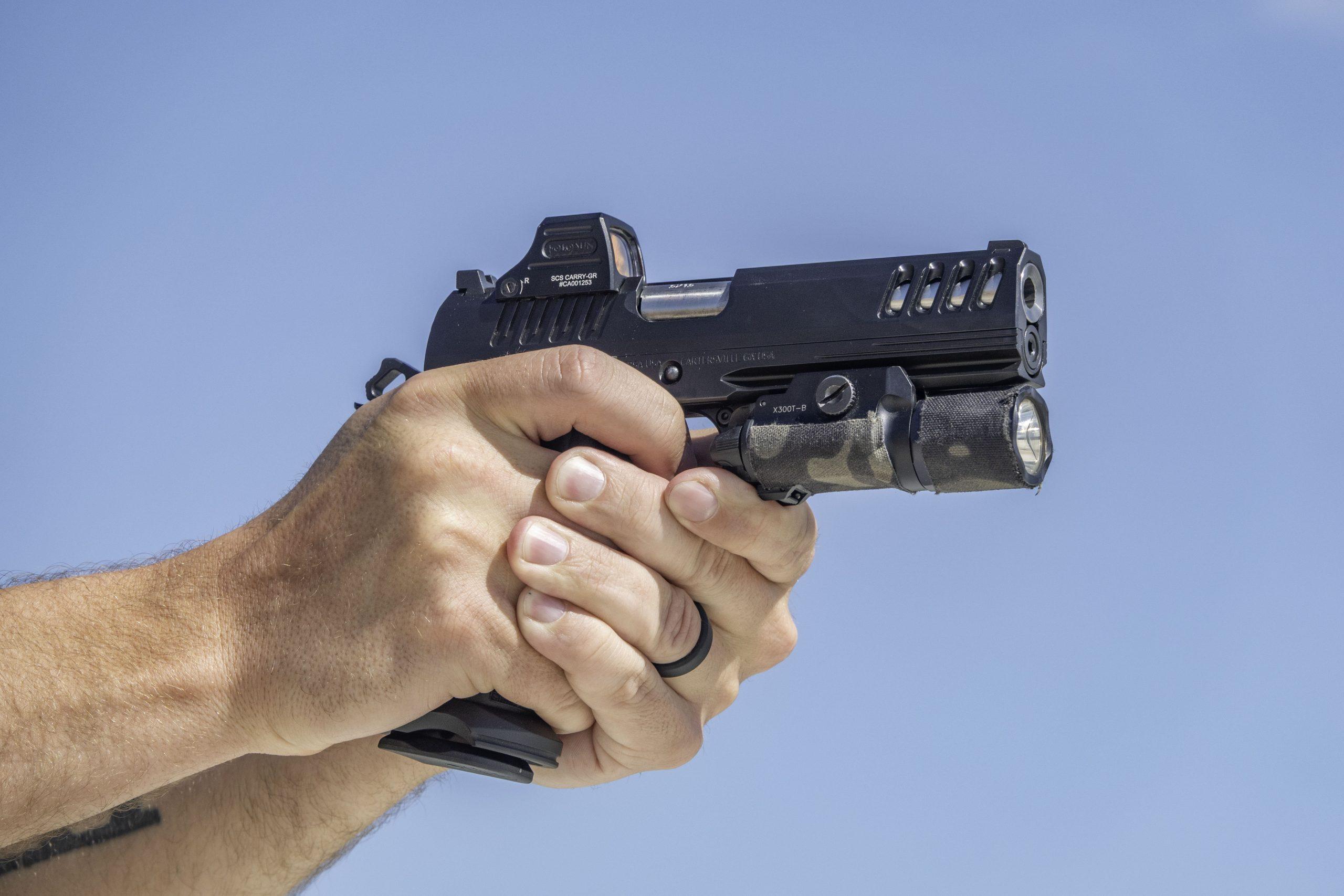
I used several different weapon lights on the TX9: the Surefire X300, the Nightstick TW30, and even the Streamlight TLR7. I did prefer the bigger lights, and they also helped the pistol fit better in holsters made for holding weapon lights. Our guide to tactical weapon lights for handguns can help you pick the right setup for your carry method.
As I said, I am a red dot shooter. So I would strongly recommend a red dot for those interested. The two I tested worked fantastically, but there are so many good options out there you might go with your personal preference. I don’t regret getting multiple T.O.R.O. optics plates.
When It Comes to Rocks to Throw
While the Taurus TX9 does offer many benefits at its modest price point, there are legitimate tradeoffs.
The T.O.R.O. optics plates are sold separately — Taurus doesn’t include them, so you’re buying into a two-tier system if you want to run an optic. The trigger reset, while not a problem, is subtle and won’t satisfy shooters who live for crisp, audible resets. Parts availability outside the Taurus ecosystem is limited compared to, say, Glock or S&W platforms.
The extractor and related internals are deemed unserviceable by the end user per Taurus’s warranty fine print, meaning if you need work done, it goes back to the factory. That fine print matters: register your warranty within 30 days for the lifetime guarantee, or you get a standard one-year warranty. Make sure you read what you’re get`ting into before doing anything beyond a typical field strip.
The TX9 also lacks the long-term durability track record of established platforms. It’s built well, but time will tell whether it proves as bulletproof as the competition over thousands of rounds in the field.
Field Strip, Reassembly, and Maintenance
The Taurus TX9 is a striking value proposition. You’re getting a duty-grade pistol with modular chassis engineering, an optics-ready platform, and genuine build quality for under $500. The grip angle is natural, the controls are intuitive, and the gun simply works — no drama, no excuses.
Here’s what seals it: the modularity actually matters. You can own all three sizes and move the core trigger pack between them, which means you’re not buying three guns — you’re buying one gun and two grip modules. That’s clever engineering that Taurus backed with a lifetime warranty. For law enforcement evaluating service pistol options, or for shooters who want flexibility without the financial hit, that’s a genuine differentiator.
The caveats are real — plates aren’t included, holster compatibility is limited, and it’s too new to have a decade of proof behind it. But if you’re looking for a defensive pistol that punches above its price point, the TX9 delivers. Just make sure you register that warranty within 30 days.
Sign up for our newsletter
Get discounts from top brands and our latest reviews!
View by Category

In-Hand Reviews

Firearm News

Featured Comparisons

Firearm & Ammo Reviews

Popular Guides & Stats

Range Gear & Accessories

Gun & Ammo Safes