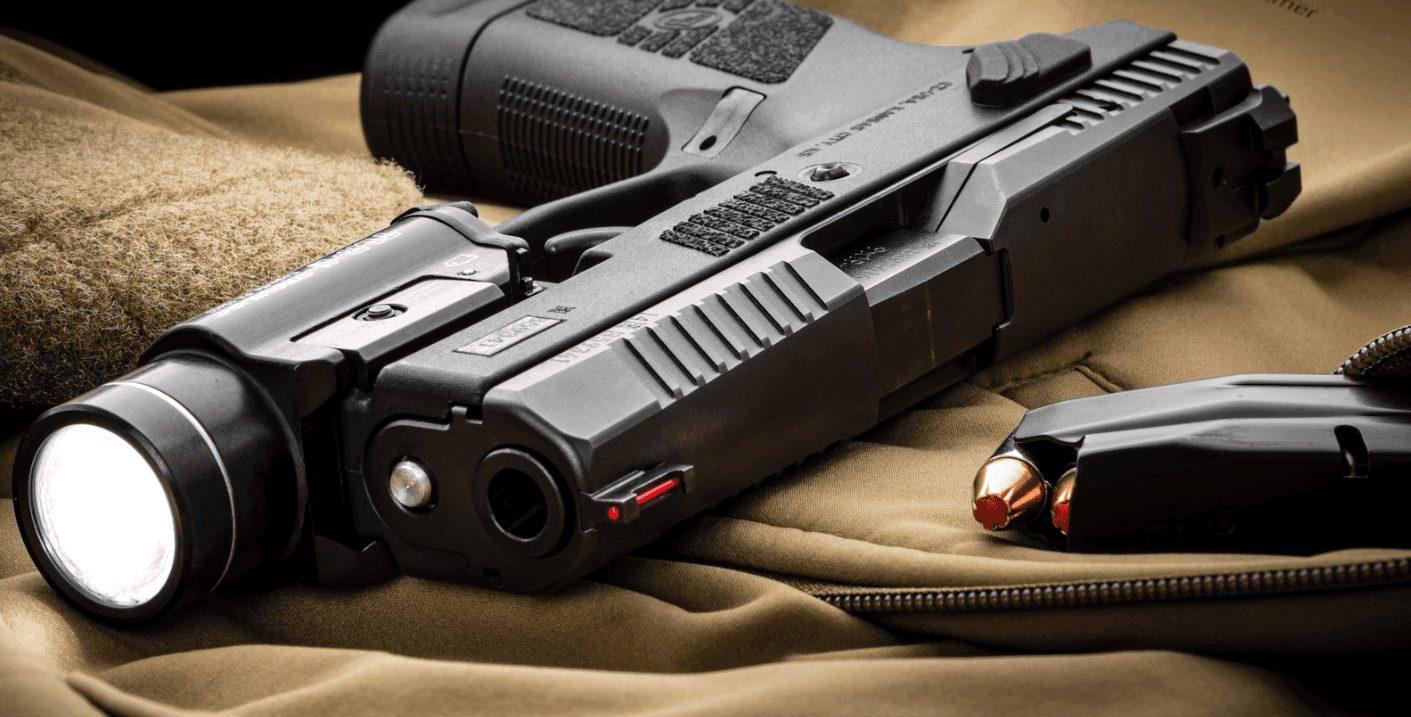
Springfield Echelon 4.0FC Review: The Duty Pistol Aiming to Dethrone Glock
Considering the Springfield Echelon? We give you the skinny after 2,000+ rounds—real-world reliability, standout ergonomics, innovative optics mounting, and how it stacks up against the Glock 19 and SIG P320.

Written By
Michael Crites
Licensed Concealed Carry Holder
Reviewed by
Editorial Team
Learn About The Editorial Team
Share:
Products are selected by our editors. We may earn a commission on purchases from a link. How we select gear.
Updated
Apr 2026
Springfield Armory has a reputation problem.
For years, the XD series occupied an awkward middle ground in the striker-fired pistol market — functional enough to earn a loyal following, but never quite escaping the shadow of Glock’s dominance or achieving the tactical credibility of SIG’s P320. The guns worked, sure, but they were rarely anyone’s first choice for serious use.
The Echelon changes that conversation entirely.
In This Article
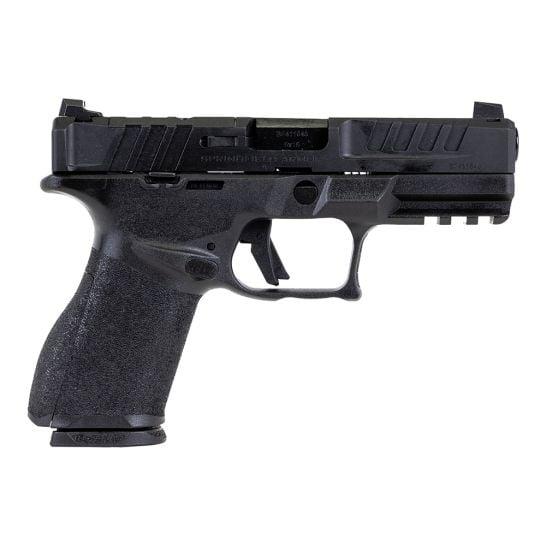
The Springfield Armory Echelon is a full-size, modular, polymer-frame, striker-fired 9mm pistol introduced in September 2023, developed jointly by Springfield Armory and Croatian manufacturer HS Produkt.
Founded in 1991 and based in Karlovac, Croatia, HS Produkt manufactures firearms for military and law enforcement customers across Europe, Latin America, and Southeast Asia. The company is best known internationally for the HS-2000, which Springfield Armory imported and sold as the XD series beginning in 2001 — one of the best-selling polymer pistols in U.S. history.
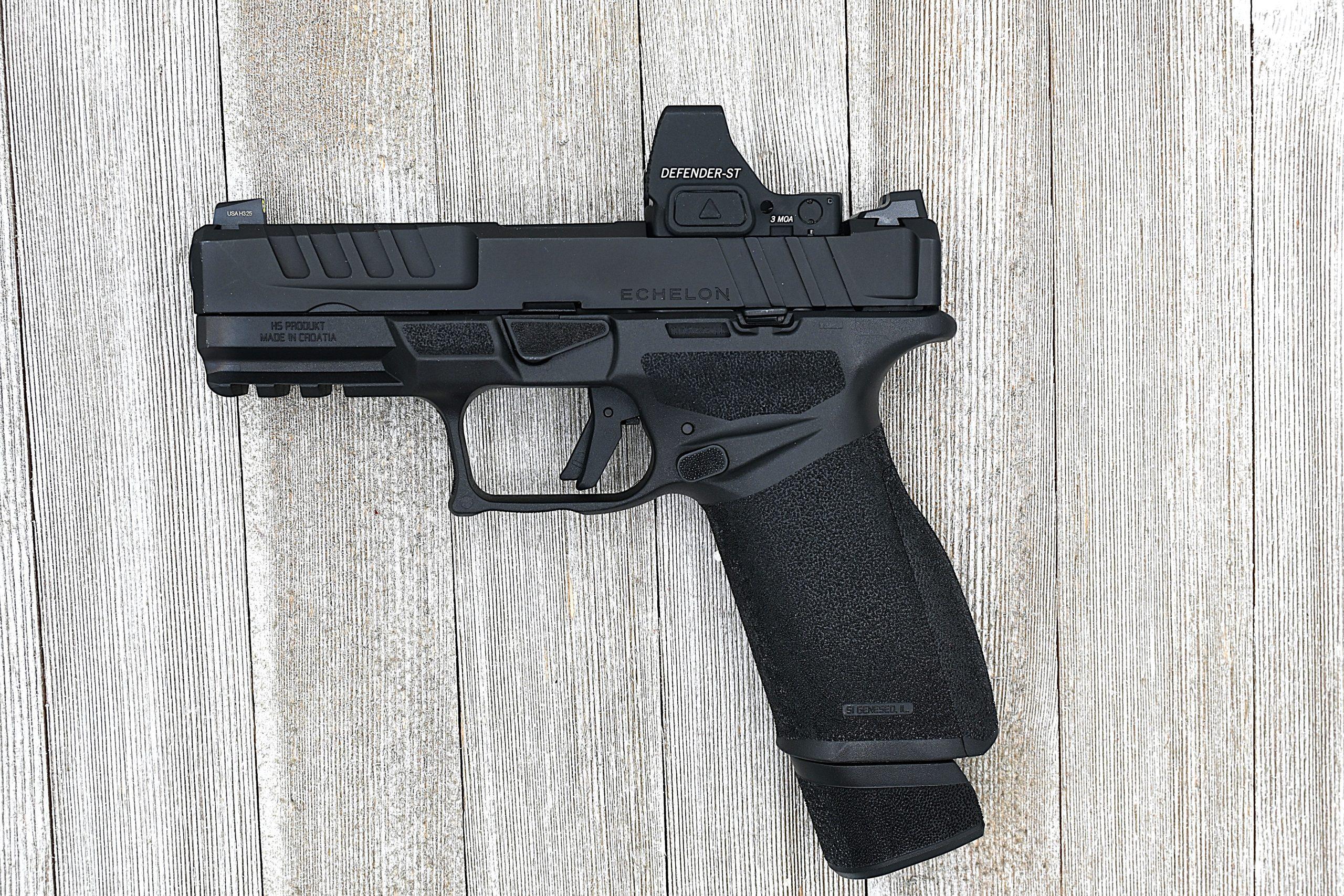
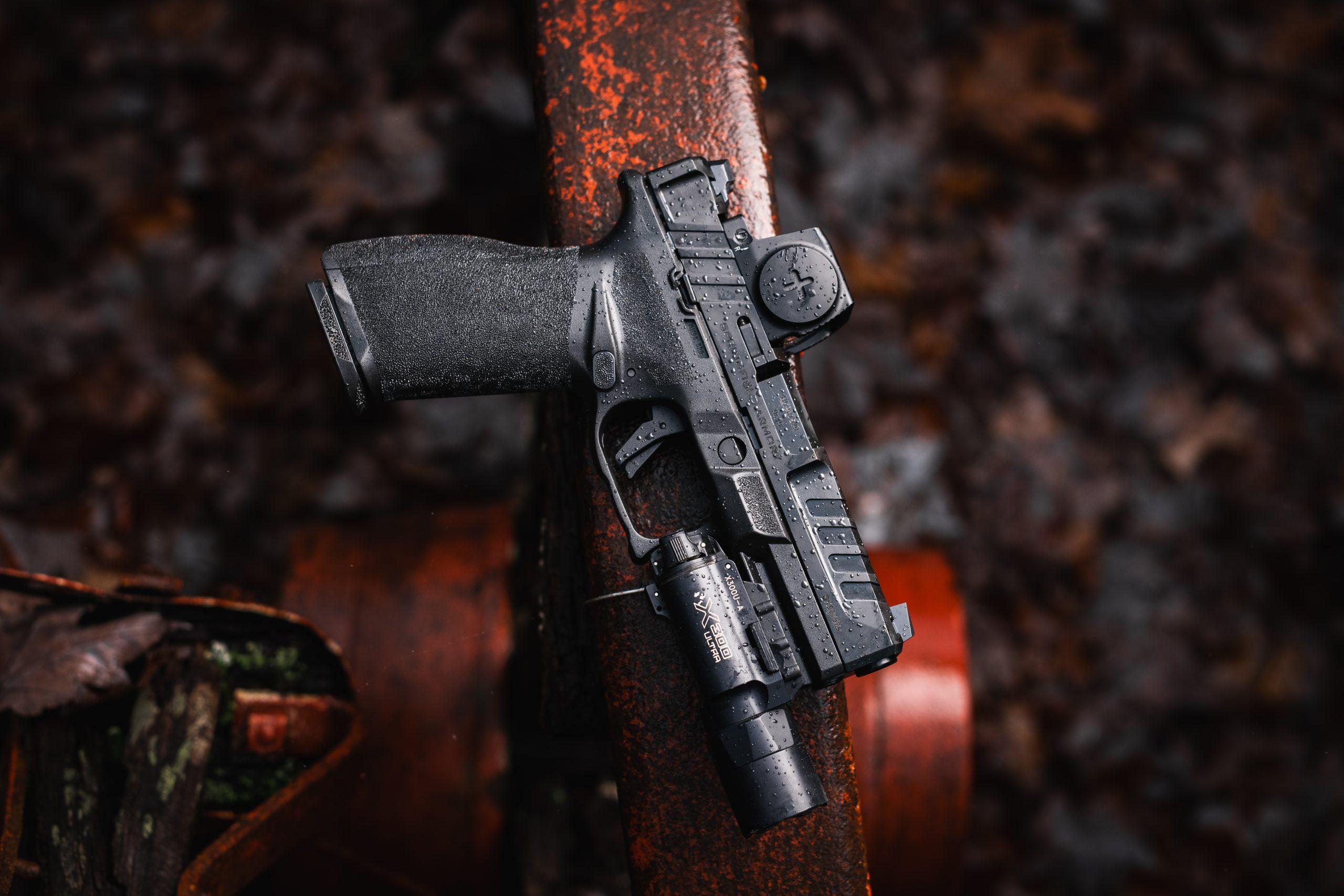
The Echelon represents their most advanced design to date, incorporating lessons from two decades of XD production and direct feedback from American law enforcement and competitive shooting communities. It is distinguished by its Variable Interface System (VIS) for direct red dot mounting without adapter plates, its Central Operating Group (COG) modular chassis, and fully ambidextrous controls — positioning it as Springfield’s direct answer to the Glock 19, SIG P320, and Walther PDP in the duty and defensive pistol market.
Introduced in 2023 as a clean-sheet design — not just another XD variant — the Springfield Armory Echelon represents the company’s most ambitious handgun project in decades. This Springfield Armory Echelon review covers a full-size 9mm striker-fired pistol built specifically to compete for law enforcement contracts, win over competitive shooters, and finally earn Springfield a seat at the duty gun table alongside Glock, SIG, and HK. If you’ve been researching the best 9mm pistols in the duty-size class, this one belongs on your short list.
And it’s working. In December 2024, the St. Louis County Police Department — with nearly 1,000 officers — adopted the Echelon as their duty pistol in a $2.1 million contract, validating Springfield’s claims about reliability and performance.
But does law enforcement adoption translate to a gun worth buying for concealed carry, competition, or home defense? After putting more than 2,000 rounds through our test gun, carrying it daily for three months, and comparing it head-to-head against the Glock 19 and SIG P320, we have answers.
This echelon pistol review isn’t another quick 500-round range report. We’re covering everything: the innovative Variable Interface System that mounts 30+ red dots without adapter plates, the modular Central Operating Group (COG) chassis, common problems users actually experience, real-world carry performance, and whether the Echelon justifies its premium price point.
The Quick Verdict



Best For
- Innovative VIS optics system
- Excellent ergonomics and grip design
- Modular COG chassis system
- Outstanding reliability
- Flat shooting and controllable recoil
Considerations
- Stiff takedown lever (out of the box)
- Aftermarket support still growing
- Full-size frame harder to conceal
- Magazine loading is stiff initially
- Slide release placement can affect grip
Who Should Buy the Echelon:
- Glock or P320 owners seeking a fresh alternative with superior ergonomics
- Red dot enthusiasts tired of adapter plates and tall suppressor-height sights
- Duty or competitive shooters wanting a modern, feature-rich platform
- Medium-to-large handed shooters prioritizing grip comfort and control
Who Should Skip It:
- Budget-conscious buyers in the $400–500 range (street price is $550–620)
- Small-handed shooters who struggle with full-size frames
- Those needing extensive aftermarket support right now (still growing)
- Shooters wanting the absolute lightest carry gun possible
Test Scores
So… how does the Springfield Echelon stack up on our 60-point scale?
Accuracy: 9/10
Consistent ~2.3–2.8 inch groups at 7 yards from the bench, with strong performance at defensive distances. Red dot use improved groups and split times noticeably.
Ergonomics: 9/10
Excellent grip design with modular sizing, aggressive texture, and a high undercut trigger guard. One of the most natural-feeling striker-fired pistols in hand.
Fit and Finish: 9/10
Well-executed overall with quality materials and tight construction. Minor complaints around initial stiffness in components, but nothing affecting performance.
Features: 9/10
VIS direct-mount optics system, modular COG chassis, full ambidexterity, and thoughtful design details throughout make this one of the most feature-rich pistols in its class.
Reliability: 9/10
99.86% reliability over 2,127 rounds with only minor ammo-related issues. Runs clean and dirty with a wide range of loads.
Value: 7/10
Strong performance and innovation for ~$600, but held back slightly by a still-developing aftermarket and premium pricing vs. budget alternatives.
Springfield Echelon at a Glance
Specifications & Pricing
| Specification | Details |
|---|---|
MSRP | $710 |
Street Price | $599–650 (typical online pricing) |
Caliber | 9mm Luger |
Capacity | 17+1 (flush) 20+1 (extended) |
Barrel Length | 4 inches (hammer-forged Melonite finish) |
Overall Length | 7.25 inches |
Height | 5.5 inches |
Width | 1.2 inches (grip) |
Weight (Unloaded) | 24 oz |
Action | Striker-fired |
Trigger Pull | 5.5–6.0 lbs (factory) |
Sights | Tritium front U-notch rear sight (tactical rack capable) |
Finish | Black Melonite (also available in Cerakote colors) |
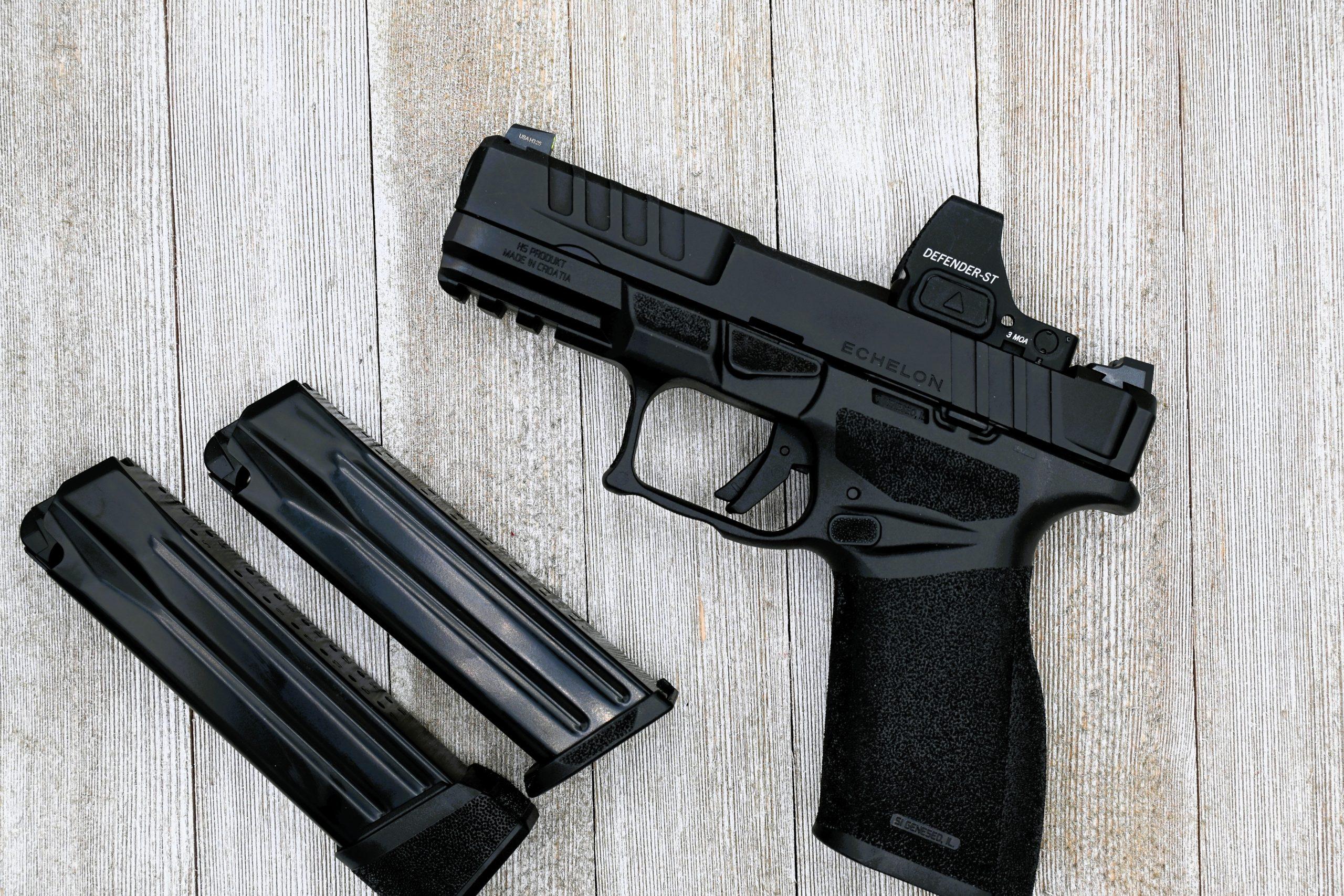
In the Box (as of 2026): The Springfield Armory Echelon ships with two 17-round steel magazines, three backstrap sizes (S/M/L), three eccentric VIS pin sets, two optic adapter plates (ACRO and Docter footprints), optic mounting screws, a polymer carry case, a cable lock, and owner’s manual. No holster is included.
Features That Set the Echelon Apart
In a market saturated with polymer striker-fired 9mm pistols, the Springfield Echelon stands out through four key features.
Variable Interface System (VIS)
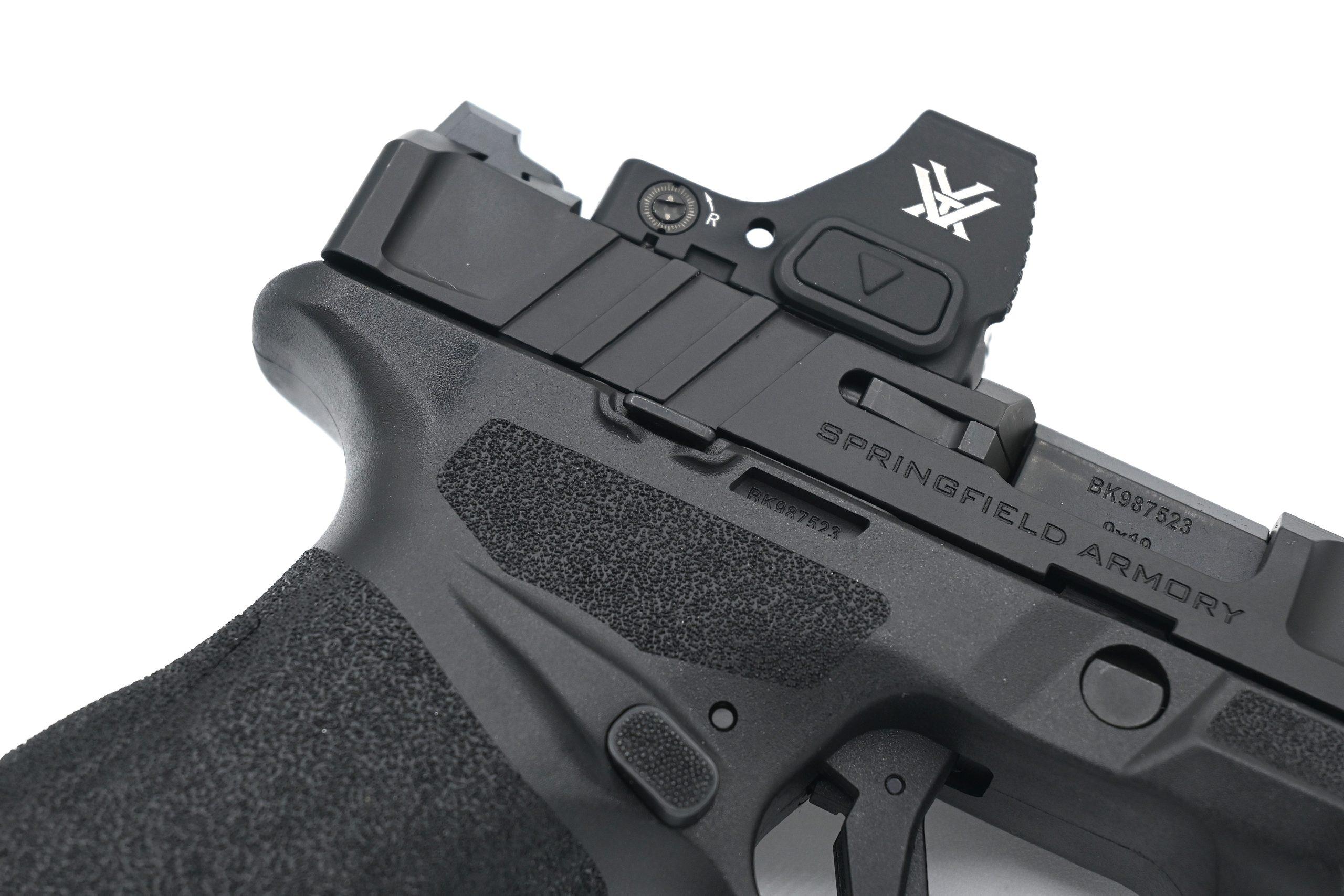
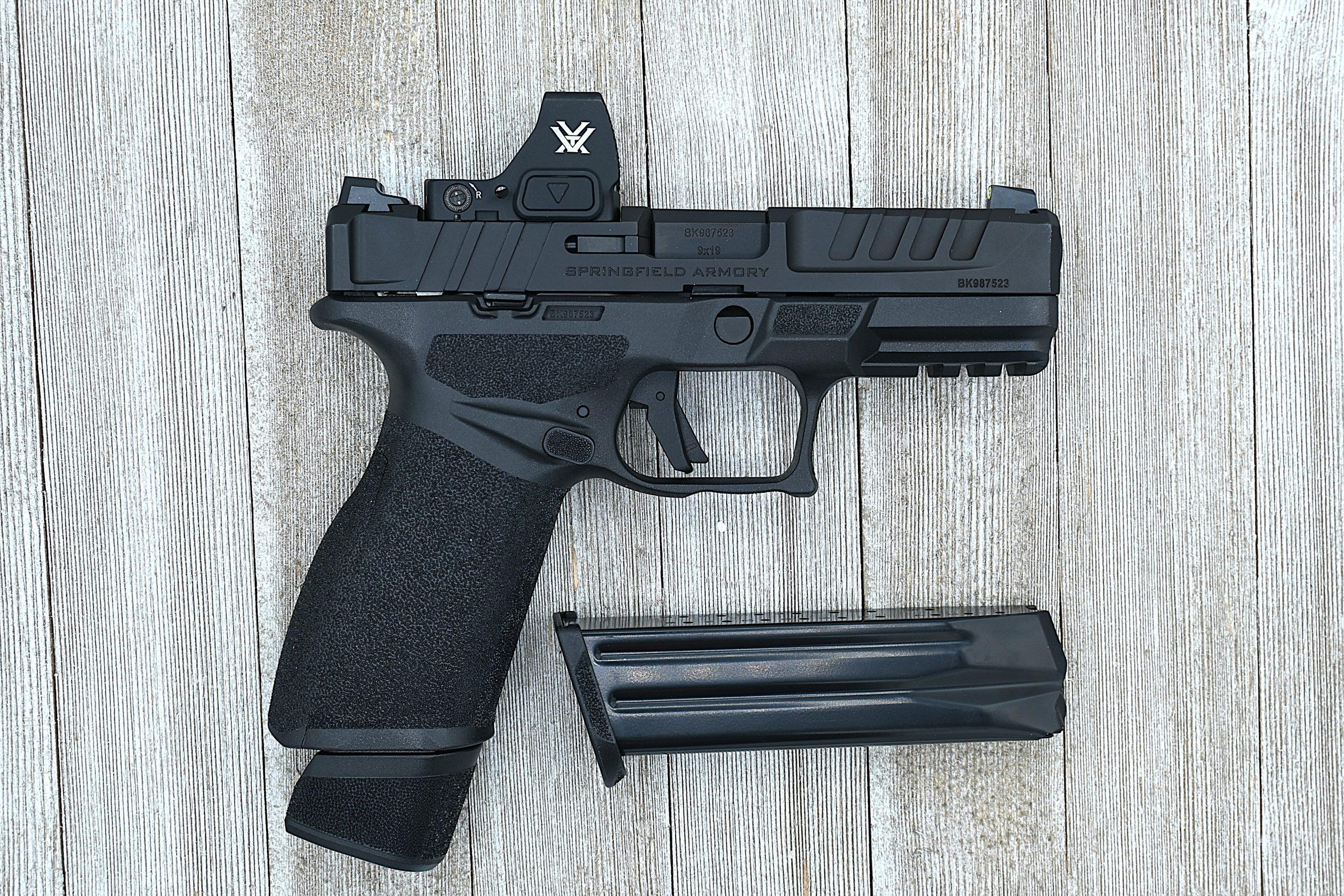
The Echelon mounts over 30 different red dot optics directly to the slide without adapter plates. Using an eccentric pin system that pivots as you tighten the mounting screws, the VIS allows low-mounted optics while maintaining co-witness with standard-height iron sights.
It’s the most elegant solution to the optic footprints problem we’ve seen on any production pistol — a genuine revolution in mounting optics to a production handgun.
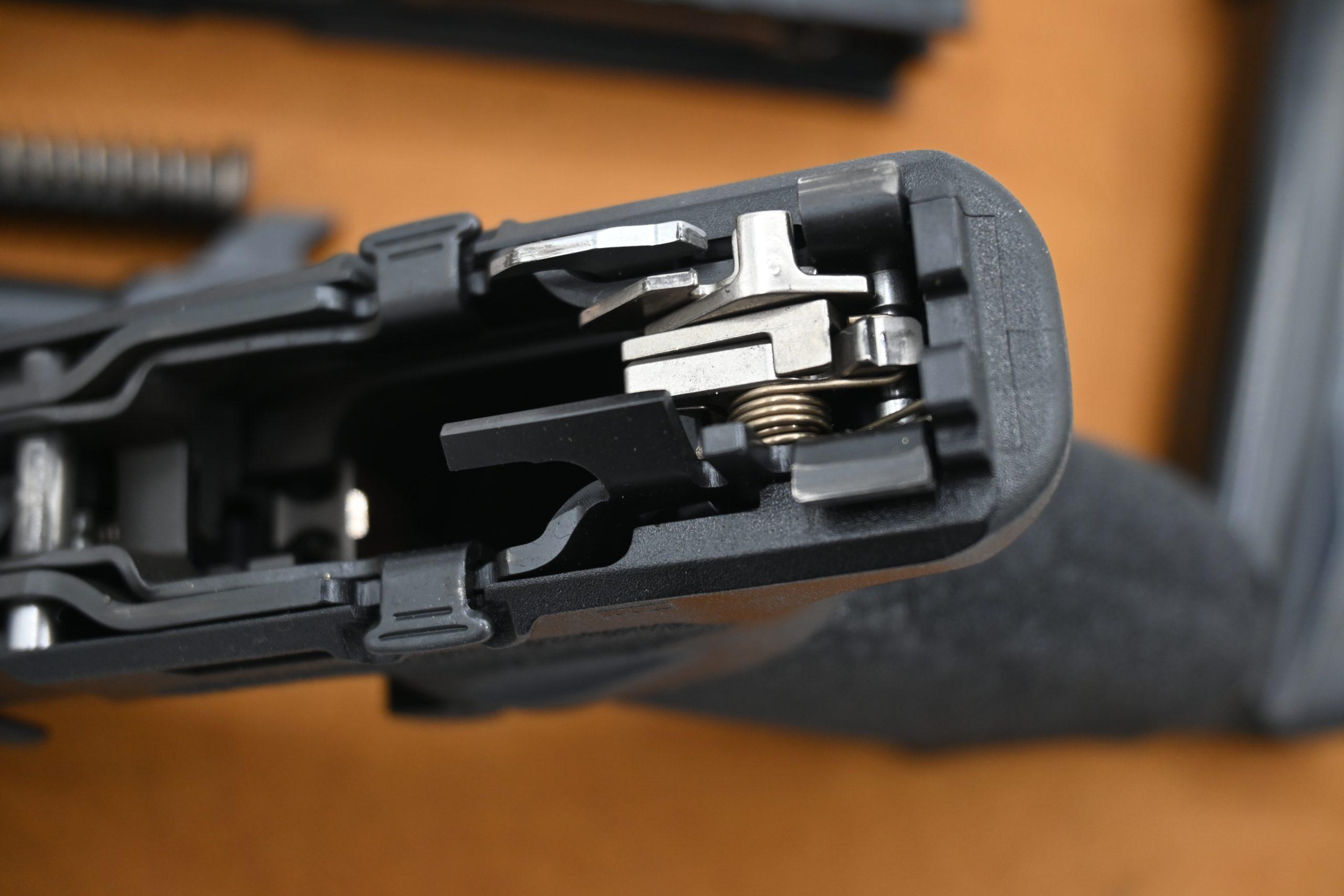
Central Operating Group (COG) Chassis Like the SIG P320’s serialized component fire control unit, the Echelon’s tool steel chassis contains all the fire control components and is the legal firearm.
This allows swapping grip modules without purchasing a new gun. Springfield currently offers small, medium, and large frames, each with three interchangeable backstraps — giving you nine possible grip configurations.
Clean-Sheet Design This isn’t an XD with a new slide. The Echelon was designed from the ground up by Springfield Armory and HS Produkt specifically for the modern duty gun market.
Every detail — from the aggressive slide serrations to the ambidextrous controls to the gas pedal takedown lever — reflects lessons learned from two decades of striker-fired pistol evolution.
Law Enforcement Validation In December 2024, the St. Louis County Police Department selected the Echelon as their duty pistol, replacing their aging firearms in a $2.1 million contract covering nearly 1,000 officers.
This marks Springfield’s first major law enforcement adoption of a striker-fired pistol and validates the Echelon’s reliability and performance claims.
Design & Features Breakdown
The Echelon packs more thoughtful design features than most guns at twice its price. Let’s break down what actually matters.
The Variable Interface System: Game Changer or Gimmick?
The VIS is genuinely clever — and after mounting five different red dots during our testing, we can confirm it works exactly as advertised.
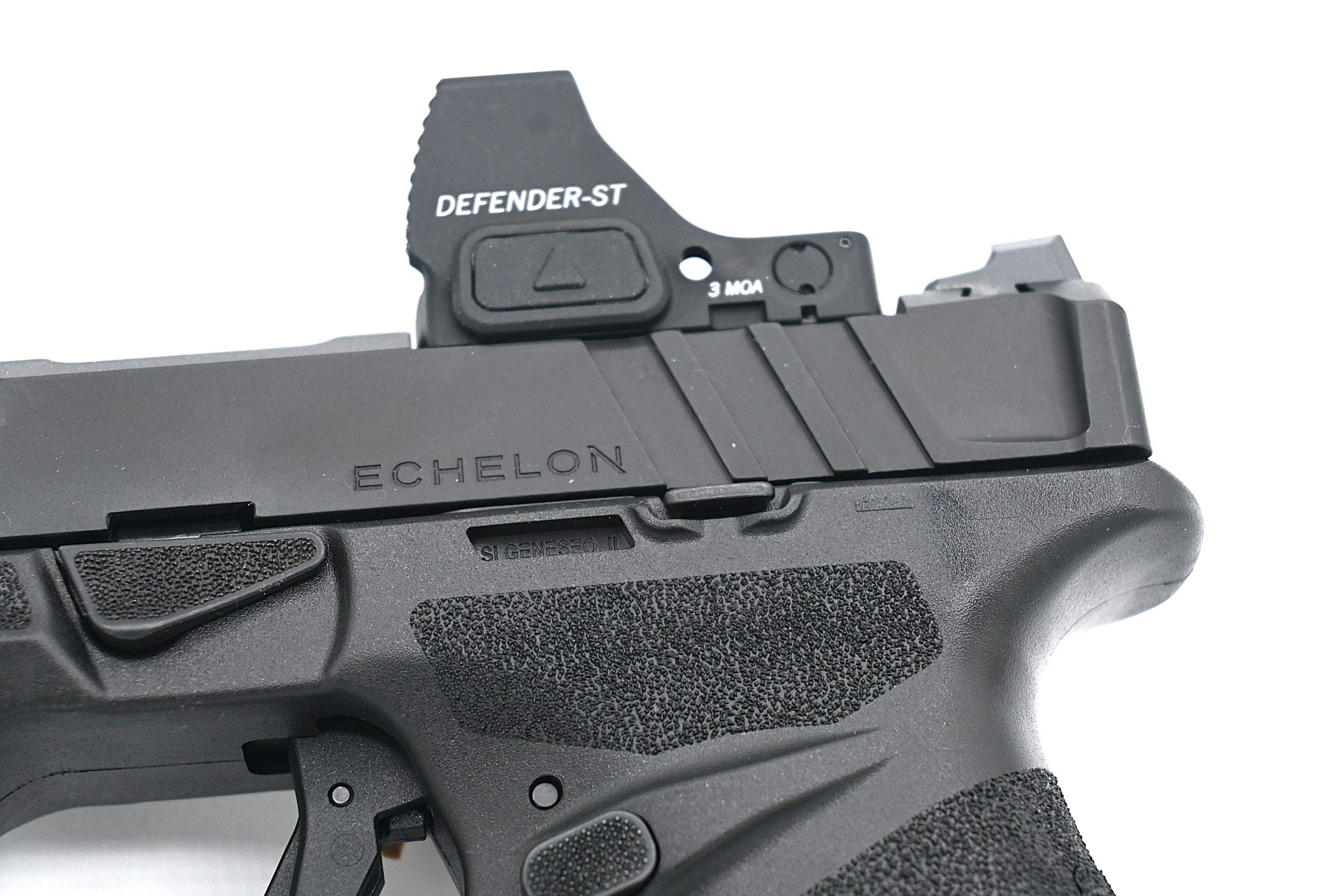
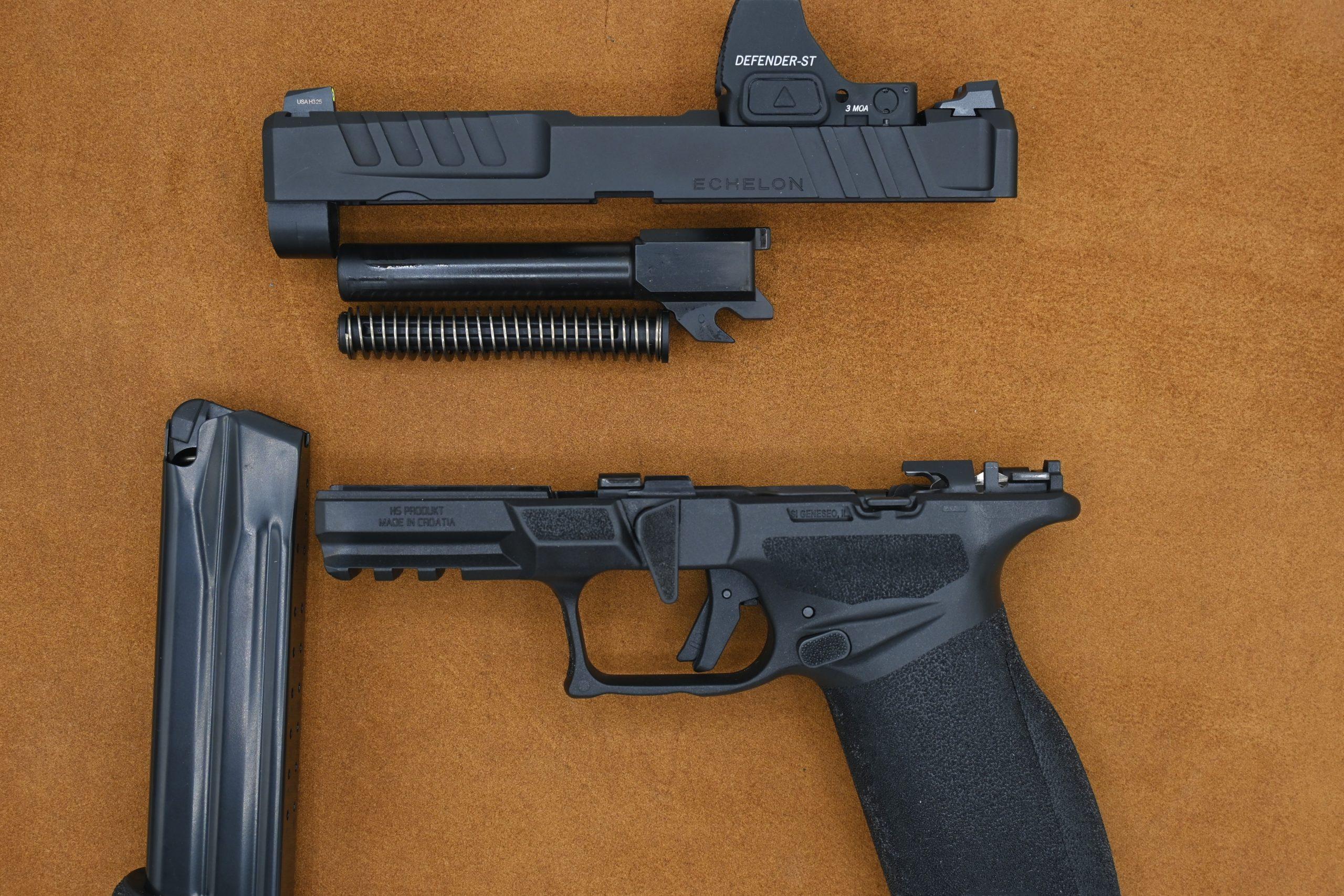
Here’s how it works: The Echelon’s slide has multiple threaded holes milled into it. Springfield includes three sets of eccentric pins — essentially small cylinders with off-center holes. When you select the correct pin set for your optic’s footprint and drop them into the slide, the pins sit loosely.
As you tighten the optic’s mounting screws, the eccentric design causes the pins to pivot inward, clamping against the optic with increasing force. The result is a rock-solid optics mounting system that sits as low as possible on the slide.
The advantages are immediate:
- No adapter plates mean one less failure point
- Lower mounting height allows co-witnessing with the rear sight and front iron
- Optic sits closer to bore axis for reduced muzzle flip visibility
- Self-locking design prevents zero shift
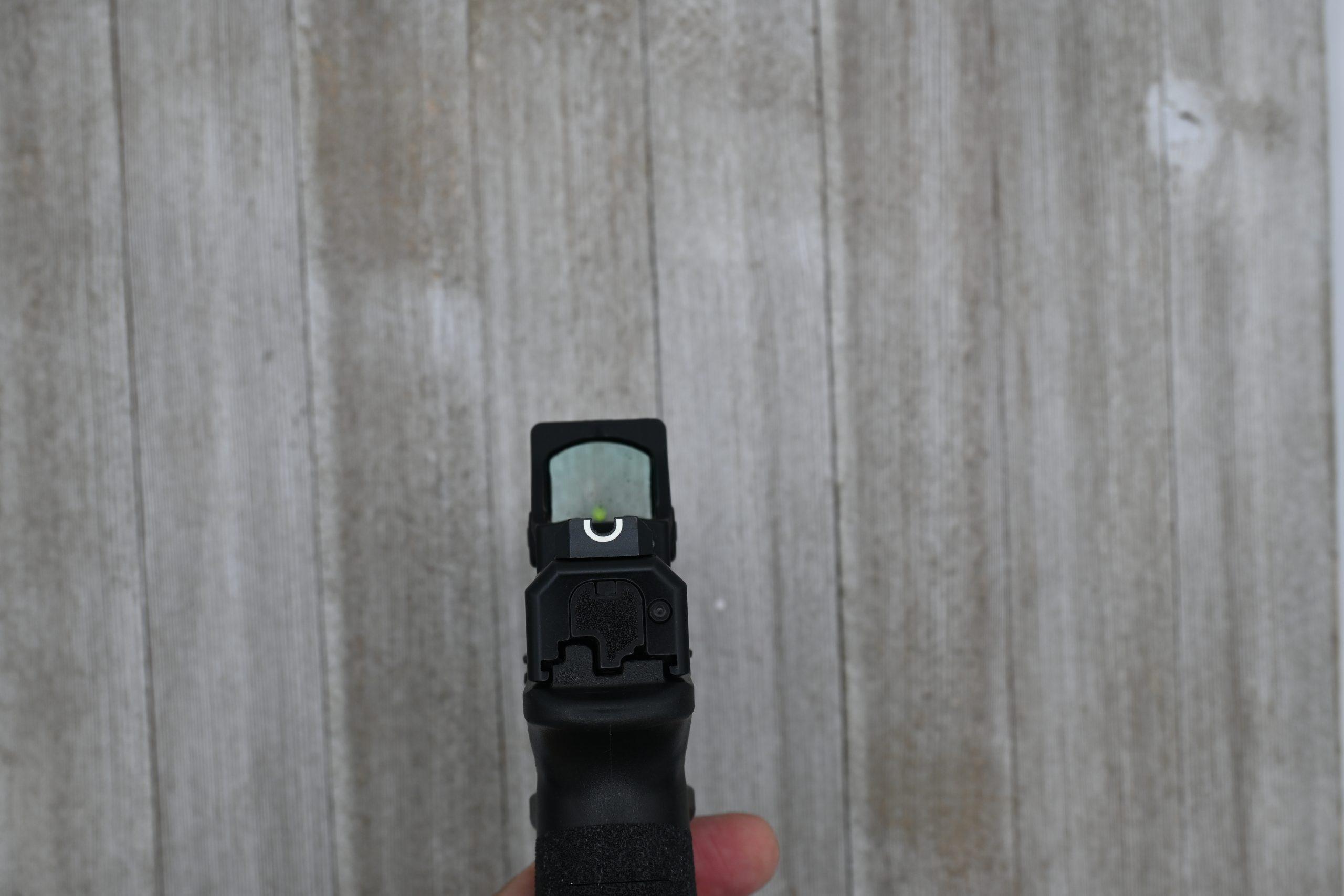
During our 2,000+ round test, we mounted a Vortex Defender, Holosun 507C, Shield RMSx, and Vortex Defender without any shift in zero. The system is legitimately better than traditional adapter plates.
The only real limitation: Not all optic footprints work with the pin system. The Aimpoint ACRO and Doctor footprints require adapter plates, which Springfield includes. But for the 30+ optics that work with the VIS, the experience is superior to anything else on the market.
See our full guide to the best pistol red dot sights for compatible options.
| Optic | Footprint | Pin Set | Notes |
|---|---|---|---|
Trijicon RMR / SRO | RMR | Pin Set 1 Screw Kit 1A | Most common; gold standard |
Holosun 507C / 508T / 509T | RMR | Pin Set 1 | Direct mount no plate |
Leupold DeltaPoint Pro | DeltaPoint | Pin Set 2 | Direct mount |
Vortex Defender / Razor | Vortex | Pin Set 2 | Direct mount |
Shield RMSx / SMS | Shield | Pin Set 3 | Fully enclosed emitter |
Swampfox Sentinel | RMR | Pin Set 1 | Budget-friendly option |
Aimpoint ACRO P-2 | ACRO | Adapter plate (included) | Plate required |
Docter / Meopta | Docter | Adapter plate (included) | Plate required |
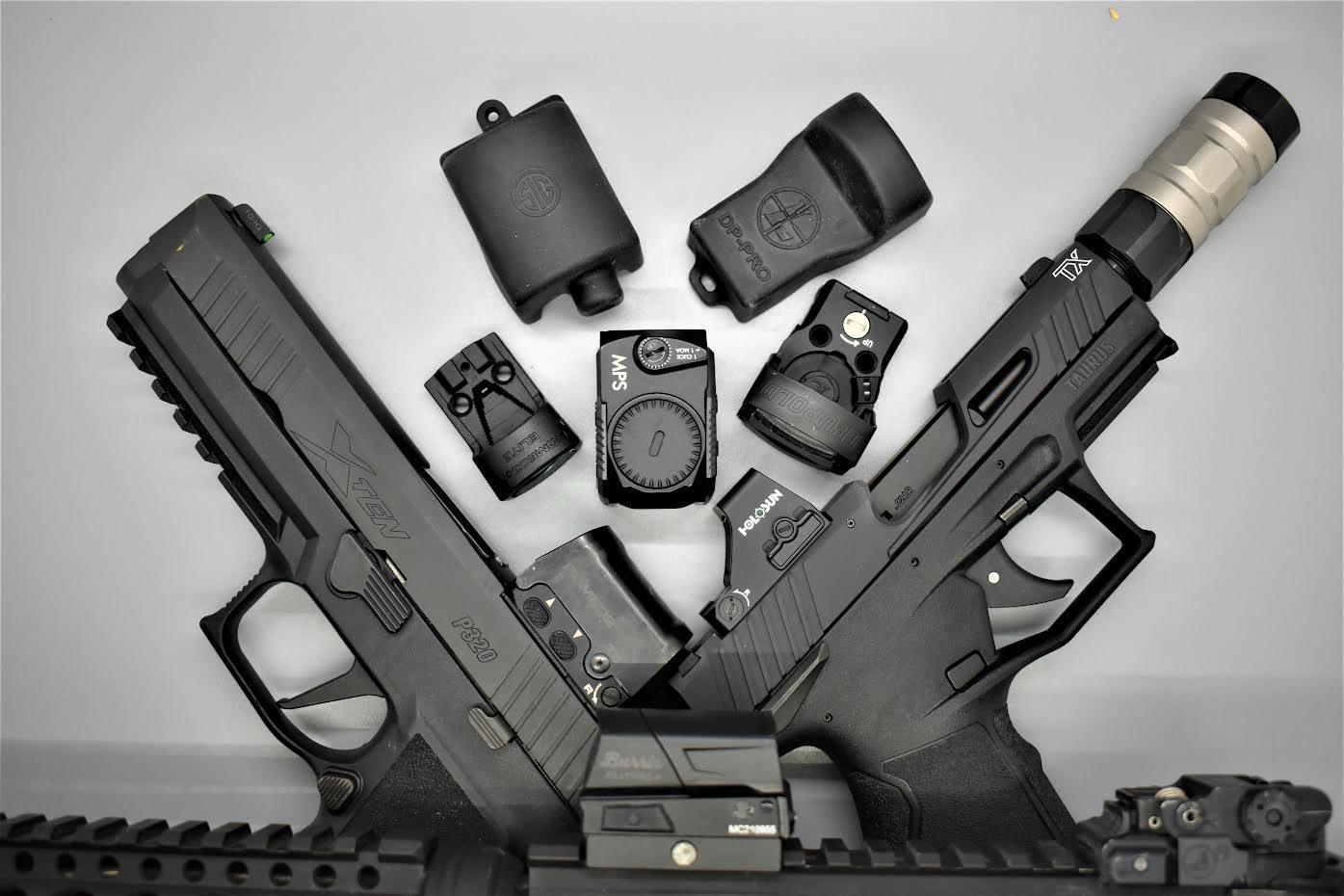
Our Red Dot Picks for the Echelon VIS System
Budget Option: Holosun 507C ($250–300) Perfect balance of features and price. The shake-awake function and solar panel backup make it ideal for duty use. Mounts directly via Pin Set 1.
Rugged Option: Vortex Defender ST ($250–$300) A hard-to-kill sleeper option with a huge viewing window and 25,000-hour battery run time. We spent most of our time shooting with this optic. It mounts directly with Pin Set 2.
Premium Choice: Trijicon RMR Type 2 ($450–500) The gold standard for duty and competition. Bombproof construction and proven reliability. Uses Pin Set 1 with Screw Kit 1A.
Enclosed Option: Shield RMSx ($400–450) Best choice if you want a fully enclosed emitter for extreme conditions. Mounts with Pin Set 3.
Central Operating Group (COG) Chassis
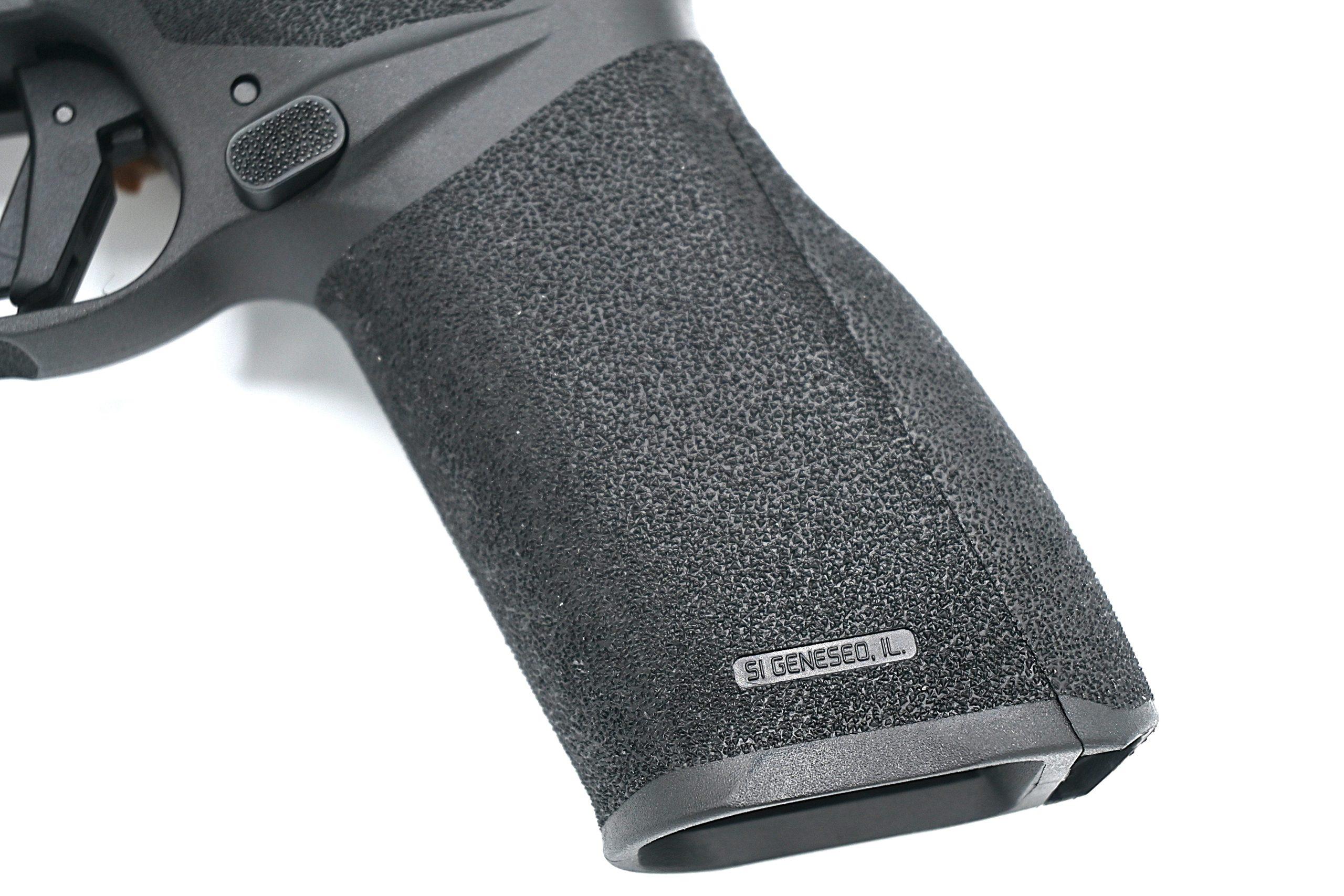
The serialized chassis system concept isn’t new — SIG pioneered it with the P320 — but Springfield’s implementation addresses some of P320’s weaknesses while adding clever features.
The COG is machined from tool steel by HS Produkt in Croatia and houses the entire fire control assembly, including a unique double-sear safety system. This second sear acts as a backup if the primary sear fails, preventing unintentional discharge even if dropped. Given the P320’s well-documented drop safety issues, this redundancy matters.
In practical terms, the modular chassis means you can swap the COG between different sized frames — small, medium, or large — to perfectly fit your hand. Each frame size also accepts three different backstraps, giving you nine total grip configurations without buying multiple guns.
We tested all three grip sizes. The medium frame with the size 2 backstrap fit our average-sized hands perfectly. Smaller shooters preferred the small frame with the compact grip (size 1 backstrap), while those with larger hands found the large frame with size 3 backstrap ideal. The modularity genuinely works.
Practical note: Frame modules cost about $80 from Springfield. That’s cheaper than buying a whole new pistol if your hand size or carry needs change.
Ergonomics & Grip
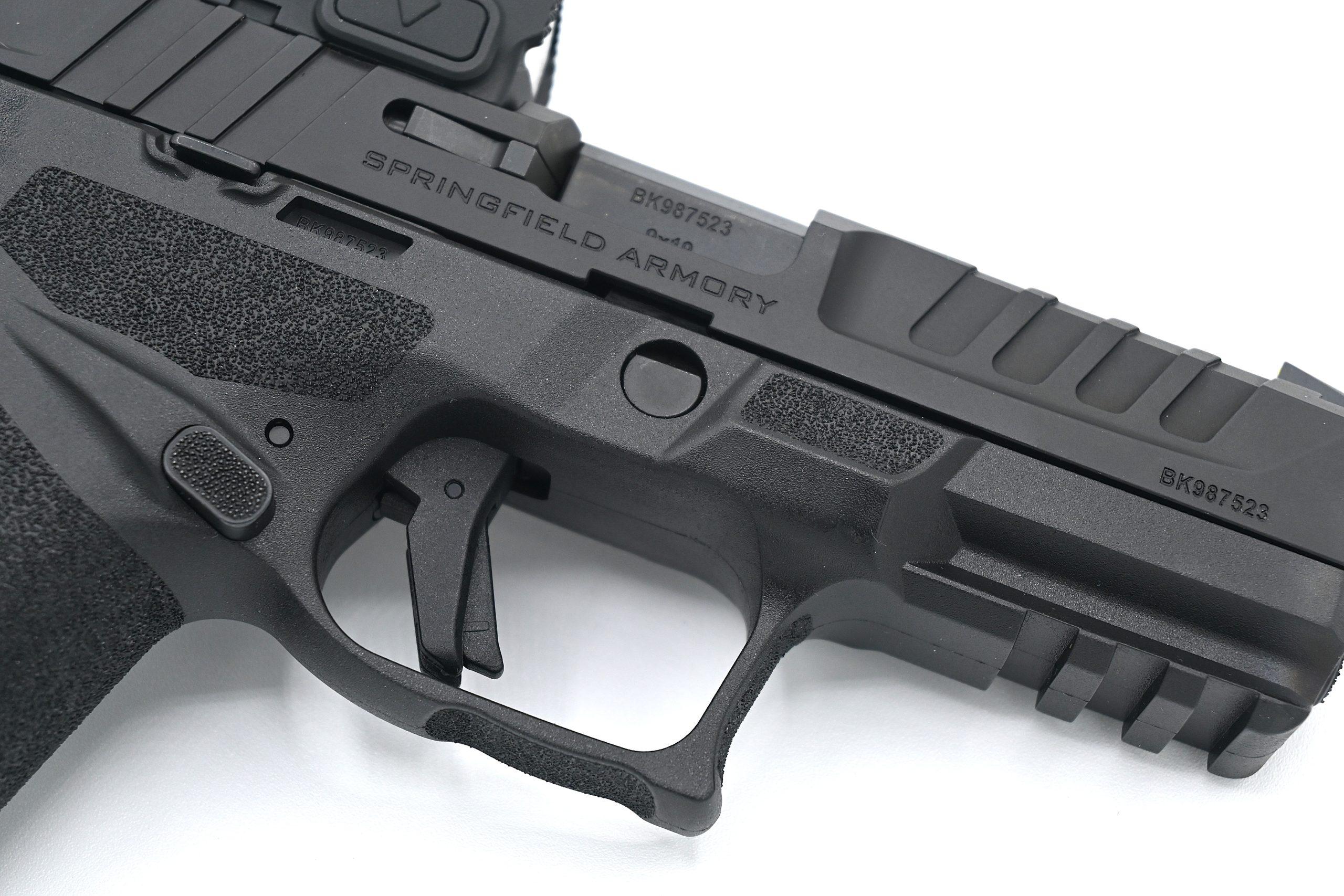
The Springfield Armory Echelon features a polymer frame with aggressive Adaptive Grip Texture, a deep undercut trigger guard, and a modular backstrap system accommodating small, medium, and large hand sizes.
This is where the Echelon truly shines. Springfield and HS Produkt clearly studied what works across the competitive landscape and delivered arguably the best-feeling striker-fired grip on the market — and the pistol feels great in the hand the moment you pick it up.
The polymer frame geometry is distinctly more rounded and organic than the blocky Glock 19 or the somewhat slab-sided P320. The frontstrap has a subtle palm swell that fills your hand naturally, and the aggressive texturing — what Springfield calls Adaptive Grip Texture — provides secure purchase without being sandpaper-rough. That grip lets you grab and hold the pistol firmly through rapid strings without fatigue.
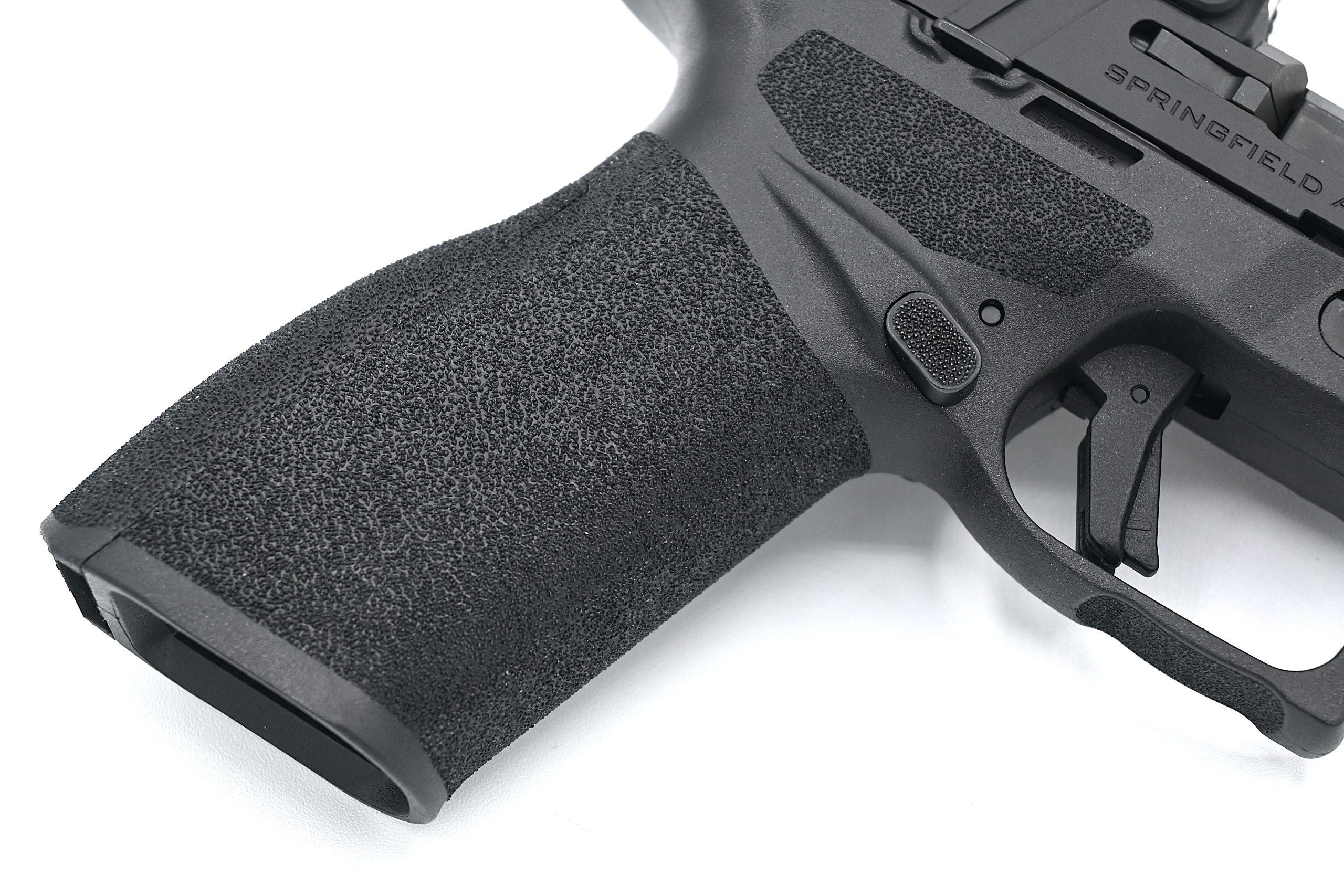
The undercut trigger guard is deep and allows a high grip that gets your hand closer to the bore axis. This translates directly to reduced muzzle flip and faster follow-up shots. We noticed this immediately when transitioning from our G19 — the Echelon just sits flatter during rapid fire.
The new Echelon 4.0FC series gun splits the difference by merging full-size capacity with a compact slide assembly, pairing a 4-inch barrel with a full-length grip module with a compact dust cover — much akin to the Glock 19 and 45.
The gas pedal effect: The takedown lever is positioned and textured to act as a thumb rest for your support hand. This isn’t just marketing — placing your support side thumb on the lever creates forward pressure that further controls muzzle rise. It’s a technique competitive shooters have used for years, and Springfield built it into the gun.
Compared to competitors:
- More rounded and palm-filling than Glock 19
- Better texturing than SIG P320 (not as aggressive as Walther PDP)
- Deeper undercut trigger guard than HK VP9
- More natural grip angle than most (splits the difference between Glock and 1911)
Bottom line: If you’ve never quite loved how a Glock or P320 feels in your hand, the Echelon deserves a try. The ergonomics are that good.
Controls & Manipulation
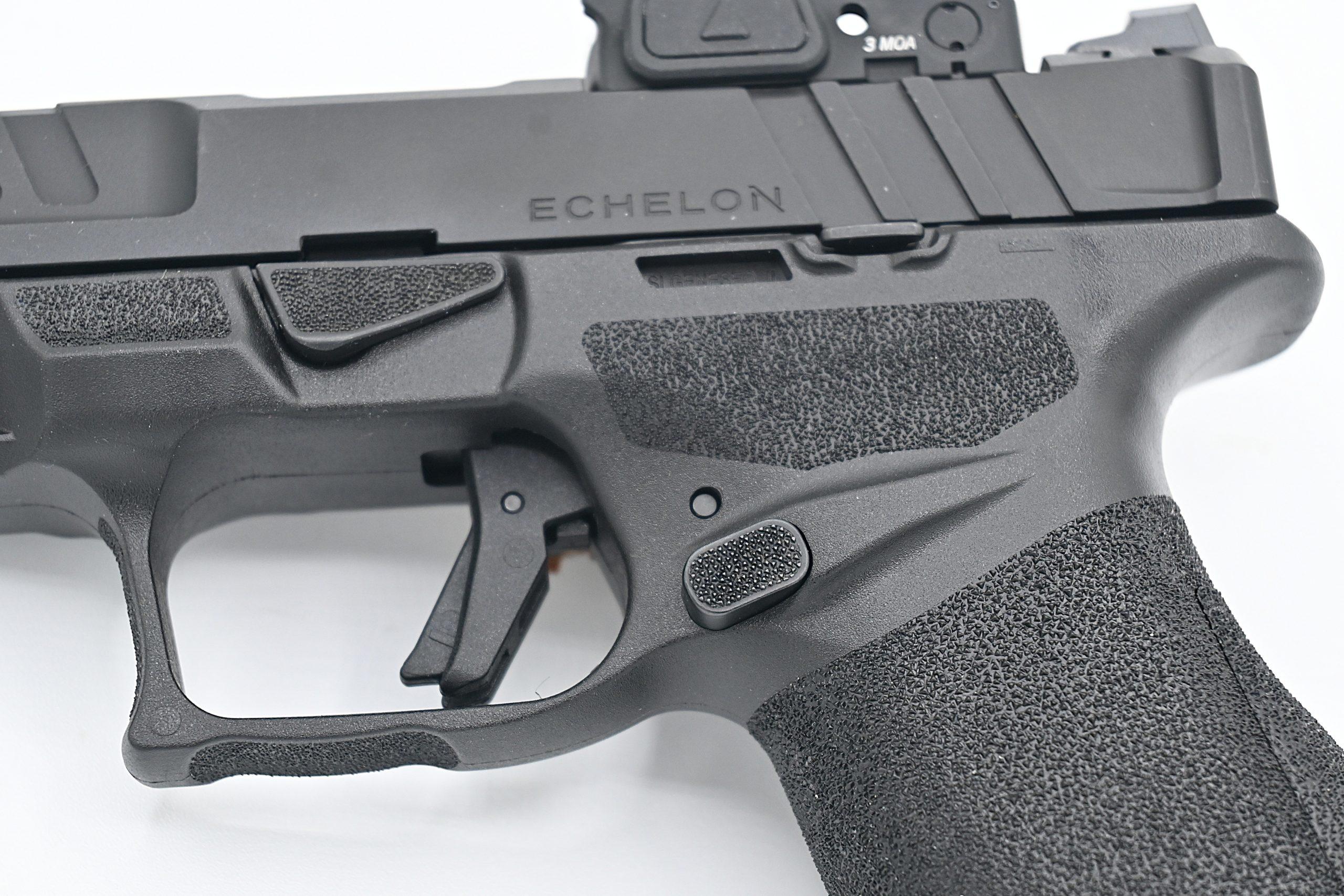
The Echelon is fully ambidextrous except for the magazine release — though Springfield makes it reversible for lefties.
Slide Manipulation
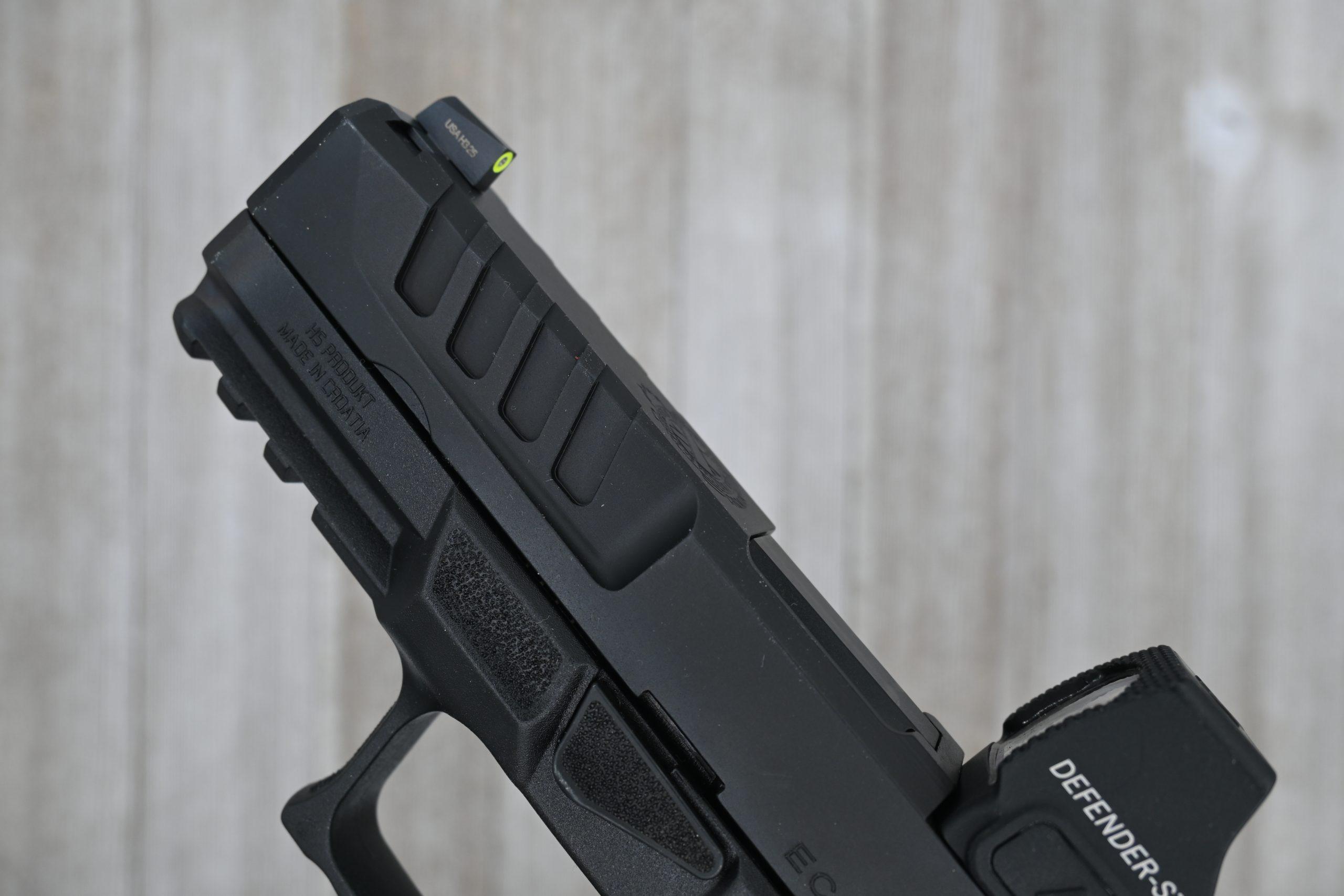
Springfield went aggressive on the slide serrations — both front and rear — and added subtle “ears” at the back of the slide above the ambidextrous slide release. These ears give you something substantial to grab when racking the slide, similar to the HK VP9. Combined with the deep serrations, slide manipulation is effortless even with wet or sweaty hands.
The slide release sits lower and further back than on a Glock, more like a SIG. This is a double-edged sword: it’s easy to thumb forward to release the slide, but some shooters (including us) occasionally ride it during firing, preventing the slide from locking back on empty. Your grip will determine if this is an issue.
Magazine Release
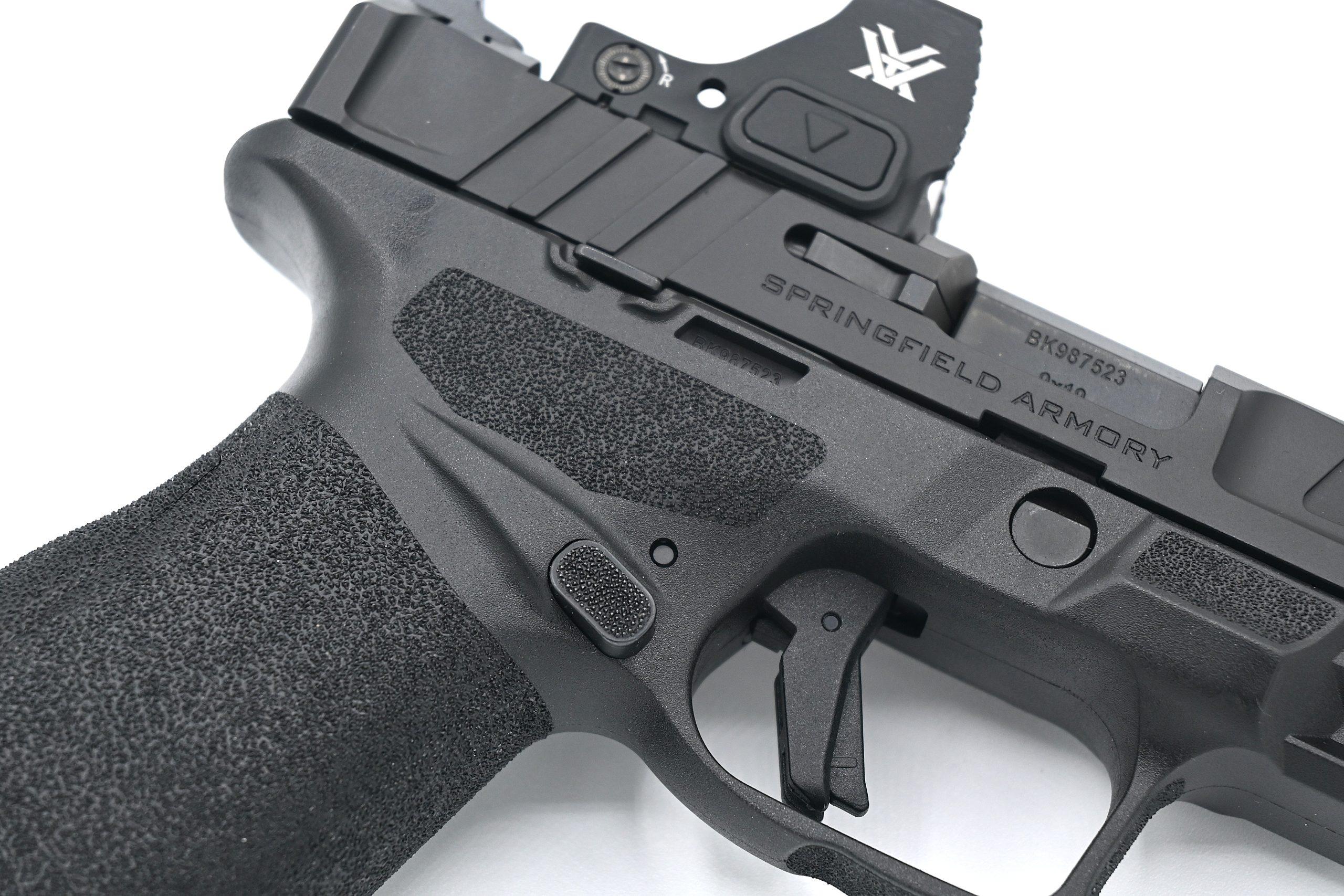
The ambidextrous magazine release is one of the Echelon’s best features. Unlike guns where you have to swap the button to the other side, Springfield’s design works from either side simultaneously. Extended shields behind the release prevent accidental activation during grip, even for shooters with large hands.
Takedown Lever
Here’s where we need to talk about the elephant in the room. The takedown lever on the Echelon is stiff — stiff. This is by far the most common complaint from new owners, and we experienced it too.
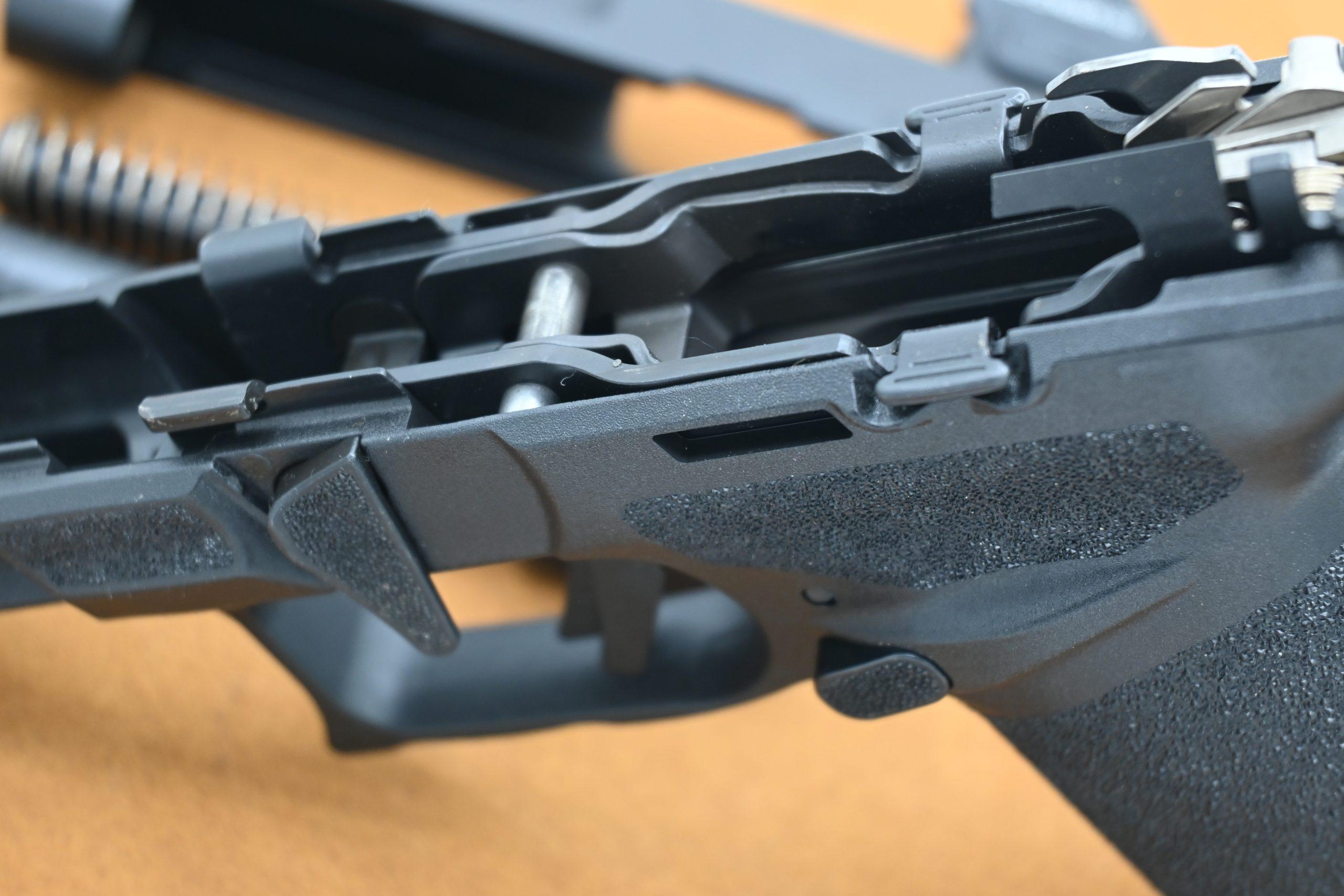
On our brand-new test gun, rotating the takedown lever required significant force and a small flathead screwdriver for leverage. This improves substantially with use and lubrication, but it’s something Springfield needs to address in future production runs.
The fix: Generously lubricate the lever and work it back and forth 50–100 times. Most owners report significant improvement after a break-in period. If yours doesn’t improve, Springfield’s customer service will address it under warranty.
Important: The lever cannot rotate unless the magazine is removed and the slide is locked back. This is a safety feature, not a defect.
Shooting Performance & Testing
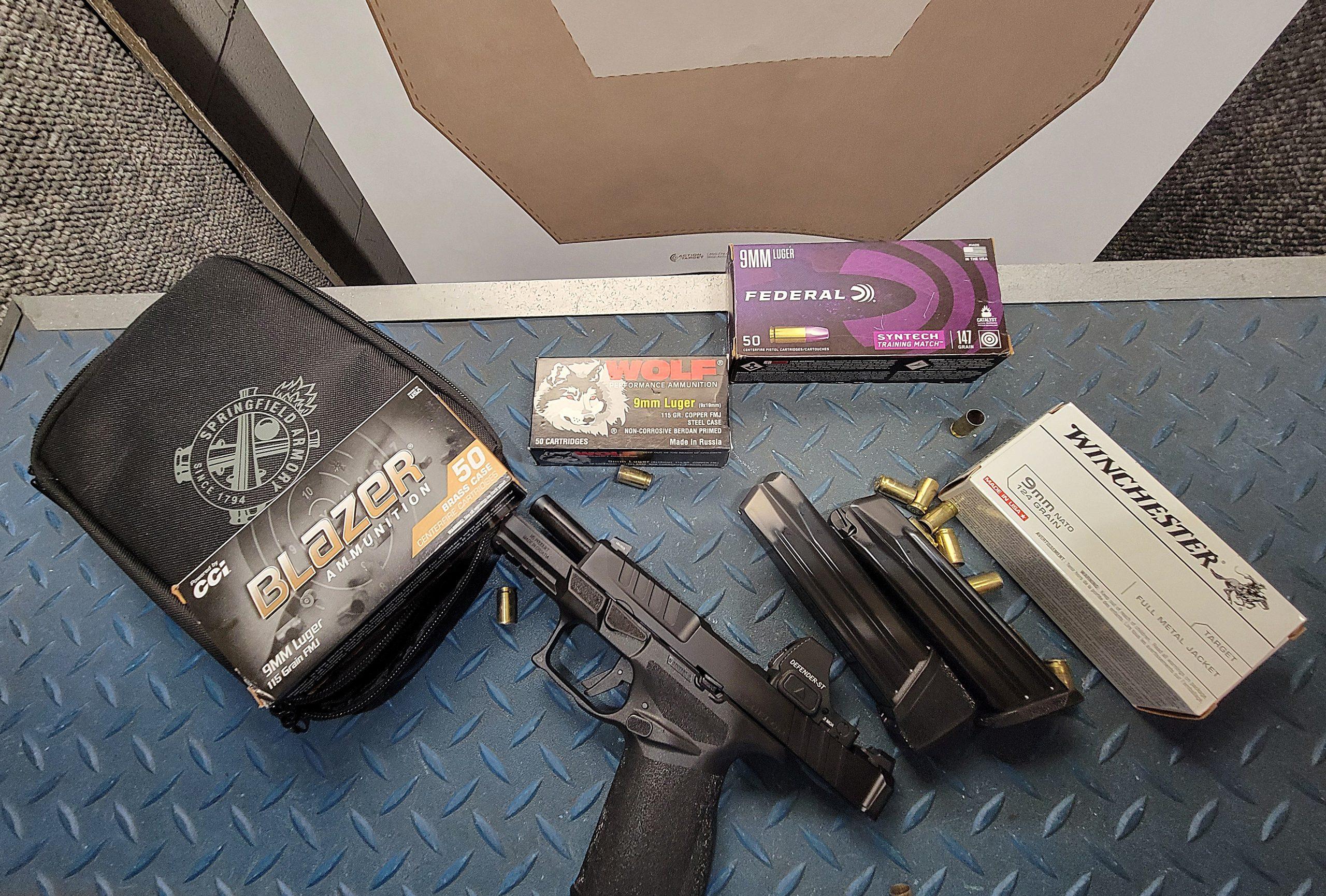
We put the Springfield Armory Echelon through comprehensive testing over three months, firing 2,127 rounds of various ammunition types across multiple range sessions.
Range Testing Methodology
Our testing protocol:
- Total rounds fired: 2,127
- Ammunition types: 8 different loads (FMJ practice and JHP defensive)
- Distance protocols: 7, 15, and 25 yards
- Red dot used: Trijicon RMR Type 2 (6.5 MOA)
- Environmental conditions: Indoor and outdoor, temperatures 45–95°F
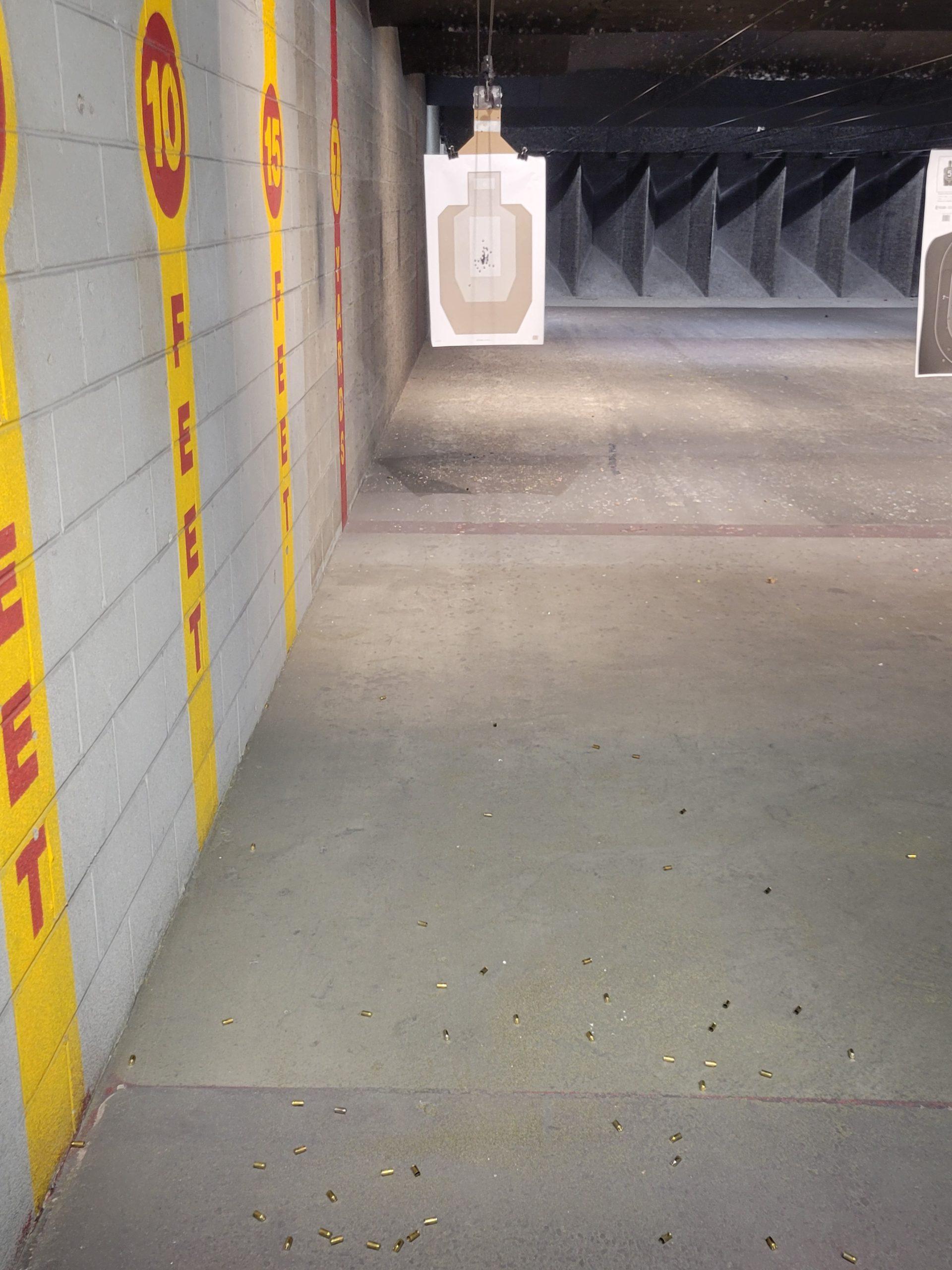
We cleaned the gun thoroughly at the 500 and 1,500-round marks. Between cleanings, we deliberately pushed it to see how much abuse it would tolerate.
Accuracy Results
The Springfield Armory Echelon is accurate to approximately 2.3–2.8 inches at 7 yards from the bench with premium defensive ammunition. The Echelon is a combat pistol, not a bullseye gun — but it’s plenty accurate for any practical purpose.
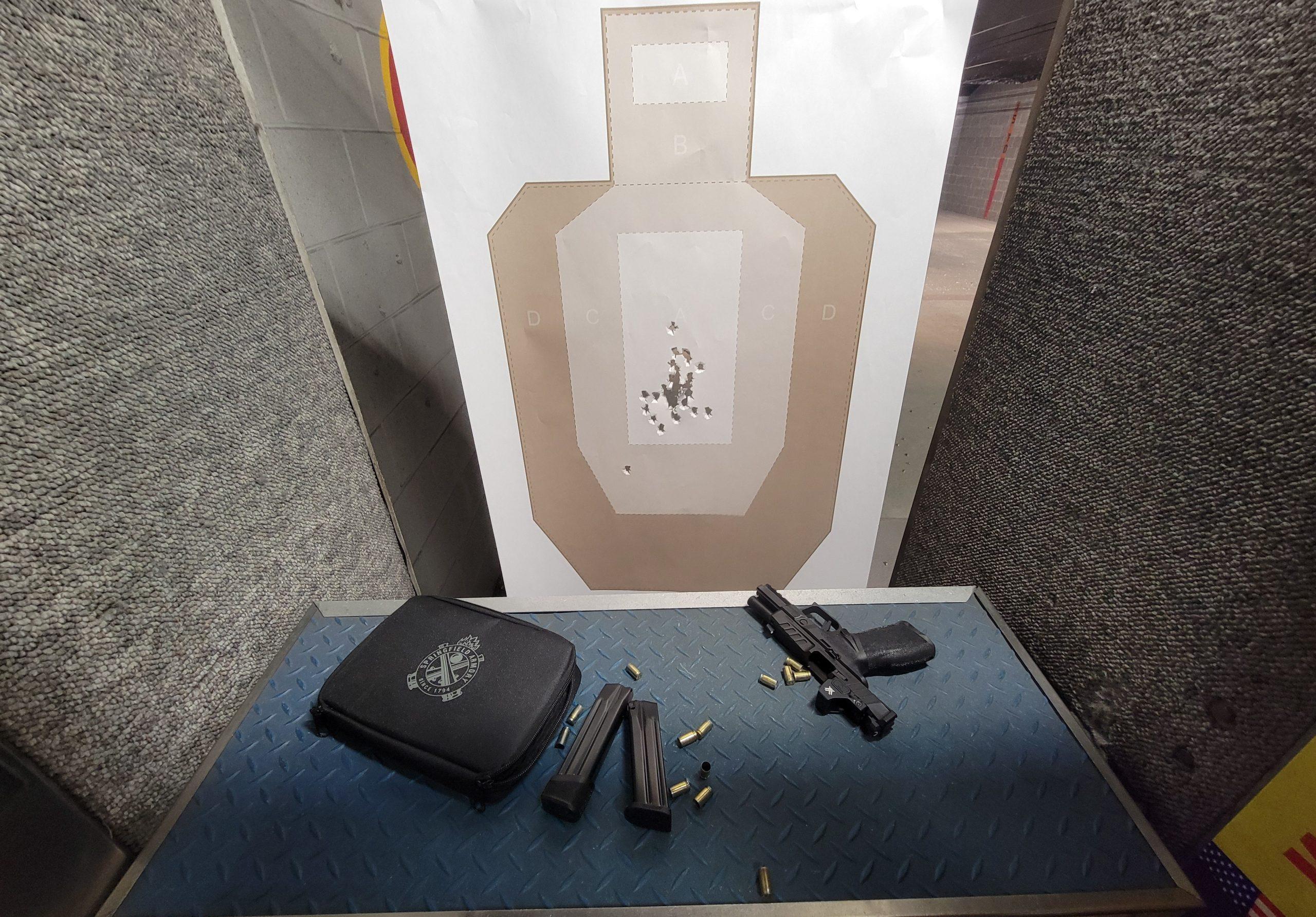
Benchrest Results at 7 Yards (5-shot groups):
| Load | Average Group |
|---|---|
Federal HST 124gr | 2.3 inches |
Speer Gold Dot 147gr | 2.6 inches |
Winchester NATO 124gr | 2.8 inches |
Federal Syntech 115gr | 2.4 inches |
At defensive distances (7–15 yards), the Echelon delivered exactly what you’d expect from a quality duty pistol. Standing unsupported at 15 yards, we could consistently print 3–4 inch groups, with flyers opening to 5 inches. That’s more than adequate for practical applications.
The Vortex Defender made a noticeable difference. Compared to iron sights and rear sight alone, our groups tightened by roughly 20% and our split times improved by about 0.1 seconds. The low-mounted VIS system deserves credit here — the dot stays visible through recoil better than on plate-mounted systems.
How it compares: The Springfield Armory Echelon shot roughly on par with our Glock 19 Gen 5 and slightly better than our stock P320. Not a massive difference, but consistent enough to be measurable.
Reliability Assessment
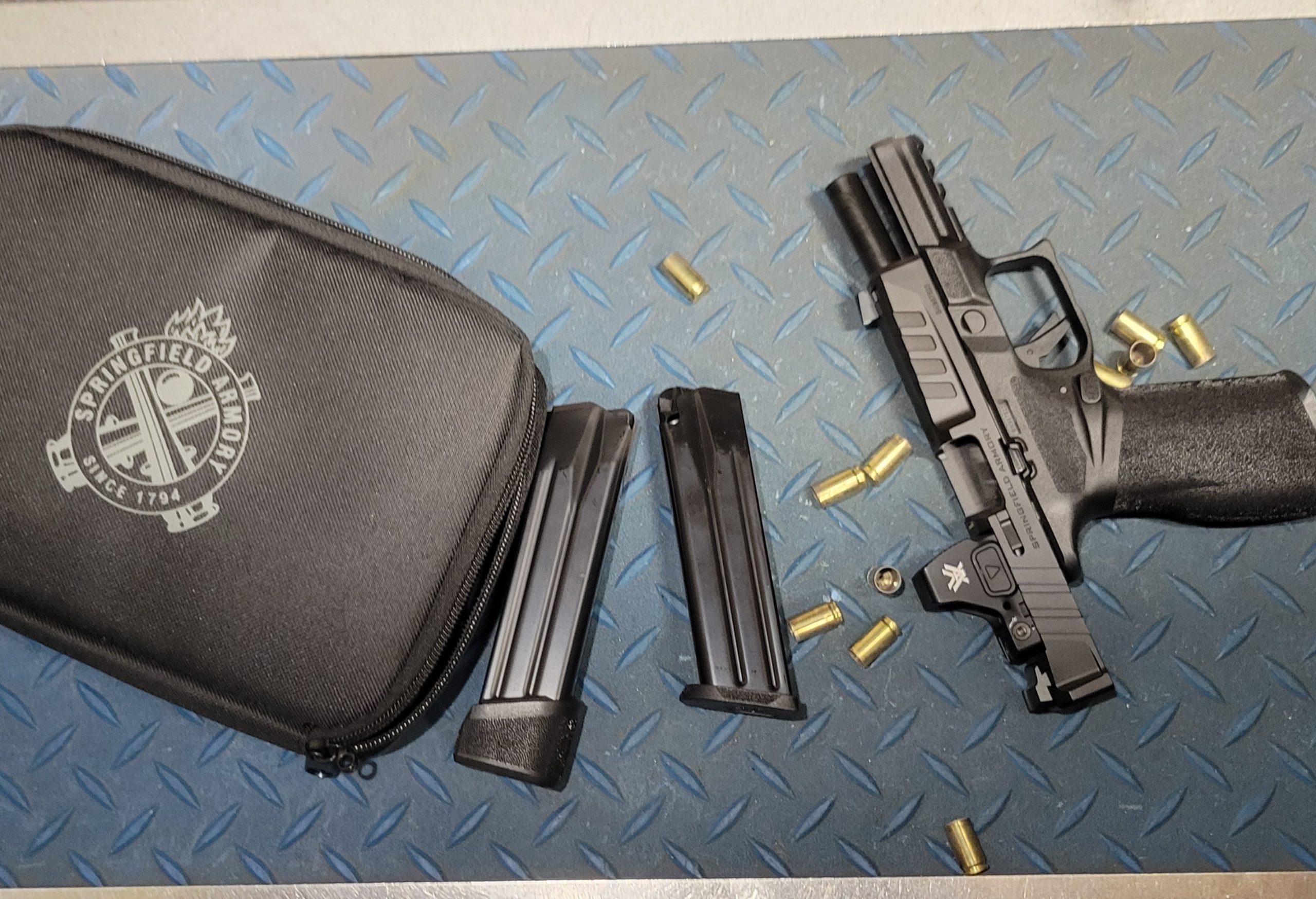
Here’s the bottom line: over 2,127 rounds, we experienced exactly three malfunctions — all of which were ammunition-related, not gun-related. In our testing, the Springfield Armory Echelon achieved a 99.86% reliability rate across 2,127 rounds and eight different ammunition types.
Malfunction log:
- Failure to fire (light primer strike) — Round 847, Winchester white box 115gr. Fired on second strike.
- Failure to fire (light primer strike) — Round 1,203, same Winchester ammo. Fired on second strike.
- Failure to eject (stovepipe) — Round 1,891, dirty gun, Remington UMC 115gr. Cleared immediately, no issues with the ejection port.
For context, most manufacturers consider 99% acceptable for duty use. The Echelon exceeds that standard.
| Load | Rounds | Malfunctions |
|---|---|---|
Federal HST 124gr JHP | 500 | 0 |
Speer Gold Dot 147gr JHP | 200 | 0 |
Federal Syntech 115gr | 600 | 0 |
Winchester NATO 124gr | 300 | 2 light strikes |
Remington UMC 115gr | 300 | 1 stovepipe |
Blazer Brass 115gr | 150 | 0 |
Hornady Critical Defense 115gr | 50 | 0 |
Federal Hydra-Shok Deep 135gr | 27 | 0 |
The Echelon digested everything we fed it, from cheap Remington UMC to premium defensive loads. No ammunition sensitivity, no weird preferences. It just works. For a deeper dive on what feeds best in compact duty pistols, check our best 9mm ammo guide.
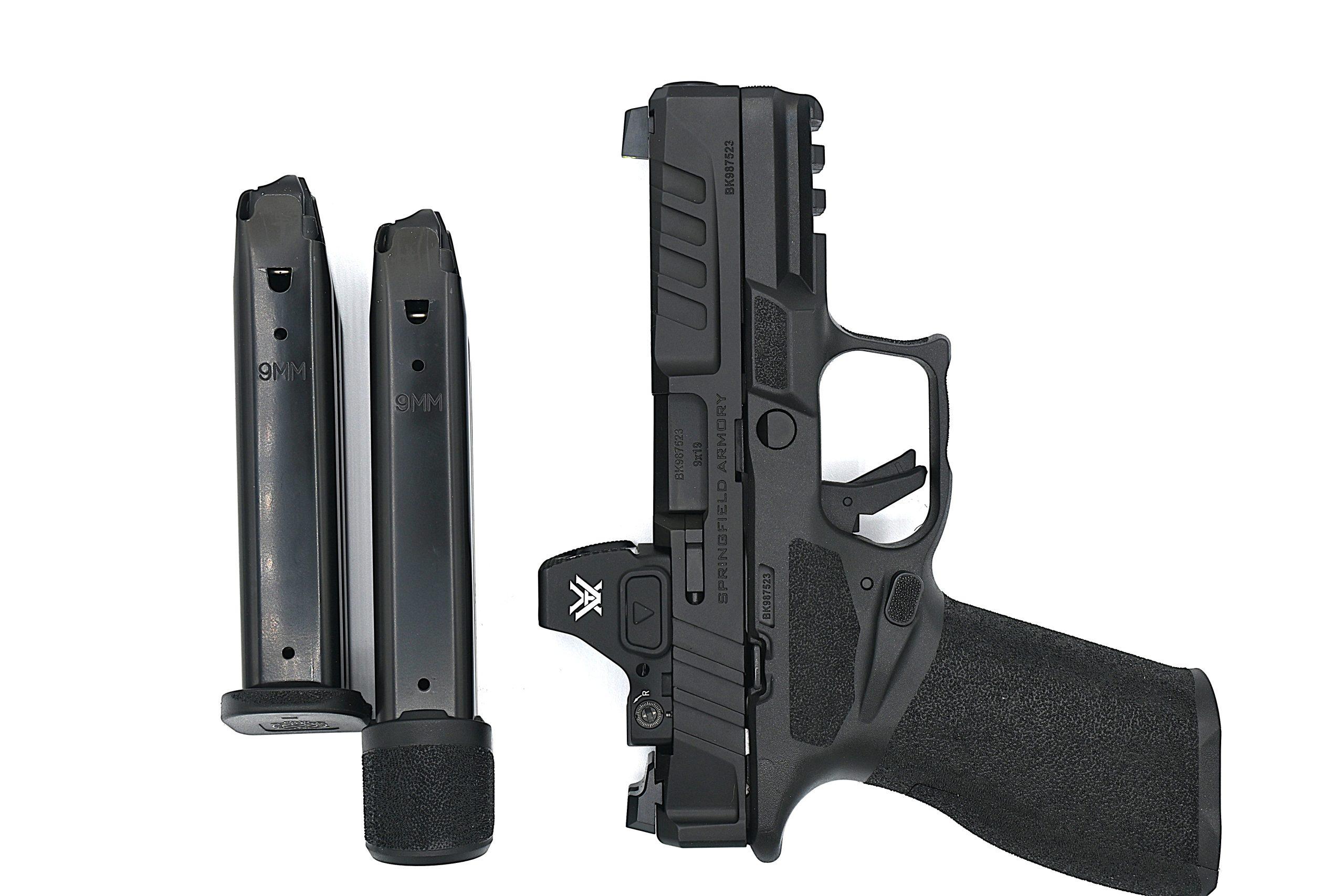
Magazine performance: We tested both 17-round flush-fit and 20-round extended magazines. All fed reliably. The 20-round magazines are steel-bodied with polymer baseplates and feature witness holes. They’re well-made and inspire confidence. The pistol ships with two magazines.
Trigger Analysis
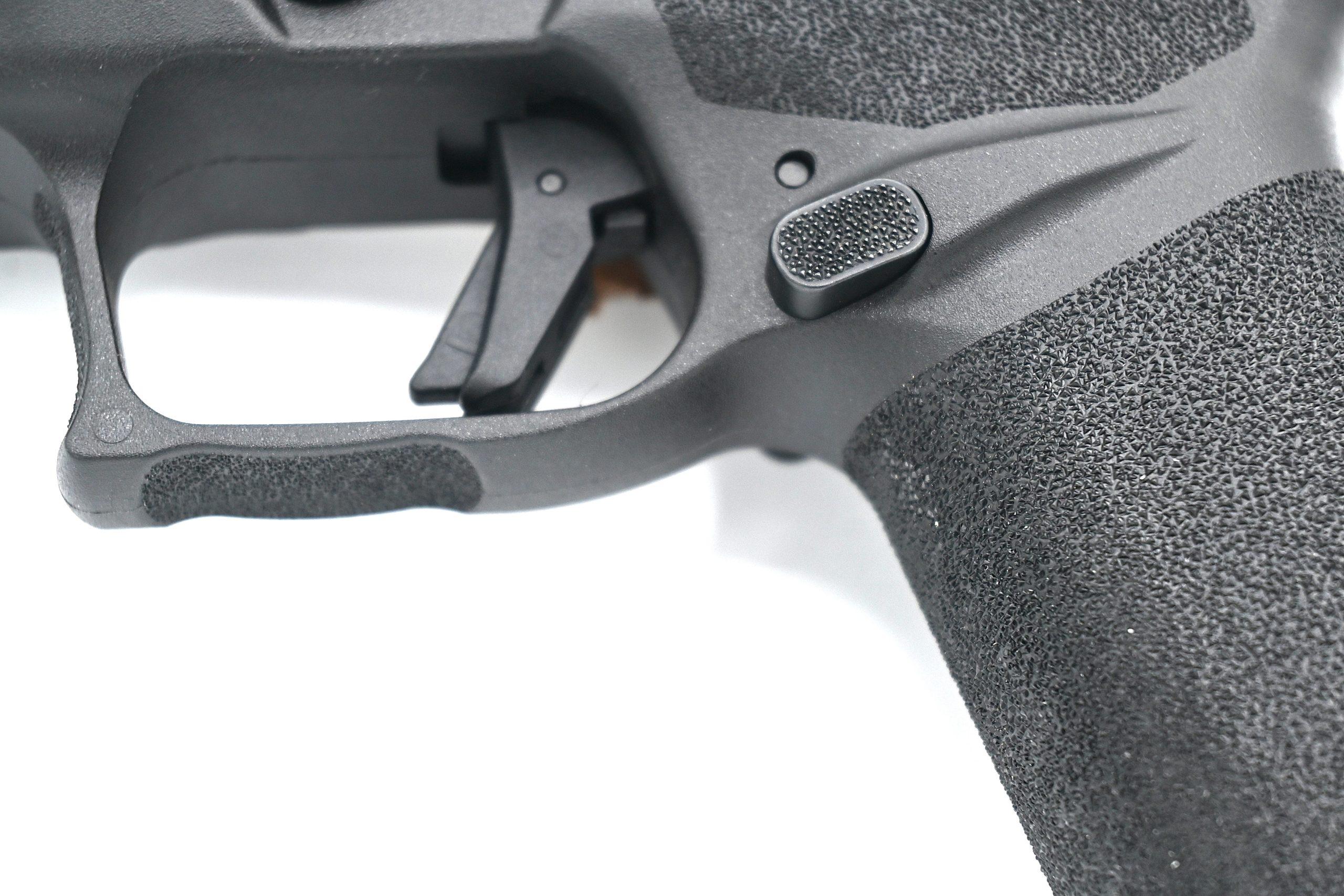
The Springfield Armory Echelon trigger pulls at an average of 5.75 lbs with a short 0.15-inch reset. The factory trigger is good — better than a stock trigger on a Glock or P320, though not quite reaching Walther PDP territory.
Measured characteristics:
- Pull weight: 5.75 lbs average (measured with Wheeler digital gauge)
- Take-up: Approximately 0.25 inches of light pre-travel
- Wall: Distinct but not hard
- Break: Crisp and relatively clean for a striker-fired gun
- Reset: Short (approximately 0.15 inches), tactile, and audible
The trigger face is lightly curved with a blade safety in the center. The safety is unobtrusive and deactivates naturally as your trigger finger presses through the stroke. We never noticed it during shooting.
What impressed us most was consistency. The pull weight varied by less than 2 ounces across twenty measurements, and the break character remained identical from first shot to last. This consistency matters more for accuracy than absolute pull weight.
Upgrade path: Powder River Precision offers a complete trigger kit ($150–180) that drops pull weight to 4.5 pounds and sharpens the break. Apex Tactical also announced they’re developing Echelon triggers for 2025 release.
Recoil & Controllability
The Echelon is exceptionally flat shooting for a polymer frame 9mm pistol. We attribute this to three factors: the ergonomic grip allows a high hold, the gas pedal takedown lever provides forward support-hand pressure, and the bore axis sits reasonably low.
Compared to our Glock 19 Gen 5 shooting the same Federal HST 124gr loads, the Echelon felt noticeably softer. Muzzle flip was reduced by an estimated 10–15%, which translated to faster follow-up shots during rapid-fire drills. Our average split times improved from 0.28 seconds with the Glock to 0.25 seconds with the Echelon.
The SIG P320 was closer, but still slightly more flippy than the Echelon. The Walther PDP remains the flattest shooting of this class we’ve tested, but the Echelon is a close second.
Practical impact: For new shooters, the reduced recoil builds confidence faster. For experienced shooters, it enables faster splits in competition or more accurate rapid fire in defensive scenarios.
Common Problems & Solutions
Let’s address the real-world issues users report. These aren’t deal-breakers, but you should know about them before buying.
Problem 1: Stiff Takedown Lever
Frequency: Very common (most reported issue across forums and reviews)
Cause: Tight manufacturing tolerances, possibly inconsistent across production batches
Our experience: Our test gun required significant force and a small screwdriver for leverage during the first few field strips. After 50+ cycles and generous lubrication, it improved to just be merely stiff rather than prohibitively difficult.
Solutions:
- Apply gun oil liberally to the lever pivot point
- Work the lever back and forth 50–100 times (magazine out, slide locked back)
- Use a small flathead screwdriver or punch in the lever’s textured grooves for leverage
- If it doesn’t improve after break-in, contact Springfield customer service
Important reminder: The lever will not rotate unless the magazine is removed AND the slide is locked back. This isn’t a defect — it’s a safety feature to prevent accidental disassembly with a loaded gun.
Problem 2: Magazine Loading Difficulty
Frequency: Common with brand-new magazines
Cause: Very strong magazine spring tension and a unique follower design that can tilt when loading
Our experience: The last 3–4 rounds in a 17-round magazine were difficult to load by hand. Using a mag loader helped significantly.
Solutions:
- Load to 15 rounds initially in 17-round magazines until springs break in
- Use an UpLULA or similar magazine loader (applies pressure evenly)
- Keep magazines loaded for 2–3 weeks to help break in the springs
- When hand-loading, push cartridges all the way to the rear of the magazine
After break-in (200–300 rounds), most users report loading becomes much easier. This is normal for new magazines with strong springs.
Problem 3: Slide Lock Not Engaging
Frequency: Uncommon (grip-dependent)
Cause: Shooter’s thumb riding the slide release during firing
Our experience: With our natural grip, we occasionally prevented slide lock on empty. Adjusting our firing-hand thumb position solved it completely.
Solutions:
- Check your firing-hand thumb position — ensure it’s not pressing down on the slide release
- The slide release sits lower than on a Glock; adjust your grip accordingly
- During dry fire practice, verify the slide locks back on empty magazines
This is technique-related, not a gun defect. Once you’re aware of it, the adjustment is simple.
Problem 4: Baseplate Issues (Early Production Only)
Frequency: Rare (early production only, largely resolved)
Cause: Manufacturing defect in some early magazine baseplates
Solutions: If your baseplate detaches during magazine insertion, contact Springfield immediately. Springfield will replace defective magazines under warranty. This issue was documented in some early YouTube reviews but appears largely resolved in current production.
Problem 5: Missing/Incorrect Backstraps
Frequency: Rare QC issue
Solution: Call Springfield customer service. They’ll ship replacement backstraps free of charge. Note: The backstrap size numbers (1, 2, 3) are printed on the bottom edge, not the back face. Size markings are S, M, L.
Comparing the Echelon Variants
Springfield now offers four main Echelon variants. Here’s how they stack up and which makes sense for different applications.
Full Size Echelon 4.0FC (This Review)
- Barrel: 4 inches
- Capacity: 17+1 (20+1 with extended magazine)
- Weight: 24 oz unloaded
- MSRP: $710 (street price $599–650)
The full size Echelon offers maximum sight radius, capacity, and shootability. It’s the most versatile option and our top recommendation for duty use, home defense, and range training.
Compact Echelon 4.0C
- Barrel: 4.0 inches
- Capacity: 15+1 (18+1 with extended magazine)
- Weight: 22.1 oz unloaded
- MSRP: $679
The compact Echelon is 0.5 inches shorter overall (7.5 inches total), features a shorter grip frame for better concealment, and uses the same VIS optic system and COG chassis as the full-size model. The compact version is the better choice for dedicated concealed carry, giving up very little in shootability while improving concealability significantly. If you want a full-size compact pistol that still carries well, this is it.
Echelon Comp 4.5F
- Barrel: 4.5 inches with integral compensator ports
- Capacity: 17+1 (20+1 extended)
- Weight: 24.5 oz unloaded
- MSRP: $749
The comp version delivers measurably flatter shooting — user reports indicate 0.02–0.03 second improvements in split times. Worth the $70 premium if you compete or just want the flattest-shooting Springfield Echelon available.
Manual Safety Models
Springfield offers both the full-size and compact with an optional frame-mounted thumb safety, positioned similarly to a 1911. The safety is positive and easy to operate. MSRP is identical to non-safety models — a pure preference decision.
Quick Reference: Which Echelon Model Should You Buy?
| Use Case | Best Echelon Model | Reason |
|---|---|---|
Duty / Law Enforcement | Echelon 4.0FC | Maximum capacity full sight radius compatibility with all duty holsters |
Concealed Carry (primary) | Compact Echelon 4.0C | Shorter grip 15+1 capacity same VIS and COG |
Home Defense | Echelon 4.0FC | Capacity light rail red dot flexibility |
USPSA Carry Optics | Echelon 4.5F Comp | Integral compensator reduces split times |
New Shooter / All-Purpose | Echelon 4.0FC | Best balance of features ergonomics and shootability |
Small Hands | Compact Echelon 4.0C (small frame) | Shorter grip modularity for fit adjustment |
Left-Handed | Either 4.0FC or 4.0C | Both feature reversible controls |
Echelon vs. The Competition
| Spec | Echelon 4.0FC | Glock 19 Gen5 | SIG P320 M18 | Walther PDP F | HK VP9 |
|---|---|---|---|---|---|
Overall Length | 7.25 in | 7.36 in | 7.2 in | 7.1 in | 7.34 in |
Barrel Length | 4.0 in | 4.02 in | 3.9 in | 4.0 in | 4.09 in |
Weight (empty) | 24.0 oz | 23.6 oz | 25.1 oz | 25.6 oz | 25.6 oz |
Capacity | 17+1 | 15+1 | 17+1 | 15+1 | 17+1 |
MSRP | $710 | $599 | $679 | $699 | $849 |
Modular Chassis | Yes (COG) | No | Yes (FCU) | No | No |
Direct Optic Mount | Yes (VIS) | MOS (plates) | Plate system | Plate system | Plate system |
Street Price | $599–650 | $520–580 | $600–700 | $640–720 | $780–850 |
Prices as of Q1 2026. Verify current pricing before purchase.
Echelon vs. Glock 19
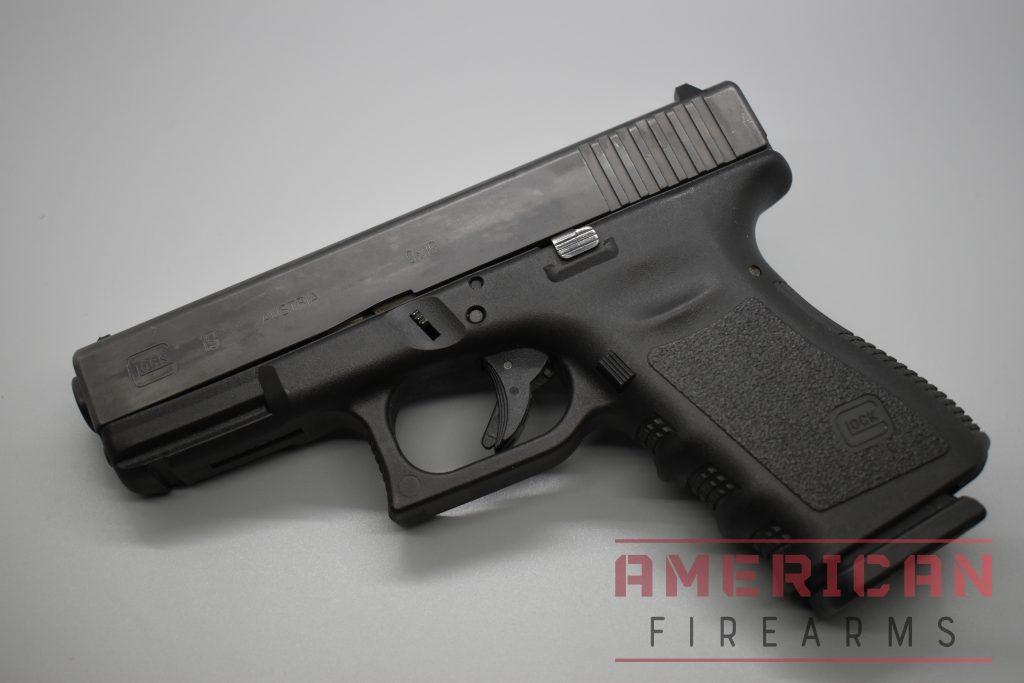
The Glock 19 is the 800-pound gorilla of this market segment — and for good reason. It works, parts are everywhere, holsters are universal, and everyone knows how to shoot one. Our guide to the best Glock handguns covers the full lineup if you’re cross-shopping.
How they compare:
| Category | Our Pick |
|---|---|
Ergonomics | Echelon (more rounded grip better texturing superior undercut) |
Trigger | Echelon (cleaner break shorter reset vs. stock trigger on Glock) |
Reliability | Tie |
Accuracy | Slight edge to Echelon |
Red dot mounting | Echelon (VIS is decisively better) |
Aftermarket support | Glock by a landslide |
Price | Similar ($600–650 range) |
The verdict: If you already own Glock holsters and accessories, the G19 makes logistical sense. If you’re starting fresh and prioritize ergonomics and red dot mounting, the Echelon is the better gun.
Echelon vs. SIG P320
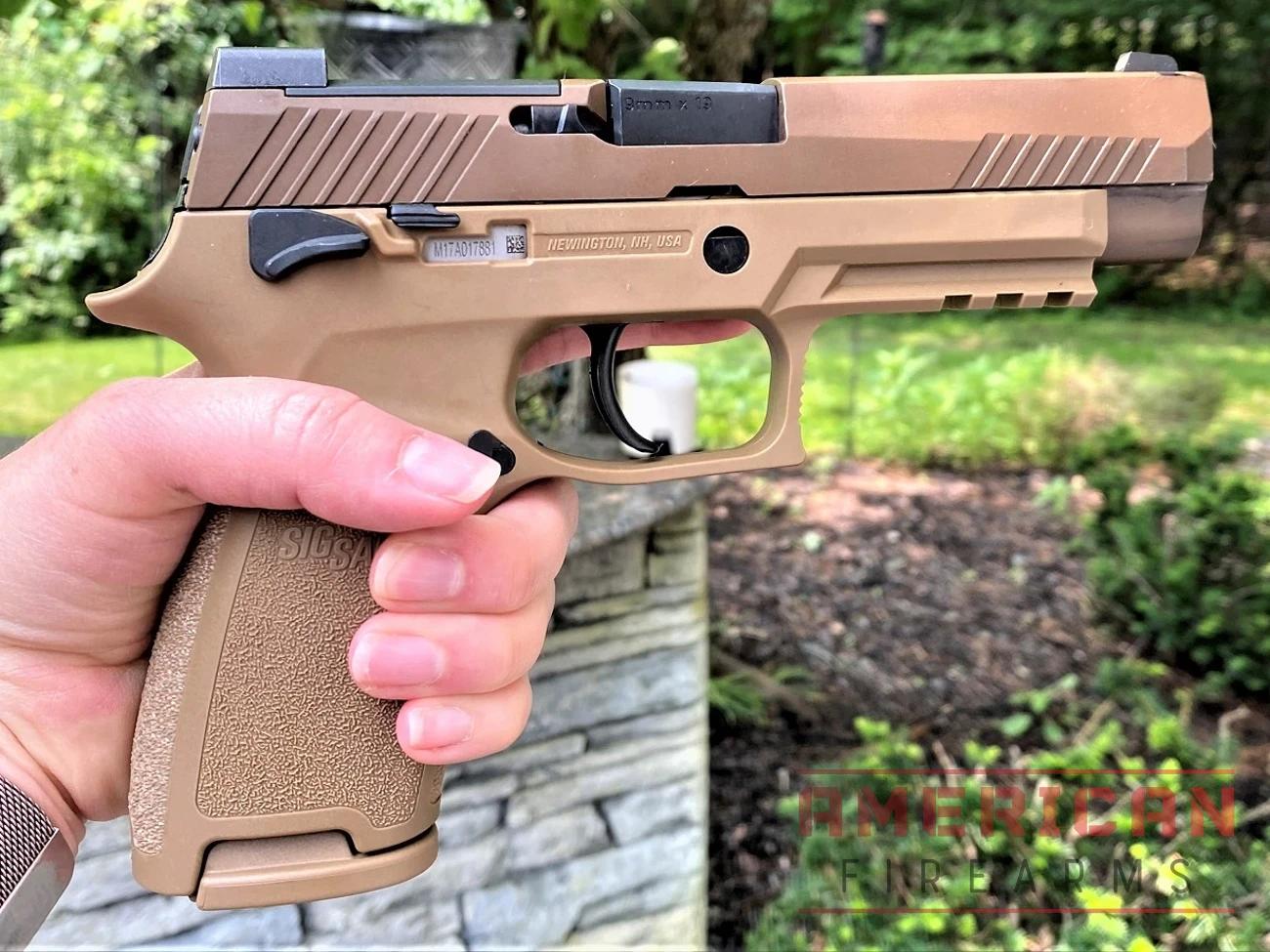
The SIG P320 pioneered the modular chassis concept that the Echelon uses. These guns share more DNA than the Echelon shares with any other competitor.
The rest of the Defender is pretty standard, and I don’t mean that as a knock against it. For a CCW-type handgun perhaps simplicity is a bonus.
| Category | Our Pick |
|---|---|
Modularity | Tie |
Ergonomics | Echelon (better grip texture and undercut) |
Trigger | P320 X-series excellent; stock P320 mediocre. Echelon splits the difference |
Safety | Echelon (double-sear system vs. P320's troubled safety record) |
Red dot mounting | Echelon (VIS beats plate system) |
Aftermarket | P320 has more currently; Echelon growing |
The verdict: The Echelon is essentially an improved P320 with better ergonomics, superior optic mounting, and enhanced drop safety. If choosing between these two, we’d take the Echelon.
If you already own a P320, check out SIG P320 upgrades before making any moves.
Echelon vs. Walther PDP
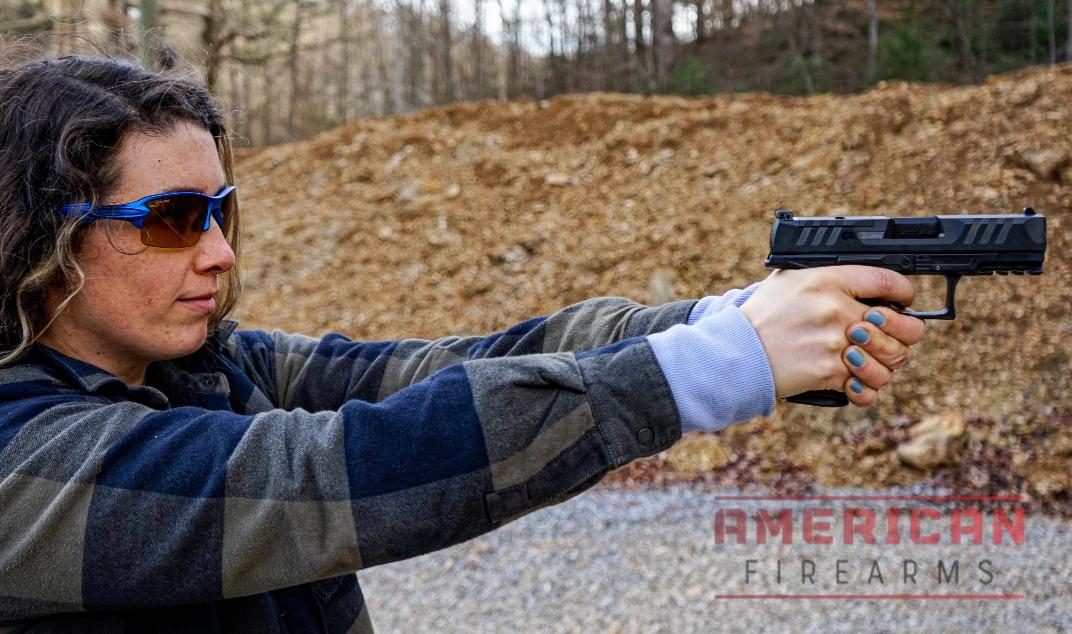
The Walther PDP is the dark horse that surprised everyone with exceptional ergonomics and trigger quality.
| Category | Our Pick |
|---|---|
Ergonomics | PDP (slightly better grip angle and palm swell) |
Trigger | PDP (best striker-fired trigger available) |
Modularity | Echelon (PDP isn't modular) |
Red dot mounting | Echelon (VIS beats plate system) |
Recoil control | PDP slightly flatter |
Price | Comparable ($650–750) |
The verdict: The PDP is the better pure shooter out of the box. The Echelon offers superior modularity and optic mounting. Choose based on whether you value modularity (Echelon) or the absolute best trigger (PDP).
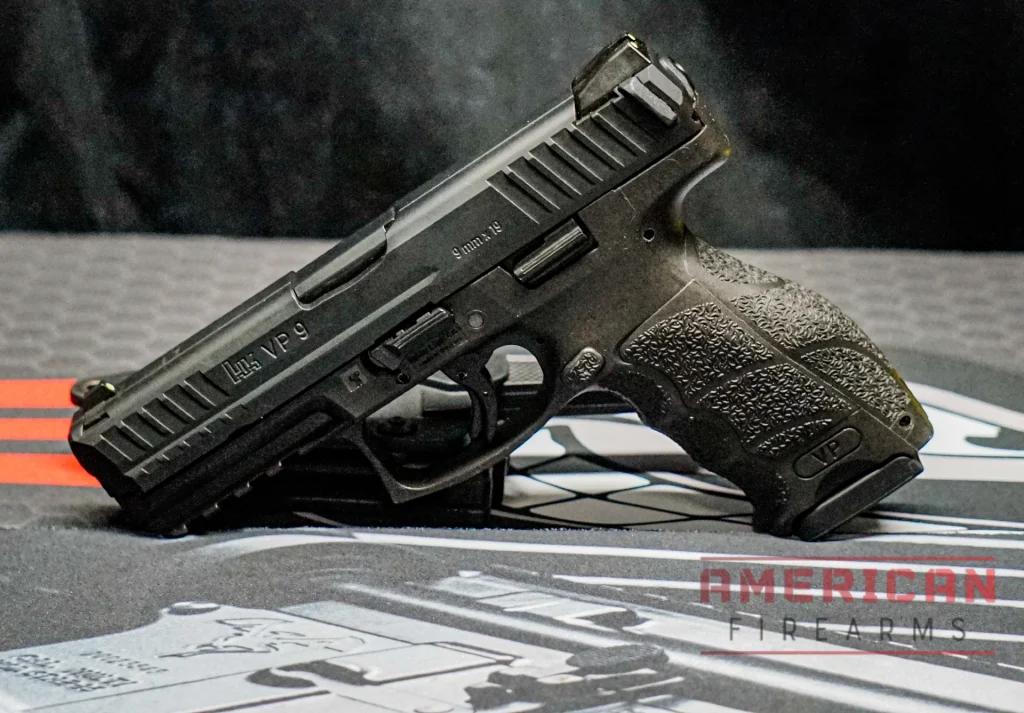
Echelon vs. HK VP9
The HK VP9 represents German engineering and premium build quality at a premium price.
| Category | Our Pick |
|---|---|
Build quality | VP9 (tighter tolerances) |
Ergonomics | Personal preference determines winner |
Trigger | VP9 |
Red dot mounting | Echelon (VIS destroys VP9's plate system) |
Capacity | Tie at 17+1 (Echelon offers 20-round option) |
Price | VP9 significantly more ($800–900) |
The verdict: The VP9 is definitely the more refined gun, but you’re paying $200–300 extra for incremental improvements. The Echelon delivers 90% of the VP9’s quality at 65% of the price.
Echelon vs. Springfield Hellcat Pro
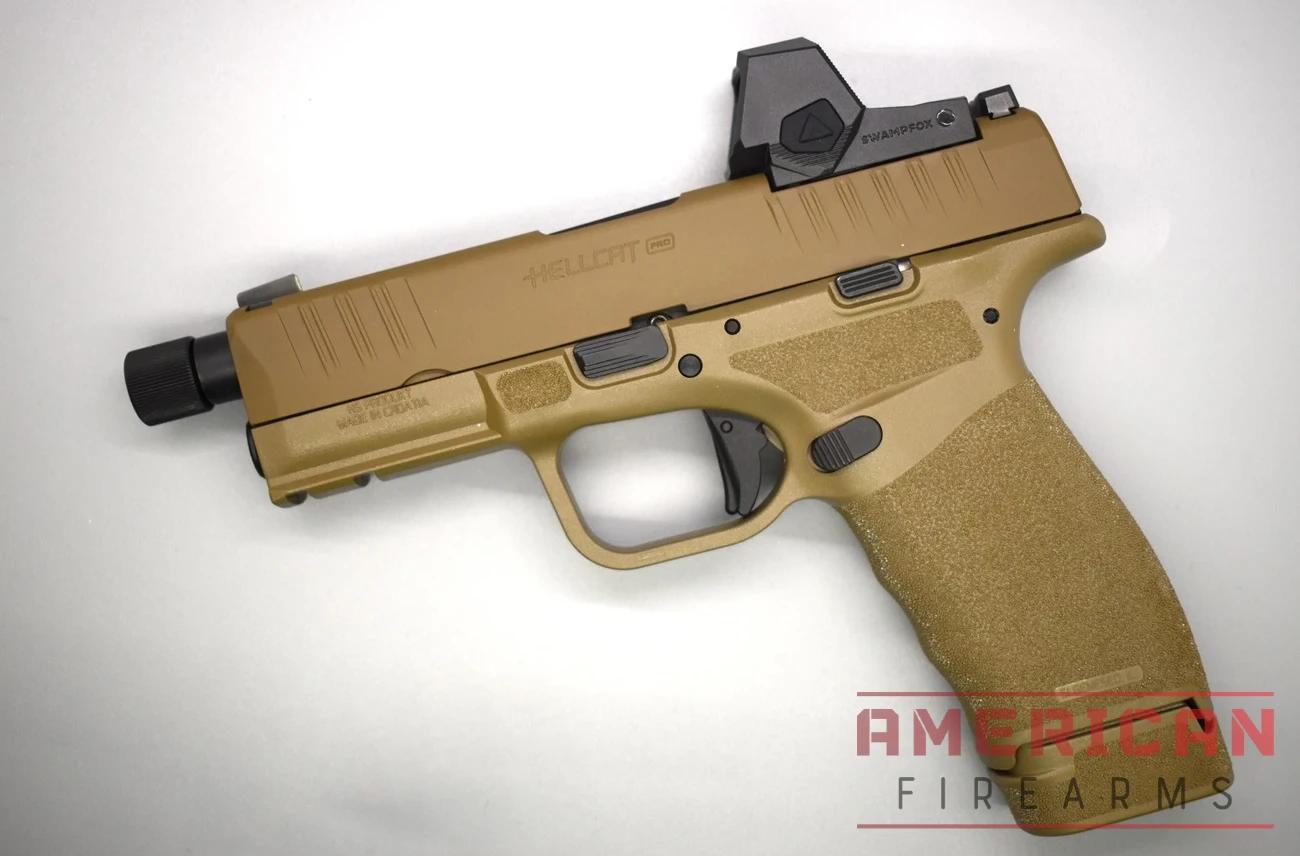
The Springfield Hellcat Pro and the Echelon share a manufacturer but serve different missions. The Hellcat Pro is a compact carry gun at 7.1 inches overall and 24 oz, optimized for concealed carry with a 15+1 capacity.
The full size Echelon 4.0FC is a duty-sized pistol prioritizing capacity (17+1), ergonomics, and the VIS optics system. If concealment is the primary goal, the Hellcat Pro wins. If you want a full-featured duty or home defense gun with best-in-class red dot mounting, the Echelon is the better platform. The COG chassis and VIS system don’t appear in the Hellcat line.
| Category | Our Pick |
|---|---|
Concealability | Hellcat Pro (0.65 inches shorter / 3 oz lighter/ 0.2 inches thinner) |
Capacity | Echelon (17+1 flush and 20+1 extended vs. 15+1 and 17+1) |
Red dot mounting | Echelon (VIS supports 30+ optics vs. Springfield Micro footprint's narrower list) |
Modularity | Echelon (COG chassis allows grip swaps; Hellcat Pro has no equivalent) |
Trigger | Echelon (5.75 lbs with shorter reset vs. ~6.5 lbs on the Hellcat Pro) |
Recoil control | Echelon (heavier slide and ergonomic grip geometry shoot flatter) |
Carry comfort | Hellcat Pro (slimmer / lighter / purpose-built for IWB) |
Price | Hellcat Pro ($499–549 street vs. $599–650 for the Echelon as of Q1 2026) |
The verdict: If concealed carry is the primary mission, the Hellcat Pro is the right choice — purpose-built for the task and $100 cheaper. If you want a full-featured duty or home defense pistol with best-in-class optics mounting and long-term platform flexibility, the Echelon 4.0FC wins on nearly every performance metric.
Buyers caught in the middle should look hard at the compact Echelon 4.0C, which closes the size gap considerably while keeping the VIS system and COG chassis.
Accessories & Upgrades
The Echelon’s aftermarket is growing rapidly. Here’s what’s available and what’s actually worth buying.
Essential Accessories
Magazines
OEM magazines are well-made and reasonably priced. 17-round flush-fit mags run $35–40, while 20-round extended magazines cost $40–45. We recommend having at least five total magazines for training.
Holsters
Springfield partnered with eight manufacturers at launch: Safariland (duty), CrossBreed (IWB), DeSantis (OWB/IWB), Comp-Tac (competition), QVO Tactical (appendix), N8 Tactical, Crucial Concealment, and Alien Gear.
See our full guide to the best concealed carry holsters for a broader look at carry options.
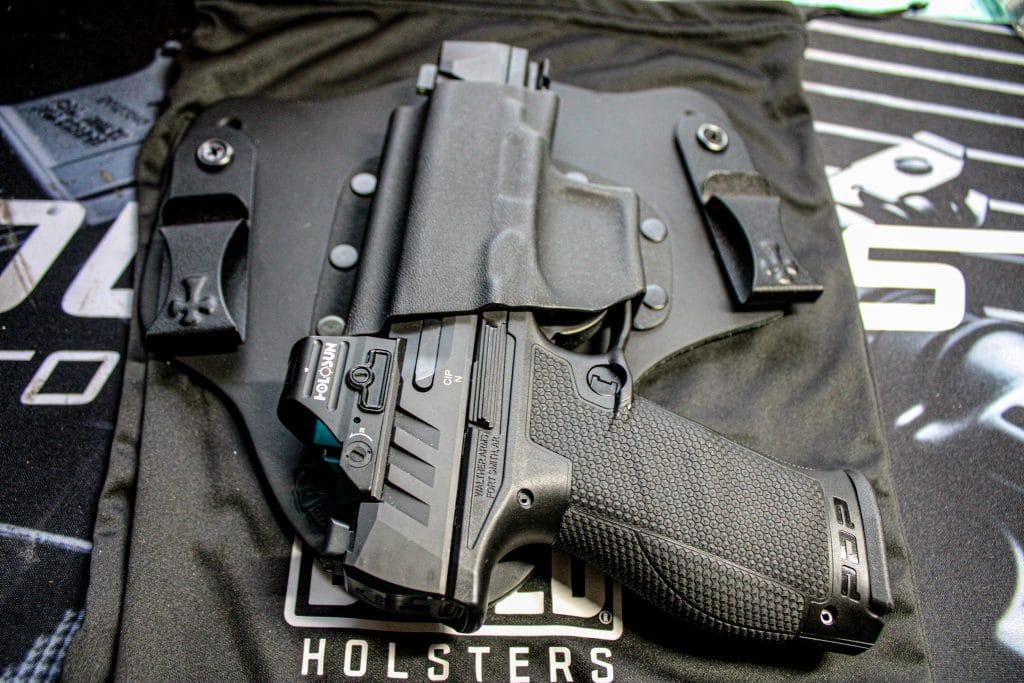
Our recommendations:
- Duty/OWB: Safariland 7TS ALS ($90–120) — Level II retention, proven reliability
- Appendix IWB: QVO Tactical Wingman ($75–90) — Excellent comfort and concealment
- Competition: Comp-Tac International ($75–95) — Fast draw, adjustable retention
Weapon Lights
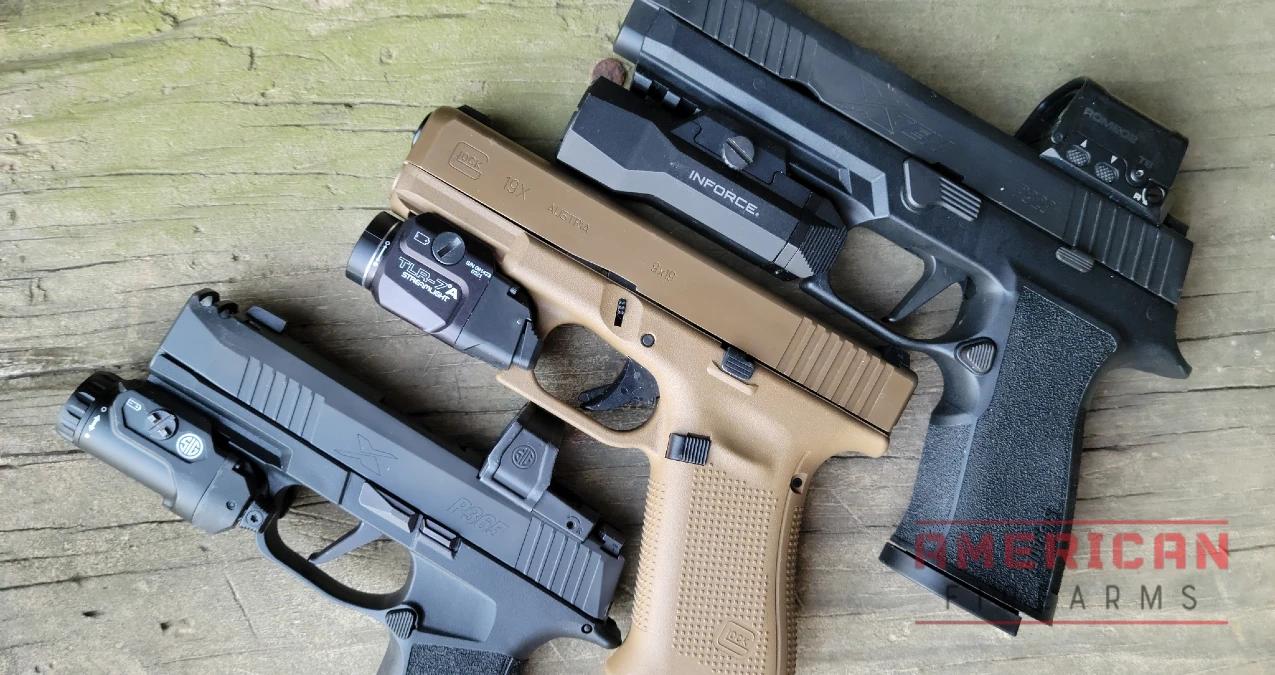
The Echelon’s rail accommodates all standard pistol lights. For a comprehensive breakdown, see our guide to the best pistol lights. We tested three during this review:
- Surefire X300U-A ($270–300) — 1,000 lumens, bombproof
- Streamlight TLR-1 HL ($130–150) — 1,000 lumens, best value
- Olight PL-Pro Valkyrie ($100–120) — 1,500 lumens, budget option
All three fit perfectly and didn’t affect holster compatibility significantly.
Popular Upgrades
Triggers
- Powder River Precision Enhanced Trigger Kit ($150–180) — Drops pull to 4.5 lbs, crisper break
- Apex Tactical Echelon Trigger ($180–200) — Highly anticipated based on their excellent P320 work
Sights
- Trijicon HD XR ($150–170) — Larger front sight, faster rear sight acquisition
- Ameriglo Hackathorn ($100–120) — Excellent value, big front dot
- Dawson Precision Fiber Optic ($80–100) — Competition-focused, very fast
Magazine Extensions
- Taylor Freelance +5 Brass Basepad ($50–60) — Adds weight and capacity
- Springer Precision +2 Aluminum ($40–50) — Minimal length increase
Backstrap Options
Springfield sells individual backstraps ($15–20 each) if you want spares or different textures. Some users sand or stipple their backstraps for custom grip feel.
Recommended Ammunition
Based on our testing, here are the loads that performed best:
Defensive: Federal HST 124gr (best overall performance, consistent expansion), Speer Gold Dot 147gr (deep penetration, reliable), Federal Hydra-Shok Deep 135gr (excellent barrier performance).
Practice: Federal Syntech 115gr (clean-burning, accurate), Blazer Brass 115gr (best value, reliable), Winchester NATO 124gr (good practice for defensive loads, similar recoil).
Avoid cheap steel-cased ammo. While the Echelon will run it, steel cases can accelerate extractor wear.
Real-World Carry Experience
We carried the Springfield Armory Echelon daily for three months in various configurations. Here’s what we learned.
Concealed Carry Performance
IWB Appendix: The full size Springfield Armory Echelon is carryable appendix, but it’s not ideal. At 8 inches overall length, it can print when sitting or bending. Shooters over 6 feet or with athletic builds will have better luck than shorter or heavier carriers.
The grip length (not barrel length) drives concealability. The 17-round magazine creates a grip that’s long enough to show. The compact Echelon 4.0C would be a better choice for dedicated concealed carry. If you’re still weighing your options, our best concealed carry guns guide covers the full spectrum of carry-optimized handguns.
IWB 3–4 O’Clock: Much more comfortable than appendix. The QVO Wingman holster with a wedge distributed weight well and kept the gun tucked close. After a week-long break-in period, we could comfortably carry for 8–10 hours.
OWB: Outstanding. The Safariland 7TS provided excellent retention and rode at a natural draw angle. This is the Echelon’s sweet spot for open carry or duty use.
Weight & Comfort
At 23.9 oz unloaded (31 oz loaded with 18 rounds), the Echelon is middle-of-the-pack for full-size 9mm pistols.
It’s lighter than a Beretta 92 (33 oz) but heavier than a Glock 19 (30 oz loaded). During extended carry, the weight became noticeable around hour 6–7 of continuous wear. A good gun belt is essential.
Duty/Law Enforcement Use
The St. Louis County PD’s $2.1 million contract validates the Echelon for duty use. Based on our testing, we understand why: 99.86% reliability over 2,127 rounds, 17+1 standard capacity, an optics mounting system that simplifies department-wide red dot adoption, a chassis system that accommodates multiple hand sizes, and a double-sear safety system that provides redundancy.
For departments considering a switch from Glock or SIG, the Springfield Armory Echelon deserves serious evaluation.
Competition Applications
We shot two USPSA matches and one IDPA match with the Echelon during testing.
USPSA Carry Optics: The Echelon is competitive here. The VIS-mounted Vortex Defender stayed rock-solid through 400+ rounds of match shooting. Our times were within 3–5% of dedicated race guns costing twice as much. The stock trigger is adequate for competitive shooting but a PRP upgrade would sharpen things up.
IDPA SSP: Works well in Stock Service Pistol division. The Echelon’s ergonomics provide an edge over blocky Glocks, and the 17+1 magazine capacity ensures you’re never short on rounds.
Maintenance & Care
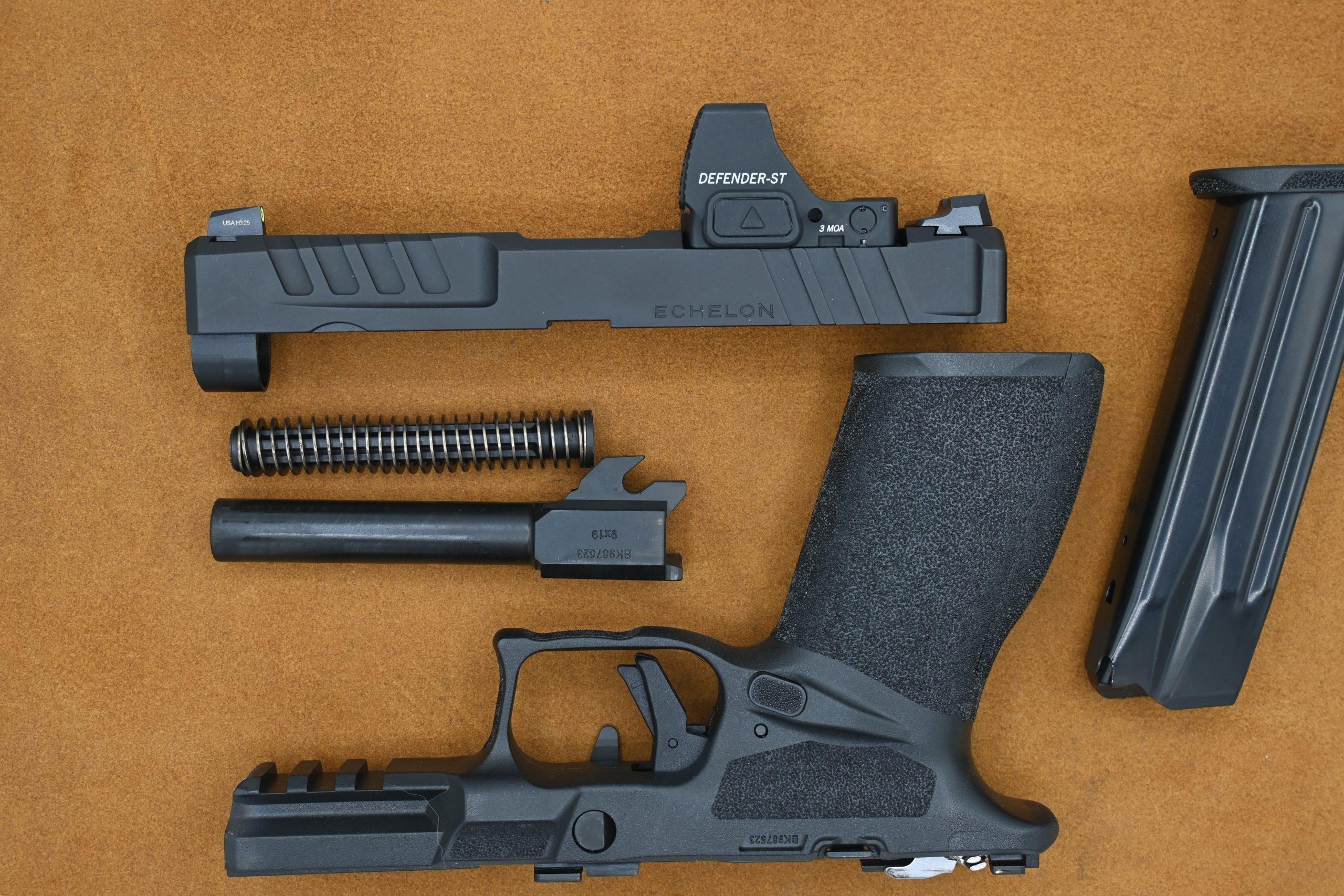
The Echelon is easy to maintain, though not quite as simple as a Glock.
Field Stripping
- Remove magazine and verify the gun is unloaded
- Lock slide to the rear
- Rotate takedown lever 90 degrees (this will be stiff initially)
- Ease slide forward and off the frame
- Remove guide rod and recoil spring assembly
- Remove barrel from the slide forward
Reassembly is the reverse. The stiff takedown lever improves with use and lubrication.
Cleaning Schedule
- After each range session: Basic cleaning (barrel, chamber, rails)
- Every 500 rounds: Detailed cleaning including disassembly and inspection
- Every 2,000 rounds: Consider detail strip for deep cleaning (or send to a gunsmith)
Lubrication Points
Focus on: barrel hood and locking surfaces, frame rails and slide rails, trigger bar contact points, takedown lever pivot (especially important early on). We used Slip 2000 EWL throughout testing. A single drop at each point is sufficient — don’t over-lubricate.
Parts Replacement
Springfield recommends replacing the recoil spring every 5,000 rounds ($15–20). The extractor and firing pin spring should be inspected at 10,000 rounds and replaced if showing wear.
Pricing & Value
What You’re Paying For
MSRP: $679 | Street Price: $599–650
At $625 average street price, the Echelon competes directly with the Glock 19 Gen 5 MOS ($600–650), SIG P320 M18 ($600–700), Walther PDP Compact ($650–750), and CZ P-10 C Optics Ready ($550–600).
Value Proposition
What you get for $625: Innovative VIS optics mounting superior to adapter plates, a modular chassis system allowing grip swaps for $80 instead of a new gun, 17+1 capacity standard with 20+1 available, excellent ergonomics, proven reliability, and law enforcement validation.
What you don’t get: Extensive aftermarket support (yet), decades of proven field history, universal holster compatibility, or a competition-grade trigger out of the box.
Is it worth it?
Yes, if you value ergonomics, plan to run a red dot, want modularity, or want to support genuine innovation over established platforms. No, if you need maximum aftermarket support now, already own a large Glock or P320 ecosystem, or are strictly budget-constrained. Budget buyers should know that Canik offers similar features for $400–450 — see our best Canik pistols guide.
Long-Term Value
The modular chassis adds long-term value. For $80, you can completely change the gun’s grip size rather than buying a new pistol. If Springfield releases additional frame options, you can upgrade without replacing the entire gun — compare that to the Glock ecosystem, where moving from a G19 to a G17 or G26 means buying a whole new firearm.
Frequently Asked Questions
Is the Springfield Echelon made in the USA?
What are the flaws of the Springfield Echelon?
What is the #1 handgun in the US?
How good is the Echelon?
Is the Springfield Echelon full-size?
What makes the Echelon special compared to other striker-fired pistols?
How does the Echelon compare to the Glock 19?
Can the Echelon use Glock or P320 magazines?
What's the best red dot for the Echelon?
Does the Echelon have a manual safety?
How many rounds does the Echelon hold?
Is the Echelon good for concealed carry?
What's the difference between the Echelon and XD series?
Is it a good home defense option?
Final Thoughts
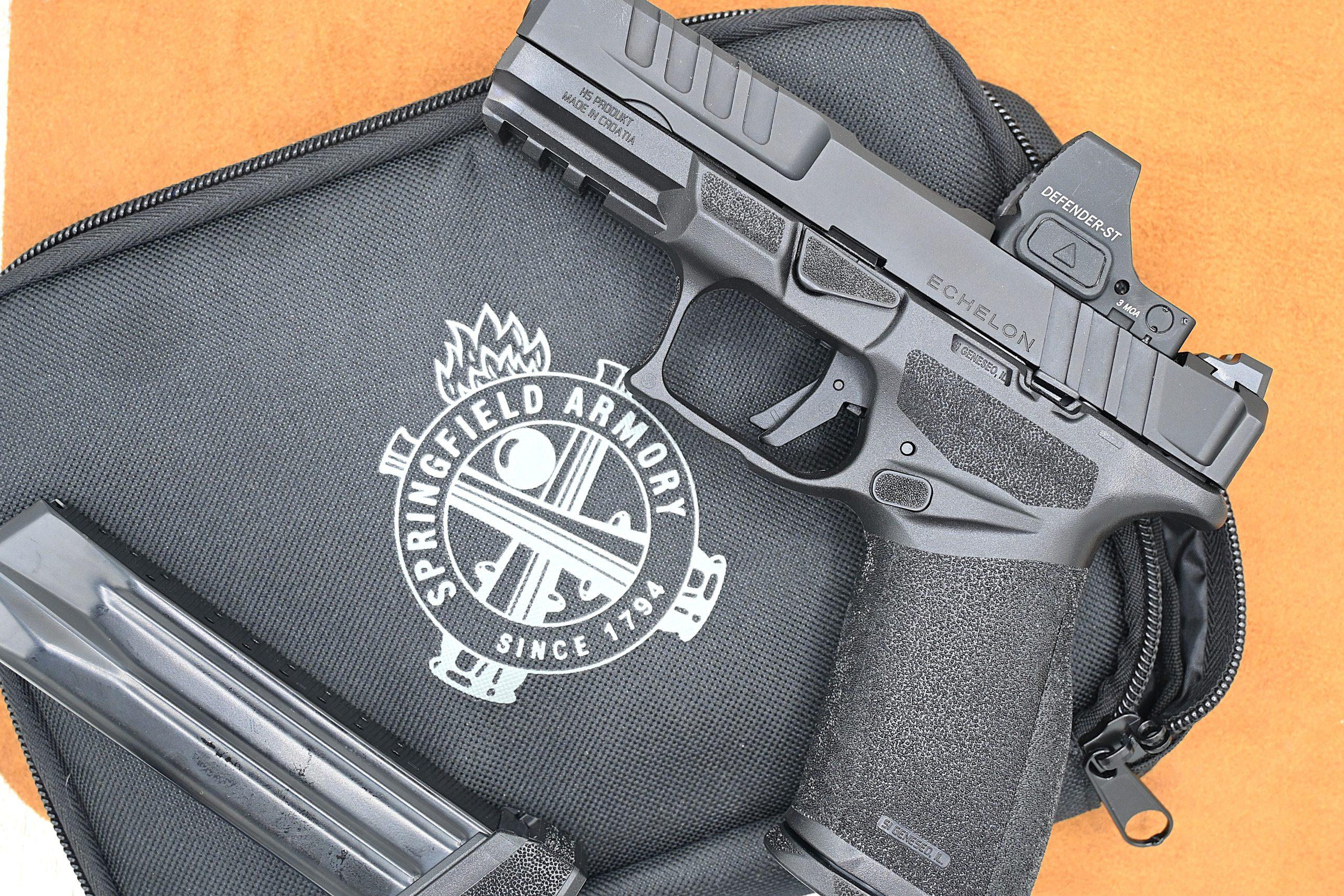
After more than 2,000 rounds, three months of daily carry, and countless hours at the range, the Springfield Armory Echelon earns its place among the top tier of striker-fired duty pistols. It’s not perfect — the takedown lever needs refinement, the price could be $50–$75 lower, and aftermarket support is still catching up — but the fundamentals are rock solid.
The Variable Interface System alone justifies serious consideration if you plan to run a red dot. Combined with the ergonomic grip, reliable performance, and law enforcement validation, the Echelon represents Springfield’s best handgun design in decades. It feels great in the hand, shoots flat, and digests every load you feed it.
If you’re shopping in the $550–650 range for a duty-capable 9mm, the Springfield Echelon deserves a spot on your short list alongside the Glock 19 and SIG P320. For many shooters — especially those prioritizing grip ergonomics and red dot compatibility — it may well be the best choice.
The Echelon proves Springfield Armory can compete at the highest level of the striker-fired market. This isn’t just another Glock clone or a warmed-over XD series pistol. It’s a thoughtful, well-executed handgun that addresses real shooter needs with innovative solutions. HS Produkt and Springfield have built something worth taking seriously.
Our Rating: 8.5/10
| Category | Score |
|---|---|
Accuracy 9/10 | |
Reliability 9/10 | |
Ergonomics 9/10 | |
Features 9/10 | |
Value 7/10 | |
Aftermarket Support 6/10 |
Springfield took its time getting here, but the Echelon was worth the wait. This is the gun the XD series should have been all along — and the gun that finally puts Springfield in legitimate competition with Glock, SIG, and Walther for duty gun supremacy.
Sign up for our newsletter
Get discounts from top brands and our latest reviews!
View by Category

In-Hand Reviews

Firearm News

Featured Comparisons

Firearm & Ammo Reviews

Popular Guides & Stats


Range Gear & Accessories

Gun & Ammo Safes