The Revolver Renaissance Is a Plinker Boom in Disguise
.38 Special revolver production fell 53% in five years. Heritage's .22 Rough Rider now drives a fifth of U.S. revolver output. We mapped what the ATF data actually shows about who's buying revolvers — and why.

Written By
Michael Crites
Licensed Concealed Carry Holder
Reviewed by
Editorial Team
Learn About The Editorial Team
Share:
Products are selected by our editors. We may earn a commission on purchases from a link. How we select gear.
Updated
May 2026
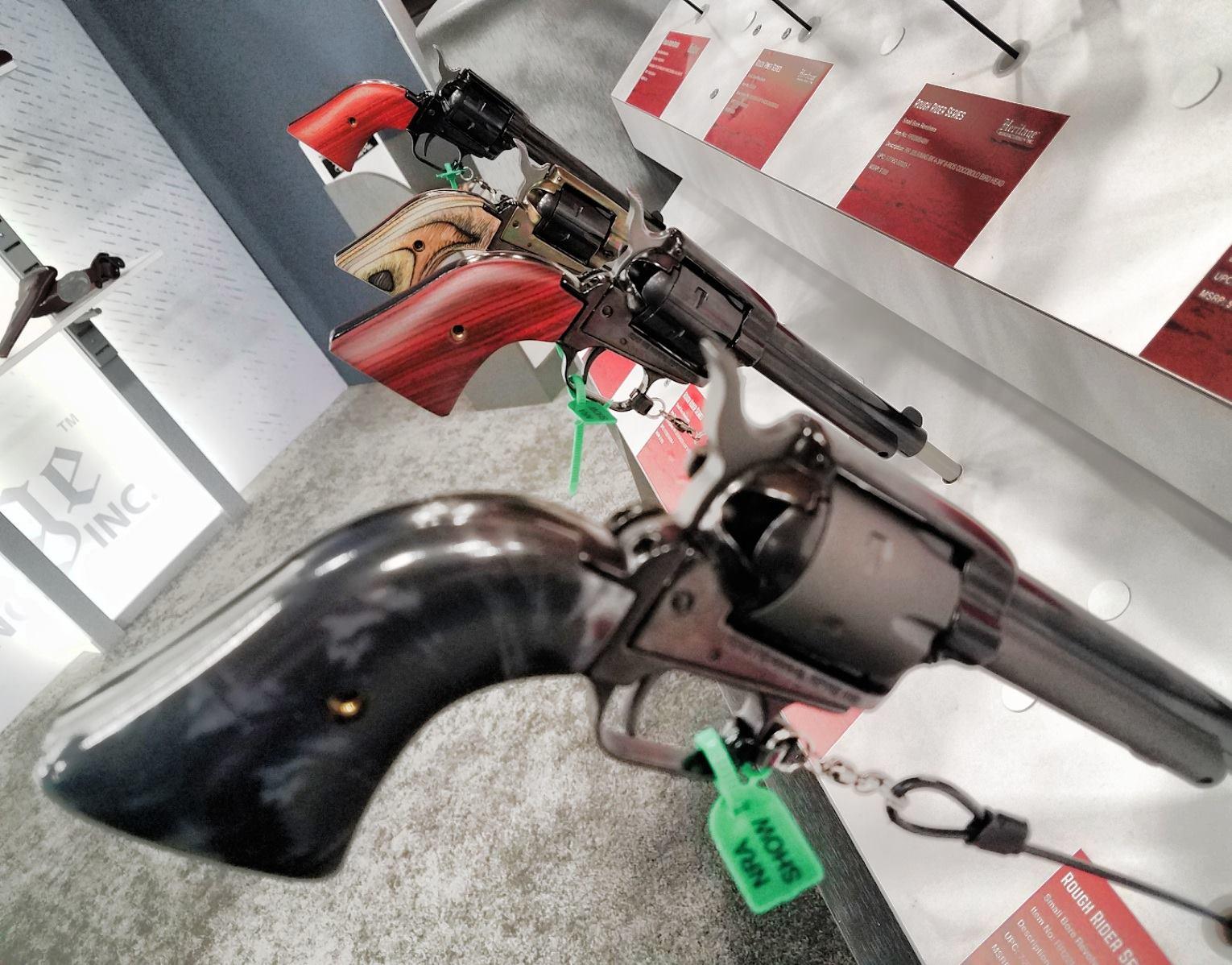
In 2023, Heritage Manufacturing produced 178,743 revolvers at its facility in Bainbridge, Georgia. That is not a typo. A single company made roughly one in every five revolvers manufactured in the United States last year, and virtually every one of them was a .22 rimfire Rough Rider — a single-action, cowboy-style plinker that retails for around $180 and traces its lineage more to Spaghetti Westerns than to serious defensive training.
If you’ve seen one at a range, it was probably in the hands of someone burning through bulk ammo for the fun of it. That’s the point.
Strip out Heritage’s volume from the 2023 ATF Annual Firearms Manufacturing and Export Report and the revolver market looks exactly like what everyone assumed it was: a slow contraction. Keep Heritage in the numbers and the revolver category appears to be growing, which is how it shows up in industry coverage and why gun writers keep running pieces on “the revolver renaissance.”
There is no renaissance. There’s a plinker boom that happens to use a cylinder.
In This Article
What the Numbers Actually Say
The ATF’s 2023 AFMER puts total U.S. revolver production at 805,054 units. That’s up from 664,832 in 2018 — a 21% increase that, at first glance, looks like a category in modest recovery. But the caliber breakdown tells a different story than the headline number.
Of those 805,054 revolvers, 375,749 were chambered in .22 rimfire. That’s 46.7% of total revolver production. In 2018, .22 revolvers represented 40.8% of the category — already the largest single caliber. By 2023, nearly half of every revolver manufactured in the country was a .22. Heritage’s 178,743 units account for 47.5% of that .22 production figure all by themselves.
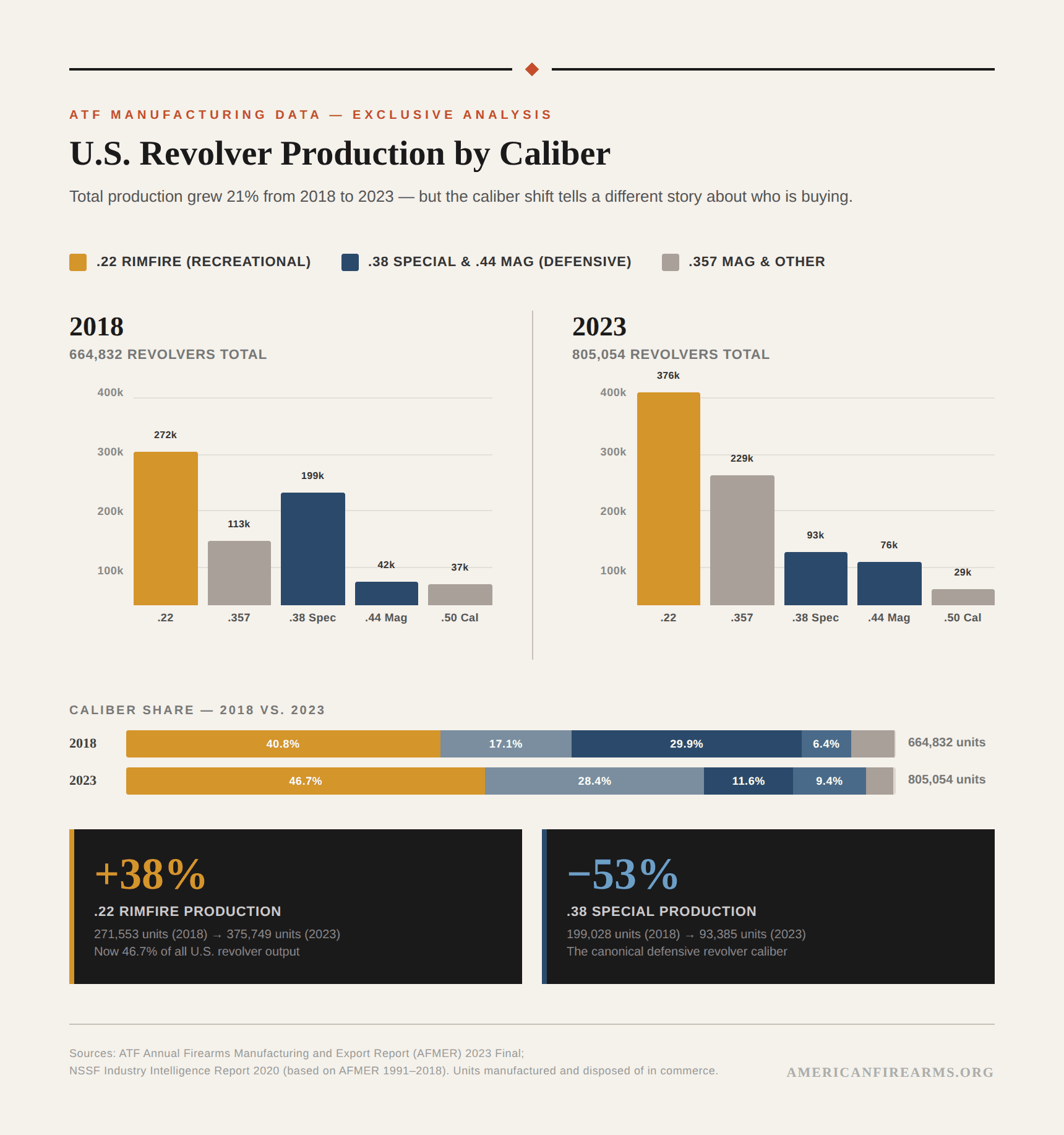
The defensive calibers are moving in the opposite direction. .38 Special — the round that anchored the defensive revolver recommendation for a century, the caliber in the S&W 642 that every gun store employee has handed to a first-time buyer — fell from 199,028 units in 2018 to 93,385 in 2023.
That is a 53% decline in five years. The .38 Special doesn’t have a recreational shooting culture. Nobody builds a Sunday range ritual around .38 Special through a two-inch barrel.
That caliber exists almost entirely for defensive or duty use, which means its production collapse is a direct signal from the market about what buyers are actually buying defensive revolvers for: less of it, by a lot.
The combined defensive-caliber share of revolver production — .38 Special plus .44 Magnum — fell from approximately 36% of the category in 2018 to about 21% in 2023. Meanwhile .22 climbed from 41% to 47%.
These are not rounding errors. They are a category-level shift in use case.
How This Happened
The revolver’s share of the overall handgun market has been in long-term decline since at least the early 1990s. In 1991, revolvers represented roughly 25% of domestic handgun production. By 2018, they’d fallen to 14.8% as pistol production scaled with 9mm defensive carry demand — the Glock effect, the M&P effect, a generation of carry permits and the defensive training culture that followed. The pistol won the defensive handgun argument so decisively that it eventually wasn’t an argument anymore.
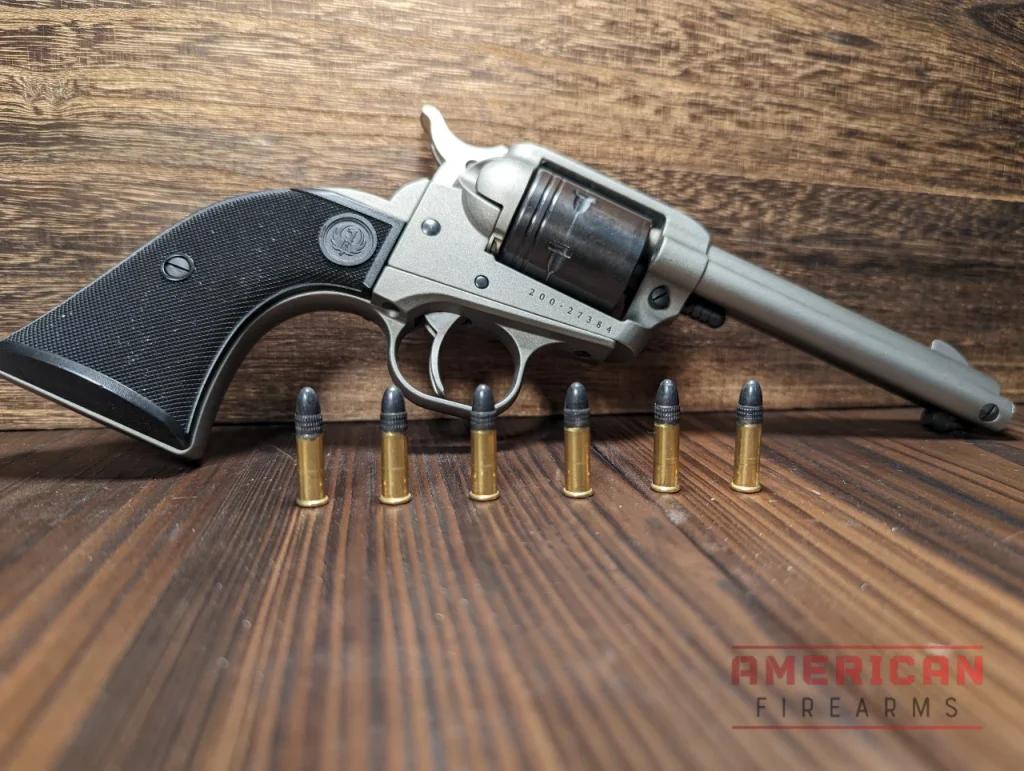
What kept the revolver category from further collapse wasn’t a defensive resurgence. It was price point and accessibility. Heritage’s Rough Rider — along with Ruger’s Wrangler, which entered the market in 2019 — gave the category a floor it didn’t have before: an inexpensive, fun-to-shoot revolver that requires almost no mechanical literacy to operate, pairs well with cheap bulk .22 LR, and appeals to new shooters, casual plinkers, and parents introducing kids to handguns. These are not defensive buyers. They’re recreational buyers making a rational choice about affordable range time.
The Ruger Wrangler, not listed separately in the 2023 AFMER because Ruger’s production is aggregated across their facilities, has sold into the hundreds of thousands since its launch — and like the Rough Rider, it is a single-action .22 revolver marketed explicitly at recreational shooters.
Both guns are good at what they do. Neither one is what anyone means when they say “keep a revolver by the nightstand.”
The Counterargument, Stated Fairly
The obvious objection is that Heritage’s numbers don’t tell you anything about why Ruger LCR or S&W 642 buyers made their purchases.
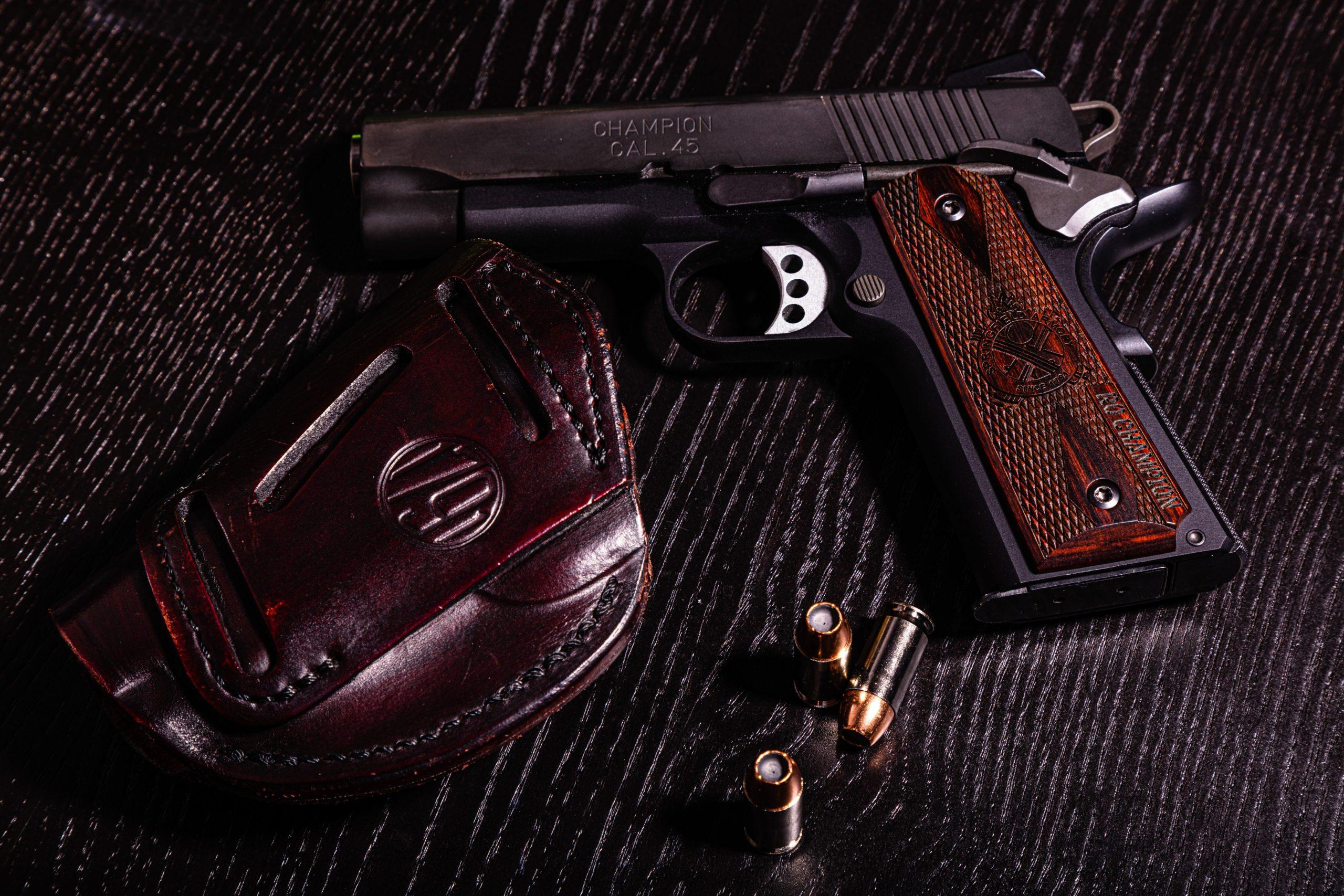
The defensive revolver market is real: the LCR in .38 Special +P is a legitimate carry gun, it’s thin enough for ankle carry, and its double-action-only trigger reduces the mechanical complexity that makes striker-fired pistols riskier in high-stress scenarios for some users.
Defensive shooting instructors who recommend revolvers to certain new shooters — particularly those without the hand strength for consistent semi-auto manipulation — are giving reasonable advice.
None of that is wrong. The argument here isn’t that revolvers can’t work for defense. It’s that the buyers keeping the revolver category alive in production terms aren’t primarily defensive buyers, and that distinction has downstream consequences for everything from product development to parts availability to training support.
The .38 Special number is the cleanest counter to the counter. If defensive revolver buyers were sustaining the category, .38 Special production would be stable or growing. Instead it’s fallen by more than half in five years while overall revolver production has grown.
Those can only both be true simultaneously if the growth is coming from somewhere other than defensive buyers. Heritage’s 178,743 .22 Rough Riders explain exactly where it’s coming from.
What It Means for the Buyer Who Is Actually Thinking About Defense
If you’re buying a revolver for home defense or carry because you’ve been told it’s the reliable, simple choice, you’re making a purchasing decision based on an advice consensus that was formed when revolvers and pistols competed more equally for defensive buyers. The consensus hasn’t updated, but the market has.
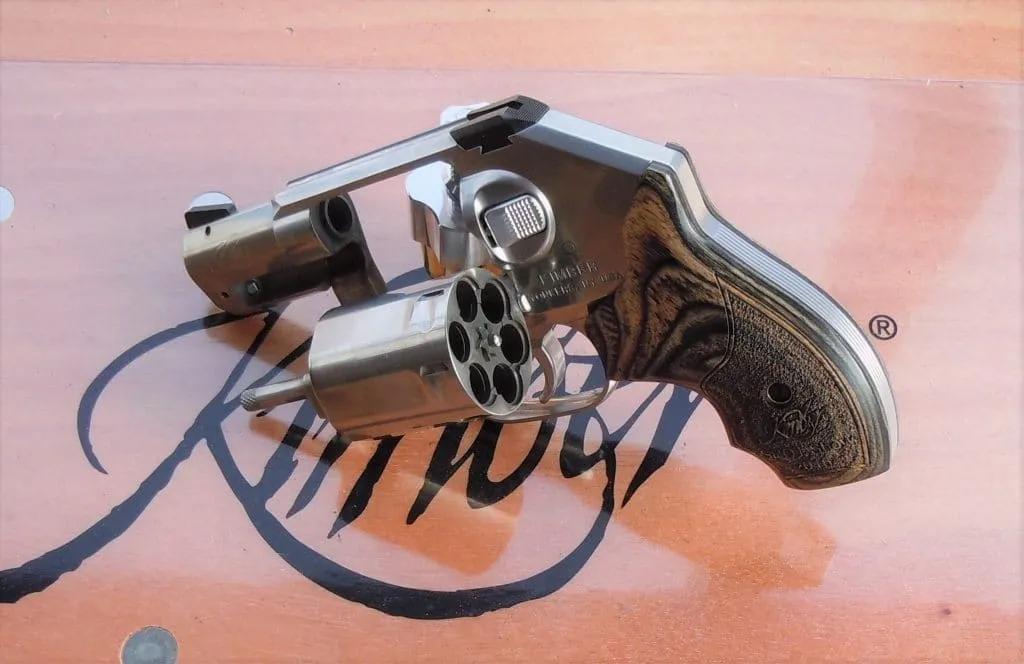
The practical consequences aren’t catastrophic. The defensive revolver won’t disappear — the Ruger LCR, S&W J-frame line, and Kimber K6s represent a genuine premium tier that isn’t going anywhere.
But the resources that sustain those guns — aftermarket holsters, training curricula built around them, ammunition development — will increasingly follow recreational buyers rather than defensive ones. The 9mm striker-fired pistol ecosystem is extraordinarily well-developed precisely because that’s where the buyers went. A maturing niche doesn’t get that level of support.
For someone choosing a first defensive handgun, the revolver has a legitimate argument in specific circumstances: older shooter with arthritic hands, shooter who can’t reliably rack a slide, someone who wants an absolute minimum-maintenance option for a vehicle or nightstand where the gun might sit untouched for years. In those cases, an LCR or a 642 remains defensible.
But “defensible” and “the market consensus” have parted ways. The industry’s continued promotional framing of the revolver as a mainstream defensive option doesn’t match what the ATF’s manufacturing data shows buyers are actually purchasing.
The Revolver Renaissance That Wasn't
There’s a version of the revolver story where the platform stages a genuine comeback — smaller, lighter guns built around modern defensive loads, carried by a new generation of shooters who rediscover the simplicity. The Kimber K6s gestured at that future when it launched in 2016: a purpose-built modern defensive revolver with a premium trigger and tight tolerances. It’s a good gun. It also didn’t move market share.
What moved market share was a $180 Rough Rider. The revolver isn’t dead. It’s just increasingly a recreational tool that the defensive advice community continues to treat as a serious carry option, and the gap between those two things is only going to widen as Heritage and Ruger’s Wrangler-class guns continue to dominate the production floor.
The .38 Special fell 53% in five years. That number is where the defensive revolver story actually lives — not in the YouTube videos about how “wheelguns are coming back,” but in what manufacturers are and aren’t making because that’s what buyers are and aren’t buying. The industry can frame the revolver however it likes. The ATF’s numbers don’t care about the framing.
Sign up for our newsletter
Get discounts from top brands and our latest reviews!
View by Category

In-Hand Reviews

Firearm News

Featured Comparisons

Firearm & Ammo Reviews

Popular Guides & Stats

Range Gear & Accessories

Gun & Ammo Safes