The Suppressor Tax Win Is Real — and Much Smaller Than Advertised
The tax stamp was the cheapest part of the suppressor ownership process. That's still true. We clarify what actually changed with the OBBB — and what didn't.

Written By
Michael Crites
Licensed Concealed Carry Holder
Reviewed by
Editorial Team
Learn About The Editorial Team
Share:
Products are selected by our editors. We may earn a commission on purchases from a link. How we select gear.
Updated
May 2026
On July 4, 2025, President Trump signed the One Big Beautiful Bill into law, and somewhere in the fine print of a sprawling reconciliation bill was a sentence the suppressor industry had been waiting ninety-one years to read: the $200 federal tax stamp on silencers, short-barreled rifles, and related NFA items was eliminated, effective January 1, 2026.
The reaction was proportionate to the wait. SilencerCo called it the removal of one of the biggest financial and psychological barriers to suppressor ownership. Silencer Central launched a promotion to cover outstanding stamps for late-2025 buyers. Industry forums lit up. R/NFA had the energy of an election night. The celebration was earned — in a category that has accumulated mostly losses since the National Firearms Act passed in 1934, a genuine rollback is worth noting.
But the question worth asking four months later is what, precisely, changed. The honest answer is that the cheapest part of the process got cheaper. Everything else stayed exactly where it was.
In This Article
What the Hearing Protection Act Was Supposed to Do
The bill that passed isn’t the bill that was proposed. For years, the Hearing Protection Act promised to remove suppressors from NFA regulation entirely — not just waive the tax, but deregulate the category so that buying a suppressor worked like buying any other firearm accessory. Walk in, background check, walk out. No registry. No wait. No fingerprints and passport photos submitted to a federal database.
That’s not what happened. The HPA language was stripped from the Big Beautiful Bill during Senate parliamentarian review before passage. What survived was a fee waiver. The NFA registry is intact. The ATF Form 4 is intact. The fingerprints and photograph requirements are intact. The SOT-holding dealer requirement is intact. The transfer process that has historically taken eight to twelve months — and that was compressed to days by ATF’s eForms system by late 2025 — is intact.
The $200 is gone. The rest of the NFA is not.
Where the Tax Was Never the Barrier
The $200 stamp mattered more as a symbol than as a practical barrier, and it’s worth being precise about why.
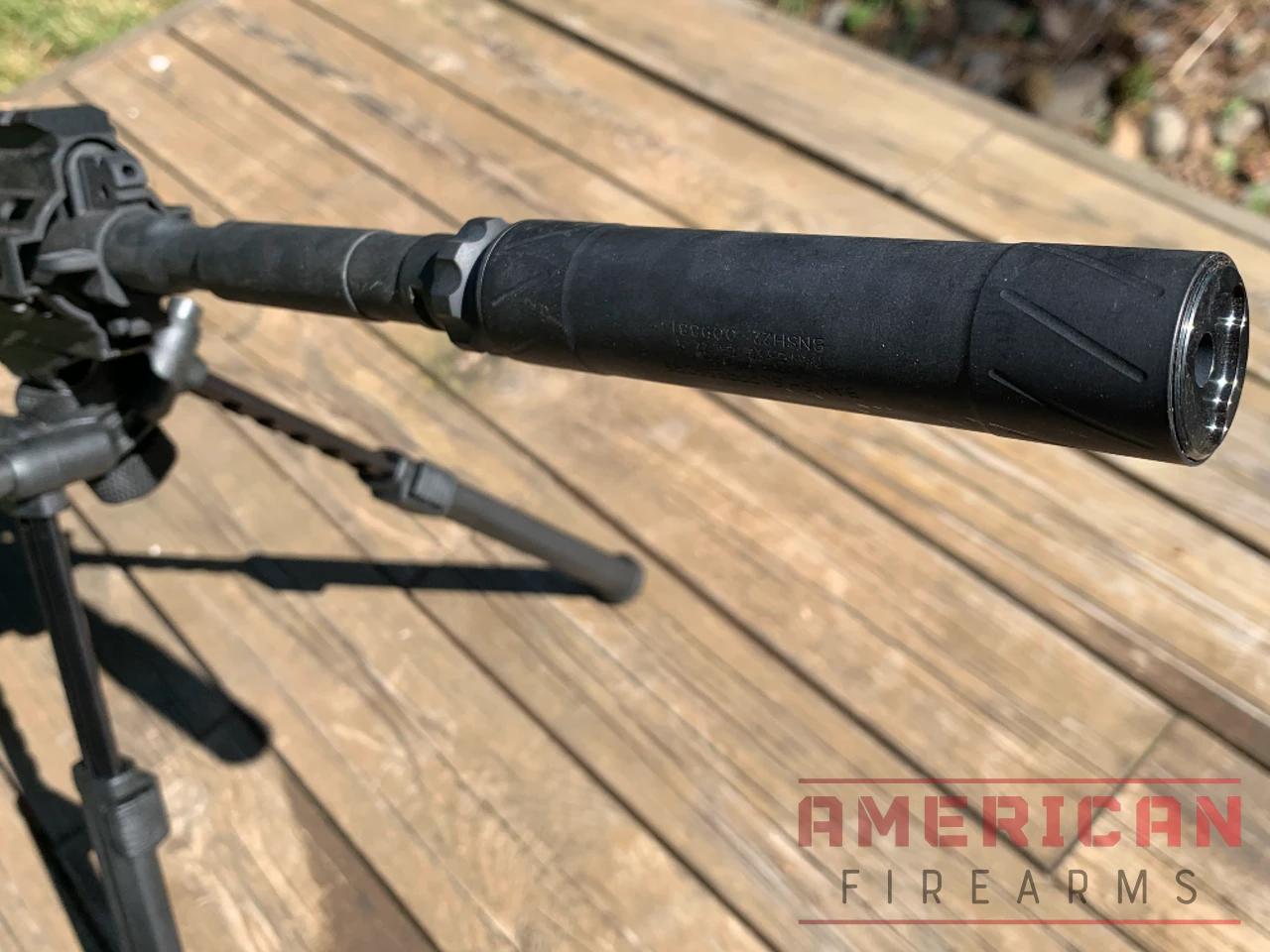
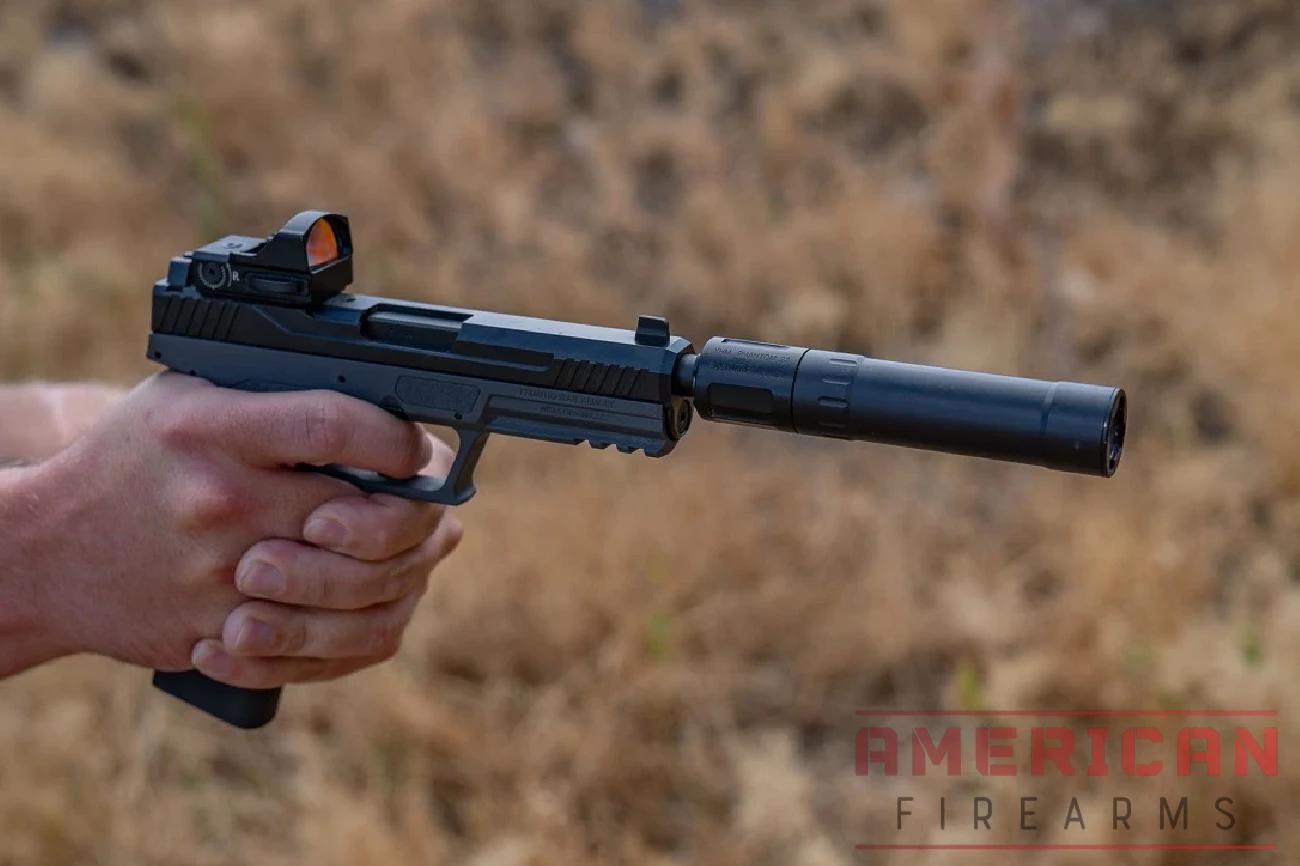
Suppressors are not cheap accessories. Entry-level cans from reputable manufacturers — your Dead Air Mask, your SilencerCo Sparrow — run $350 to $450. Mid-tier rifle suppressors, $600 to $900. Premium options from Gemtech, OSS, or the upper SilencerCo line cross $1,000 without difficulty.
The $200 tax was real money on top of those prices, but for a buyer who can afford a $700 rifle suppressor, the $200 stamp is an annoyance, not a decision point. For a buyer who couldn’t swing the stamp, there’s a reasonable chance they couldn’t swing the suppressor price either.
That math was always the problem with framing the $200 as the primary access barrier. Suppressors are manufactured at meaningful scale — the ATF’s 2023 AFMER data reports 1,305,530 miscellaneous firearms produced that year, a category that includes suppressors as its largest component.
That production exists. But it’s concentrated in a market where the buyer profile is, to a substantial degree, someone who planned ahead, has the budget, and was willing to tolerate a bureaucratic process. The $200 was not screening those buyers out.
What was screening buyers out is the process itself. A new suppressor buyer in 2026 without the $200 stamp still needs to: select a suppressor from an SOT-holding FFL, submit an ATF Form 4 with two sets of fingerprints and a passport photo, wait for ATF approval before taking possession, and remain compliant with the NFA registry for the life of their ownership.
That process is shorter than it was in 2022 — eForms processing in late 2025 was running days rather than months for clean applications — but as of May 2026 the surge of pent-up demand has extended Form 4 processing to almost a week. The ATF’s own guidance anticipated processing delays as buyers who had been waiting for the stamp elimination rushed the queue.
Then there’s the state question, which the federal celebration largely ignored. Suppressors remain prohibited for civilian ownership in California, New York, Illinois, New Jersey, Massachusetts, Hawaii, Delaware, Rhode Island, and several other states. Millions of American gun owners — a substantial share of the total national firearm-owning population — received zero practical benefit from the federal change. Their state law didn’t move.
The Right Way To Think About Can Ownership
The right way to think about suppressor ownership in 2026 is not as a decision unlocked by the tax elimination. It’s as a decision shaped by three independent variables, only one of which changed.
State law is the first filter. If you live in a prohibition state, the federal change is academic. Full stop.
The NFA process is the second filter. The Form 4, the wait, the dealer SOT requirement — these remain. For a buyer who was deterred by the process rather than the price, nothing changed. For a buyer who was deterred by both, half the deterrent is gone.
The total cost of suppressor ownership is the third filter. With the $200 stamp removed, the total acquisition cost on a mid-tier rifle suppressor drops from roughly $900 to $700. That’s a real reduction. For buyers near the margin of affordability, it moves the needle. It doesn’t transform the category.
If you’re in a suppressor-legal state, have absorbed how the Form 4 process works, and have been holding off primarily because of the $200, January 1 was your day. Buy the suppressor. The process is as frictionless as it’s been in ninety years.
If you were waiting for suppressors to become as easy to buy as a rifle scope, that outcome required the Hearing Protection Act’s full passage. It didn’t pass. The Constitutional Hearing Protection Act (H.R. 3228, Rep. Clyde) is in committee as of early 2026, and the three constitutional lawsuits challenging whether NFA registration can persist without the tax may eventually force the issue — but court timelines are not a purchasing strategy.
Three Valid Objections
“The $200 adds up across a collection.” Correct. A buyer adding three suppressors over five years saved $600 under the new regime. That’s real money. The piece isn’t arguing the tax elimination is worthless — it’s arguing it’s not the transformative access expansion the community anticipated. Those are different claims.
“Dropping the barrier at all will bring new buyers into the category who wouldn’t have come otherwise.” Probably true on the margin. But the evidence for $200 as a category-defining barrier is weak when the alternative explanation — that suppressor buyers are deterred by process friction, not stamp cost — fits the available data. If suppressor registrations were 150,000 annually before the change, a doubling to 300,000 would be meaningful. A 20% bump would confirm the marginal buyer thesis but wouldn’t change the mainstream ownership picture.
“You’re moving the goalposts — the elimination was a political win, not just a financial one.” The strongest version of this objection. The $200 tax carried symbolic weight as a punitive relic of 1934 politics. Removing it has political meaning that transcends the dollar amount. Fair point. But political wins and access expansions are different things, and most of the commentary conflated them.
So, What Actually Changed?
The suppressor market is more accessible in 2026 than it was in 2025. The barrier to entry is lower. The buy-in is more defensible for a budget-conscious shooter. Those are real improvements, and the industry that worked for this outcome deserved the July 4 moment it got.
What didn’t change is the architecture. A suppressor is still a registered NFA item. The federal government still maintains a central registry of who owns one and where. The dealer infrastructure requirement still limits where you can make the purchase. The approval process still requires patience the gun counter at your local big-box retailer is not built to accommodate.
Hiram Percy Maxim patented the first commercially successful suppressor in 1909 and sold it through newspaper ads as a tool for neighborly range use. He probably didn’t anticipate that 116 years later, the federal government would eliminate the tax that made his product a bureaucratic exercise — and leave every other piece of the exercise exactly where it was.
The $200 is gone. The wait is not. Plan accordingly.
Meet the Experts

Written By
Michael Crites
Licensed Concealed Carry Holder
- Founder of AmericanFirearms.org
- Licensed Concealed Carry Holder
Firearm News
Further Reading
Sign up for our newsletter
Get discounts from top brands and our latest reviews!
View by Category

In-Hand Reviews


Firearm News

Featured Comparisons

Firearm & Ammo Reviews

Popular Guides & Stats

Range Gear & Accessories


Gun & Ammo Safes